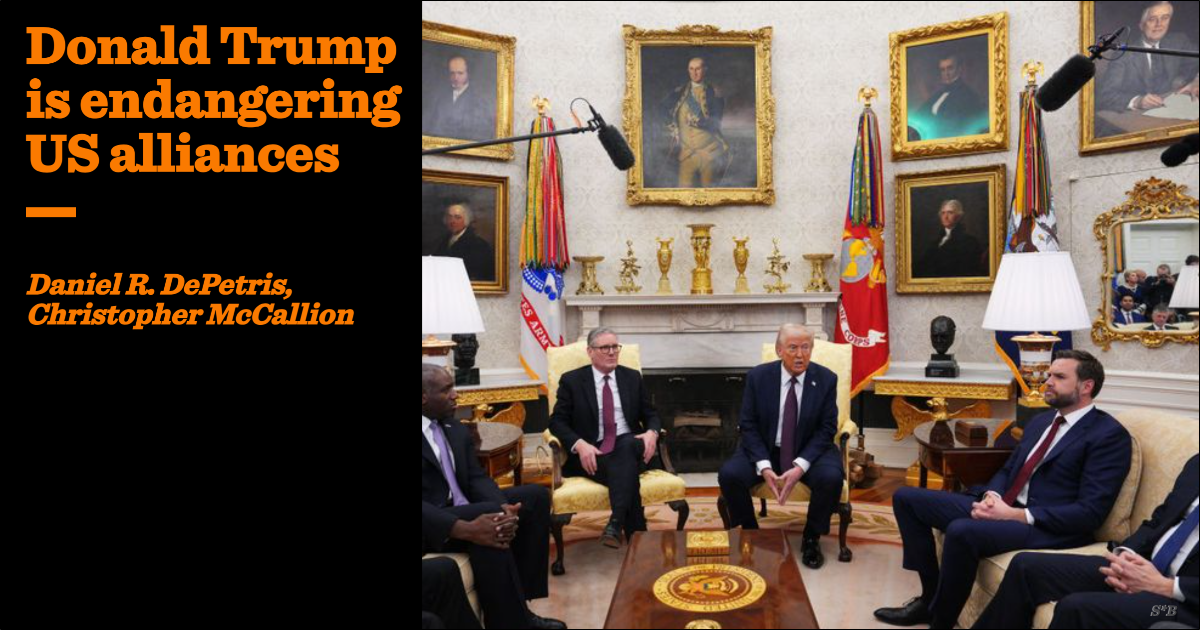
During his speech at the World Economic Forum in Davos, President Donald Trump backed off his threats to use force to acquire Greenland and to impose tariffs on eight European countries who opposed a U.S. takeover of the island. Instead, it was announced that Trump had come to a “framework” agreement with NATO Secretary General Mark Rutte, which reportedly permits the United States to construct additional bases there. For the time being, this has allayed some immediate fears about an imminent military crisis between the U.S. and its NATO allies.
Yet even if the specifics of an agreement get settled — no sure thing given Trump’s propensity to change his mind and Denmark’s red-line on conceding to anything that undercuts their own sovereignty — the damage between Washington and its NATO allies may have already been done. By forcing allies to undergo routine demonstrations of servitude and rituals of humiliation, Trump risks overplaying his hand to the long-term detriment of U.S. power. The danger is not that the military alliance — which is already past its expiration date — might eventually come to an end, but that Washington will unnecessarily turn Europe and Canada into antagonists who feel compelled to balance against the United States.
Despite the outlines of an agreement and the beginning of negotiations on the details, Trump remains fixated on the notion of bringing Greenland under de facto U.S. control. This is equal parts baffling and unsurprising. Yes, the largely icebound island is strategically placed in the northeast Atlantic between Europe, North America, and the Arctic. Yes, Greenland also has deposits of critical minerals and fossil fuels that the United States, and Trump himself, covets. But the fundamentals were already on Washington’s side: the United States already effectively controls Greenland, which is covered by NATO’s Article 5 clause; Denmark was willing to significantly enhance U.S. access and influence on the island even before Trump opted for a strategy of coercion; and despite Trump’s claims to the contrary, Greenland faces no risk from Russia or China. Indeed, there is more Russian air and naval activity in the Bering Strait off the coast of Alaska than there is in the Arctic Circle.
Moreover, even if Trump acquired Greenland by purchase rather than force, only 17 per cent of Americans and 6 per cent of Greenlanders want the U.S. to possess the island. That brings a whole new set of delicate questions. Would the 56,000 or so residents of Greenland have full citizenship rights, or would they be held in permanent representational limbo like Puerto Rico and Guam? What would Trump do if Greenlanders tried to resist what they almost certainly would view as a colonial occupation? And shouldn’t incorporation into the United States require the consent of the governed, both current and prospective?
The macro-level international consequences of this strange episode may well be the most important, however. Trump’s tendency to lean on coercion to get what he wants, coupled with the imbalance of power between the United States and every other member of NATO, has highlighted the dilemma that Europe and Canada find themselves in. This is partly a problem of their own making. Having made the choice to become security dependents of the United States, these same countries now find themselves potentially at the mercy of their own protector’s predations. Even Canada is sounding alarms about the emergence of a more dog-eat-dog world, in which the strong use their power to extract concessions from, if not dominate, the weak. As Canadian Prime Minister Mark Carney said in his speech at Davos which reads like an elegy for the U.S.-led international order, Canada and Europe must now “hedge against uncertainty” and diversify their economic and security partnerships, including with China. Trump’s coercive tactics are causing even staunch U.S. allies to reexamine their current relationships with Washington.
The rupture over Greenland is a symptom — however peculiar to Trump’s own caprices in its specifics — of the fact that the trans-Atlantic alliance is incongruent with the current international balance of power. NATO lost its raison d’etre when the Cold War ended, and ever since, it has sought — and in some cases stoked — new rationales to continue its existence. Europe can deter Russia without the United States, and there is no danger of a hegemon emerging on the continent that would justify an indefinite U.S. military commitment. Absent a common threat or the emergence of a mutual adversary that can upend the balance of power in Europe, the United States and its European allies will increasingly find themselves with often divergent interests.
While Trump has adopted a derisive stance toward U.S. allies, he does not seem to want a full rupture with NATO. Instead his foreign policy moves to date suggest he seeks to preserve U.S. global hegemony and employ the threat of a possible U.S. withdrawal from NATO to extract greater tribute from its members. The Greenland episode is a case in point. Yet how long will this strategy work?
Washington’s allies and partners are not defenceless or without leverage. The European Union, the United Kingdom, and Canada have a combined GDP comparable to the United States or China. Together, they account for the largest share of U.S. trade. Their political fragmentation is what currently prevents them from becoming an independent pole within the international system. But this divergence could quickly dissipate if the United States were to bring its coercion to a new level by, say, forcibly annexing sovereign Danish territory. Such a scenario would in effect transform Washington into the most powerful, and proximate, threat to Western Europe. Canada, facing the lingering threat of a more powerful neighbor on its border — not to mention Trump’s repeated desire to make Canada “the 51st state” — would almost certainly be pushed toward Europe.
Although these balancing moves may sound implausible today, they become much more likely if Trump continues on his current course. Just this month, Canada forged closer economic ties to China, no doubt an outgrowth of the Trump administration’s tariff policies. The Canadian military has begun considering how the nation could repel a U.S. invasion. Indeed, the last time there was a multipolar distribution of power in the international system, less than a century ago during the interwar period, the United States still viewed the United Kingdom as a potential rival and had invasion plans for Canada, then a part of the British Empire, on hand as a result.
Aggression by the United States may also, in time, drive Europe’s economic union toward a more political union. The threat from a more powerful and belligerent neighbor, or the risk of being caught between other great powers, is precisely the kind of external pressure that encourages states to form in the first place. If Europe and Canada come to view the United States as an enemy, they have the latent power to eventually become a security competitor in the North Atlantic, which Washington would in turn have to deter. None of this would benefit U.S. security or prosperity.
Given its current interests and limitations, the United States can — and should — pursue a managed and graceful transition out of NATO that still preserves its close economic and friendly cultural ties with Europe. It is unnecessary to choose between either a permanent military commitment on the continent’s behalf or to instead turn its longtime European allies into enemies, throwing a grenade behind us on our way out the door.