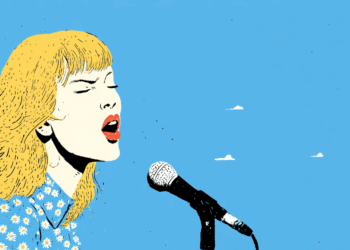
Dolly Parton was born into poverty in the mountains of East Tennessee in 1946, spending her early years in a crowded cabin that lacked plumbing and electricity. In “Ain’t Nobody’s Fool,” Martha Ackmann’s enjoyable biography of the country music superstar, the author notes that despite their hardscrabble circumstances, the Parton children – there were eventually 12 – were encouraged to dream. It’s possible that even in her wildest dreams Dolly Parton couldn’t imagine the impact she would have as a singer, songwriter, actor, entrepreneur, and philanthropist.
Ackmann writes that Parton was blessed, from the start, with “musical talent, a strong backbone, and a gift for storytelling.” She was also hard-working and ambitious. As a young girl she sang with her sisters at church, and by the time she was around 10 years old she was performing in local venues in Sevierville, Tennessee, considered the big city by mountain folk like Parton. She was soon invited to appear on the area’s local radio and television shows.
Parton was ridiculed by her classmates, both for her audacious intention to become a star and for what remains her signature style. “Her peers thought her clothes were too tight, her makeup too thick, and her hair too high,” Ackmann writes. After high school graduation, Parton moved to Nashville in pursuit of a music career. She knocked on record executives’ doors with her uncle, Bill Owens, with whom she wrote songs. Of their bold approach, she once remarked, “We didn’t know it couldn’t be done until we already did it.” (Shortly after moving to Nashville she met Carl Dean, whom she married in 1966 and who died in March 2025.)
Why We Wrote This
Dolly Parton started writing songs when she was 11 years old, and the country music star hasn’t stopped since. Her down-home warmth and business acumen have carried over into projects such as movie acting, children’s literacy programs, and an amusement park. A new biography, “Ain’t Nobody’s Fool,” charts her challenges and successes.
In 1967, Parton’s big break arrived when she began appearing on “The Porter Wagoner Show,” a popular syndicated television program. Wagoner was a fixture at the Grand Ole Opry, and he and Parton were a successful vocal duo. But he was, according to Ackmann, overbearing and domineering, and their partnership was tumultuous. After seven years, Parton struck out on her own. One of her most famous songs, “I Will Always Love You,” was written as a farewell to Wagoner. He loved the song but sued her for breach of contract anyway.

Ackmann efficiently covers the highlights of Parton’s music career, from her solo work in country and pop to her celebrated collaborations with musicians including Kenny Rogers and, as a trio, Emmylou Harris and Linda Ronstadt. Parton has always been a prolific songwriter: A secretary at the music publishing business that Parton created with Owens said that she once showed up at the office with 12 new songs she’d written the night before.
Parton was known to eavesdrop on conversations taking place around her and jot down ideas on any scrap of paper she could find. She once asked a young autograph-seeker what her name was and, struck by the answer, repeated it to herself, over and over, as she walked away so as not to forget it. That moment led to the repetition at the opening of “Jolene,” which became a No. 1 country hit in 1974.
Parton’s acting career began auspiciously with the 1980 film “9 to 5,” in which she held her own with veteran performers Jane Fonda and Lily Tomlin. “Steel Magnolias,” the 1989 ensemble film, was another highlight, although Parton appeared in a number of bombs, too.

© Country Music Hall Of Fame And Museum
Still, Ackmann points out that Parton has generally made sound decisions. In 1974, she received a phone call from Elvis Presley’s formidable manager, Colonel Tom Parker. Elvis wanted to record “I Will Always Love You” but insisted on being given at least half of the publishing rights. Parton, self-possessed even in her late 20s, insisted on retaining the copyright. While Presley canceled the recording, Whitney Houston’s 1992 version of the song ended up earning Parton somewhere between $6 million and $10 million in royalties.
Parton’s business savvy has also been a boon to her home state. Her Dollywood amusement park, which opened in Pigeon Forge, Tennessee, in 1986, has become what some have called “the economic engine of East Tennessee,” creating thousands of jobs.
The irrepressible Parton, who reportedly needs only three to five hours of sleep per night, has managed to attract and retain a fan base that includes traditional country fans, the LGBTQ+ community, young hipsters, and beyond. She’s also earned widespread praise for her philanthropic efforts, which include a nonprofit that sends free books to children from birth until age 5. (Her interest in literacy stems from the fact that her father never learned to read or write.)
Ackmann – a journalist and the author of a biography of poet Emily Dickinson, among other works – interviewed a handful of the singer’s relatives and business associates, but Parton herself did not agree to be interviewed. The author relies primarily on previous books and articles on Parton and the singer’s 1994 autobiography, “Dolly: My Life and Other Unfinished Business.” This prevents “Ain’t Nobody’s Fool” from breaking new ground in the way that, say, the 2019 podcast “Dolly Parton’s America” did. Parton’s lack of involvement is particularly noticeable when Ackmann speculates about the singer’s emotions; for example, she writes of Parton’s first recording that “making a record out of what she had written must have felt to Dolly like magic.”
Still, the celebratory narrative captures Parton’s talent, her decency, and her cultural significance. “The thing that’s always worked for me … is the fact that I look so totally artificial, but I am so totally real,” the singer once remarked. “It gives me something to work against. I have to overcome myself. I have to prove how good I am.” Parton has proven it beyond a doubt, and “Ain’t Nobody’s Fool” is a solid accounting of how she got there.