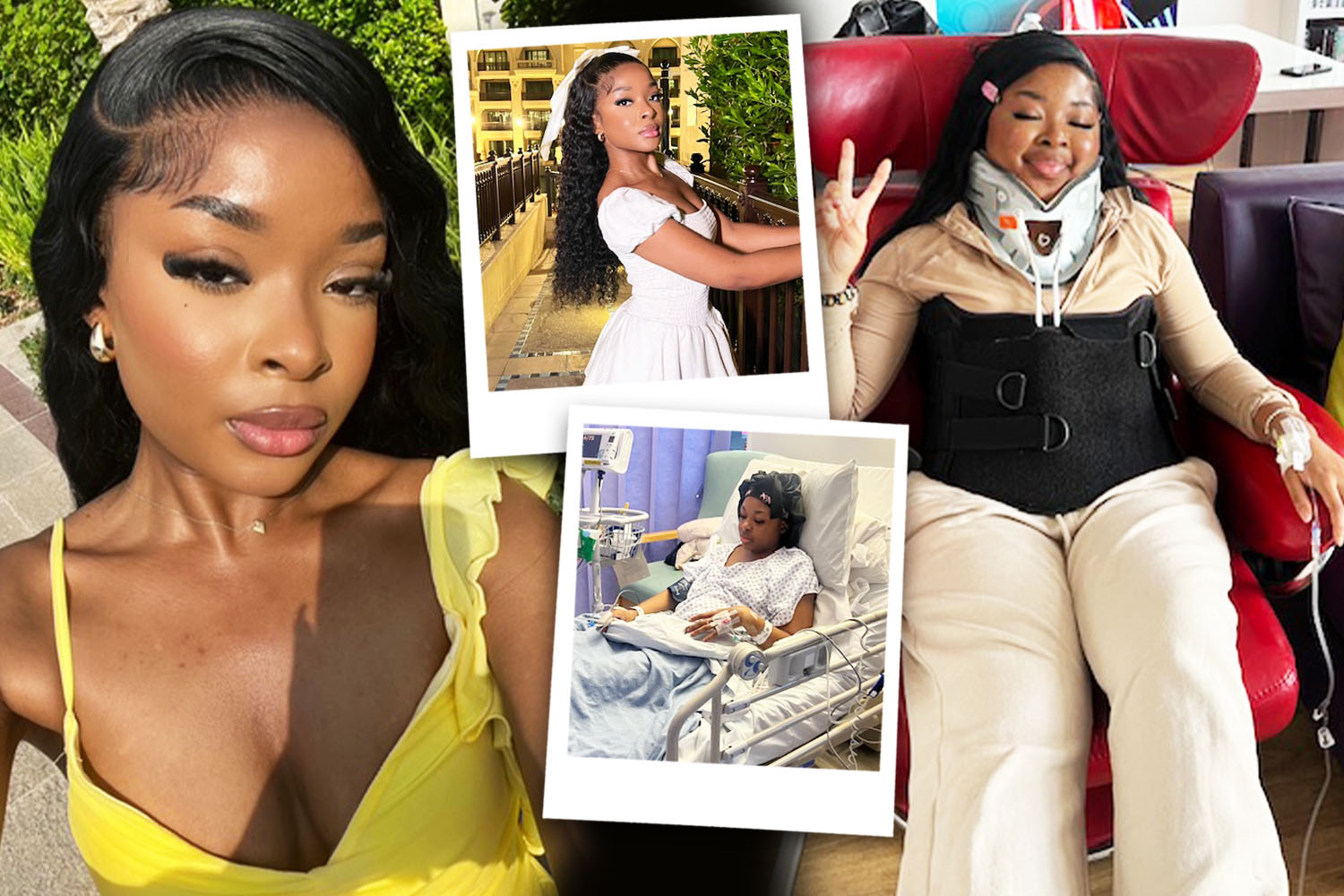
HER back pain was so debilitating she couldn’t sleep and had to crawl to the bathroom. Even more frighteningly, she was rapidly losing weight and her spine was making loud cracking noises that were far from ordinary.
But Nothando Nhliziyo, 22, went to the GP four times, only to be continually dismissed and told to “take paracetamol and do some stretches”.
She later visited a chiropractor and went to A&E only to be turned away yet again.
When the pain first started in November 2024, Nothando, from Leicester, didn’t worry that it might be something sinister.
“Initially I thought it might be my job as a hairstylist making my back hurt because I’d stand for long hours,” she tells Sun Health. “I never thought that it would be something so serious.
“When the GPs would send me away and say, ‘Take some ibuprofen, take paracetamol, do these stretches’, it made me think, ‘If they don’t take it seriously then why should I take it seriously?’.”
Nothando made appointments every two weeks, hoping to be seen by a different doctor who might listen to her concerns.
But as her back pain became ever more severe, she knew she had to do something drastic to be taken seriously.
“The pain was chronic and debilitating,” she says.
“I couldn’t sleep, I couldn’t even turn over, I couldn’t get out of bed. I’d crawl to the bathroom.
“My back would make crunching noises, I’d have spasms and my whole body would stiffen up. It was just out-of-this-world pain.”
After a particularly severe episode in January, Nothando went back to A&E – only for staff to ask her: “Why would you come to A&E for back pain?”
Out of desperation, she stayed for 12 hours and eventually told medics that she had fallen down the stairs to avoid being sent away again.
Sure enough, they finally agreed to scan Nothando, and found she had cancerous lesions that had spread all over her spine, pelvis and left adrenal gland.
She was then admitted as an inpatient and spent the whole of January under investigation.
Doctors kept her in the dark until they could be sure of exactly what she was suffering from.
Finally, at the end of the month, she was told she had cancer of unknown primary – meaning the disease has spread but doctors can’t find where it started.
“When I heard it was cancer, I just wanted the ground to swallow me up,” Nothando recalls. “I just wanted to vanish.
“Both my parents burst out in tears. I didn’t know what to say at all. The room just was full of wailing.
“It was the craziest moment of my life. It was so traumatic.”
But the trauma wasn’t over. It took multiple scans, tests, a biopsy, the surgical removal of her left adrenal gland and months of waiting to receive a decisive diagnosis.
During this limbo period, Nothando’s sisters Samantha, 20, and Fenny, 26, slept beside her in the hospital on a mattress because she was so distressed.
In April 2025, Nothando was told she had stage four angiosarcoma – one of the rarest cancers in the UK with around 64 cases diagnosed every year in England.
It makes up only 0.05 per cent of all cancers.
Angiosarcoma is a form of sarcoma, which starts in the bones and soft tissues.
It can affect any part of the body, on the inside or outside, including the muscle, bone, tendons, blood vessels and fatty tissues.
There are about 100 different sub-types of sarcoma.
Sarcoma is a silent killer. The symptoms are sneaky and can pop up at the last minute, so a lot of people don’t get diagnosed until it’s too late
Nothando Nhliziyo
“I remember the doctors saying the cancer was stage four, metastatic, rare and incurable,” Nothando says.
“I was so numb to hearing bad news that I didn’t cry. I just sat there and my face stayed the same all throughout the appointment. I didn’t know how to react.”
What made matters even more difficult for Nothando and her family was that doctors told her there wasn’t much to be done about the cancer due to its location on her spine.
She underwent chemotherapy to try to prevent the disease from spreading or growing, but Nothando is desperate to find a treatment plan to prolong her life.
“They didn’t give me any hope,” she says. “They started me on palliative care and I thought, ‘Are they not going to at least give me some options?’
“They did offer me some radiotherapy and chemo, and I had a lot of medication for pain management.
“But by the time they told me what it was, they were already giving me the impression that they had given up on me.”
How to spot the signs of sarcoma
SARCOMA is a type of cancer that can appear anywhere in the body.
About 5,900 people are diagnosed every year in the UK – or 16 each day.
There are two main types of sarcoma: soft tissue sarcoma and bone sarcoma (also known as primary bone cancer).
Within these two, there are around 100 sub-types.
The most common symptom is a lump that is growing or changing. This might be painless at first, but soreness may increase as the growth presses against nerves and muscles.
Other signs include:
- Swelling, tenderness or pain in the bone that can be worse at night
- Stomach pain
- Feeling sick
- Loss of appetite or feeling full after a small amount of food
- Blood in your poo or vomit
Sarcoma can affect anyone at any age. While it’s the third most common cancer in children, our risk increases as we get older.
Like other cancers, it’s often given a number in a staging system to describe how advanced it is, with stage one being small, in one place and easier to treat and stage four being larger, spread to other parts of the body and often incurable.
Surgery is often the first treatment, sometimes followed by chemotherapy or radiotherapy.
Survival depends on many factors. Overall, about 85 per cent of people survive their cancer for one year, and 70 per cent are still alive after five years.
The rates are lower for some sub-types, including vascular sarcoma, of which about 35 per cent of people survive five years after diagnosis.
Source: Sarcoma UK and Cancer Research UK
When Nothando looks back at the last year, it’s hard for her to believe how much her life has changed.
“Life has drastically changed in so many ways,” she reflects. “I had my own studio, N. N. Hair, I was working with my best friend, we had days full of clients, I was doing my own thing, and I wanted to be a businesswoman, an entrepreneur.
“Never in my wildest dreams would I ever have expected this.”
Nothando profoundly wishes she had been taken seriously by doctors earlier on in her journey, but she feels she had no other choice but to lie in A&E.
“My experience has unfortunately taught me that if you have to exaggerate, and if you have to lie, do it,” she adds.
“I’ve seen so many cases where GPs and doctors don’t take people seriously until it’s too late, until they’re in their coffin.
“Look at me now; I’m at stage four and people are talking to me about hospice care, when I could have been at stage one, I could’ve been treated earlier.”
‘Countless sleepless nights’
She wants to urge others to take any unusual symptoms seriously and always push for answers.
“It’s never a waste of the GP’s time,” she adds. “No matter what, do not downplay your own health, your symptoms, or how you feel.”
Nothando is being supported by her parents, who have taken time off work to look after her.
“My mum and dad wish the diagnosis had happened earlier so that I could be treated,” Nothando says.
“They hate the fact that I’m being told, ‘This is it. This is all we can offer you. We don’t know what else to do but to manage your symptoms’. It crushes them.”
Nothando’s sister Fenny says she feels like the “world is ending” when she thinks about what’s happening to her beloved sister.
“I’m devastated,” she says. “When I found out about her diagnosis, time stopped. It truly felt like the world was ending.
“My beautiful, bright and successful sister being struck with this illness was a true heartbreak for me.
“It’s not something someone could ever imagine happening so suddenly and I struggled to accept it for a long while.
“I’ve dealt with countless sleepless nights and tears but everyday I keep her in my prayers and stay smiling for her.”
Nothando has taken it upon herself to fight for a second opinion. She has done tons of research about her condition in the hope she might be put on a clinical trial.
She’s even started a GoFundMe page to try to raise funds to be able to undergo treatment, even if it needs to be abroad.
“I’m gathering all the information I can and trying to email as many doctors as possible, because I know that there’s something out there for me, even if I have to go down the private or international route,” Nothando says. “I’ll do what I can to save my life.”
Nothando is particularly passionate about informing people about sarcoma, which gets nowhere near the publicity of other cancers like prostate and breast.
“Not many people know about angiosarcoma,” she says.
“We, as the people who are actually facing sarcoma, need to do more with our voices because sarcoma is a silent killer.
“The symptoms are sneaky and can pop up at the last minute, so unfortunately a lot of people don’t get diagnosed until it’s too late.”
Nothando hopes that by getting her situation out there, she will find a breakthrough in her treatment options.
“I am hoping for a miracle at this point,” she adds. “I’ll go to any doctor anywhere in the world.”
Responding to the need for more effective treatment, charity Sarcoma UK is currently funding two projects specifically aimed at developing new treatments for angiosarcoma.
“We currently lack reliable ways to identify which patients will respond to treatment,” says Sarcoma UK’s acting head of research, Kate Quillin.
“Immunotherapy, which has shown dramatic results for some cancer types, hasn’t yet delivered the same results for angiosarcoma patients.
“The good news is that we have committed over £250,000 towards research projects which aim to address this gap.
“The researchers are investigating ways to improve the activity of immune cells against these aggressive tumours and exploring ways to personalise treatment and understand which patients might respond.
“This sort of work could lead to kinder, more effective treatment and bring us closer to giving patients like Nothando better options and real hope.”
When to see your GP and when to go to A&E
NOTHANDO’S story is a powerful reminder that if you genuinely fear something serious is wrong with your health, you must persist and push for answers.
However, it’s also vital to use the right NHS services for the right problems.
The health service is under enormous pressure, and using emergency services (like A&E and 999) for minor issues can tie up vital resources that are needed to save lives.
For common problems like simple back pain, headaches, minor cuts, coughs, or cold symptoms, you should try:
- Your local pharmacy – they can offer advice, provide over-the-counter treatments, and spot warning signs that mean you need to see a doctor
- NHS 111 – if you need urgent medical help but it’s not life-threatening, call 111 or visit 111.nhs.uk, where you can get health advice, be connected to a nurse or out-of-hours doctor, or schedule a slot at an urgent treatment centre
- Self-care – simple muscular back pain often improves with self-care measures like staying active, using over-the-counter painkillers like paracetamol or ibuprofen, and applying heat or ice packs
Your GP should be your first port of call for persistent, worrying or complex health issues, and for symptoms that are not getting better with self-care.
Nothando’s experience shows that if your symptoms are severe, unusual (like rapid weight loss or cracking noises), and your GP is dismissing them, you have a right to ask for a second opinion, see a different doctor, or request specific tests.
A&E or calling 999 is for genuine life-threatening emergencies only. This includes:
- Loss of consciousness
- Chest pain (indicating a heart attack)
- Severe breathing difficulties
- Heavy bleeding that won’t stop
- Severe injuries or broken bones
- Symptoms of a stroke