A doctor has been struck off after he invented a fake landlord and fictional tenancy agreement as part of a £12,000 housing benefits scam.
King’s College Hospital doctor Olubunmi Adeagbo-Sheikh told the Department of Work and Pensions (DWP) that he was renting a London property.
Adeagbo-Sheikh, who is in his 40s, actually lived with his mother in Swanley, Kent but fraudulently claimed £900 a month for his fictitious home in the capital – at an address that didn’t exist.
He was able to maintain the deception for 13 months between September 2018 and September 2019, collecting £11,700 in total.
He pleaded guilty to dishonestly making a false statement to obtain a benefit, advantage or payment in February 2024 and avoided jail time.
Now Dr Adeagbo-Sheikh has been removed from the medical register, with the Medical Practitioners Tribunal Service calling his ‘deliberate’ fraud ‘fundamentally incompatible with his continued registration’.
Dr Adeagbo-Sheikh qualified with a Bachelor of Medicine and Surgery in 2013 in Nigeria, and worked as a locum doctor there before moving to the UK in 2016.
In 2024 he was working as a junior clinical doctor at King’s College Hospital NHS Foundation Trust.
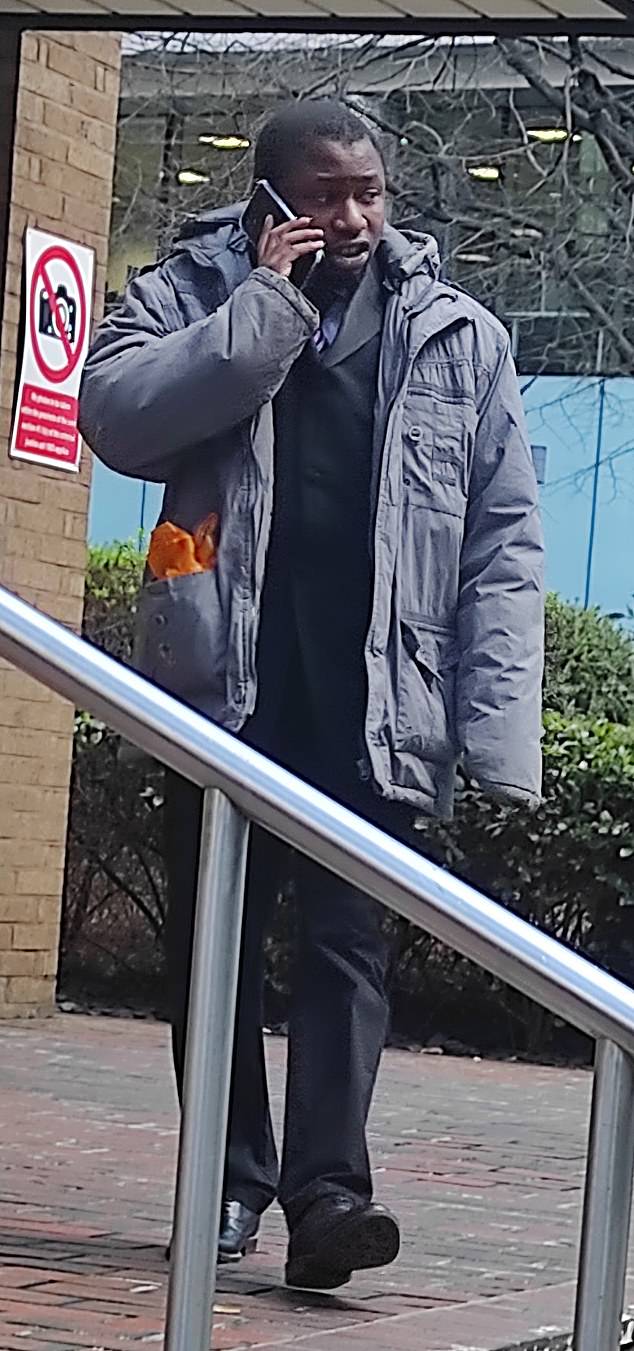
Nigerian Olubunmi Adeagbo-Sheikh, 41, made the fake claim while training to work as a medic in the UK. Pictured: Adeagbo-Sheikh outside court in February 2024
On 16 August 2018 Dr Adeagbo-Sheikh submitted an application for Universal Credit to the DWP which included a claim for housing costs of £900 per month for rent at a London property.
The address of the house that Dr Adeagbo-Sheikh gave in that application did not exist and the tenancy agreement he provided was completely concocted.
The DWP investigated the irregularities and Dr Adeagbo-Sheikh was arrested on October 7, 2019.
His laptop was seized and examined, and the police found WhatsApp messages between the doctor and a friend referring to the fraud.
Further documentation included fake copies of a tenancy agreement for a non-existent property and a false CV.
Dr Adeagbo-Sheikh was later summoned to appear before Westminster Magistrates’ Court in 2023 with the charge of dishonestly making a false statement to obtain a benefit/advantage/payment.
The prosecutor in the case said: ‘This deprives the public purse of valuable resources that could be used elsewhere and it also increases the costs and administrative burden on the system, because people like you seek to cheat the system.’
Dr Adeagbo-Sheikh completed the unpaid work requirement of 100 hours of his Community Order by July of 2024, and later paid back the money to the DWP.
However, he failed to alert the General Medical Council, which accredits doctors, that he had a criminal conviction.
At a tribunal held by the MPTS, he was found to have ‘not upheld’ the ‘honesty and integrity that is a fundamental tenet of the medical profession’.
It found: ‘This Tribunal has found that Dr Adeagbo-Sheikh made a deliberate choice to commit fraud, which was persistent in terms of continuing to receive the monies into his bank over a 13-month period and would likely have continued if the fraud had not been uncovered.
‘The Tribunal was clear as to the importance of honesty and integrity that is a fundamental tenet of the medical profession and of the impact and seriousness when this is not upheld.
‘The Tribunal returns to… the need for doctors to make sure that their conduct justifies their patients’ trust in them and the public’s trust in the profession.
‘This principle has been undermined by Dr Adeagbo-Sheikh’s actions and all of the various paragraphs within the SG that have been shown to apply in this case also show the seriousness of the situation.’
It continued: ‘In all the circumstances, the Tribunal determined that Dr Adeagbo-Sheikh’s conduct was fundamentally incompatible with his continued registration.
‘The Tribunal therefore directs that Dr Adeagbo-Sheikh’s name be erased from the Medical Register.
‘It concluded that, in all the circumstances, despite the remorse and genuine apology by Dr Adeagbo-Sheikh for his actions and the arguments put forward cogently by Mr Gledhill, erasure was the only necessary and proportionate sanction which would sufficiently and adequately promote and maintain public confidence in the medical profession and promote and maintain proper professional standards and conduct for members of that profession.
‘In all the circumstances, the Tribunal determined not to impose an immediate order of suspension on Dr Adeagbo-Sheikh’s registration.’