Despite 10 days of heavy and furiously paced U.S. and Israeli airstrikes on Iran with the declared aim of regime change, the Islamic Republic early Monday signaled defiant continuity by choosing a new supreme leader in wartime.
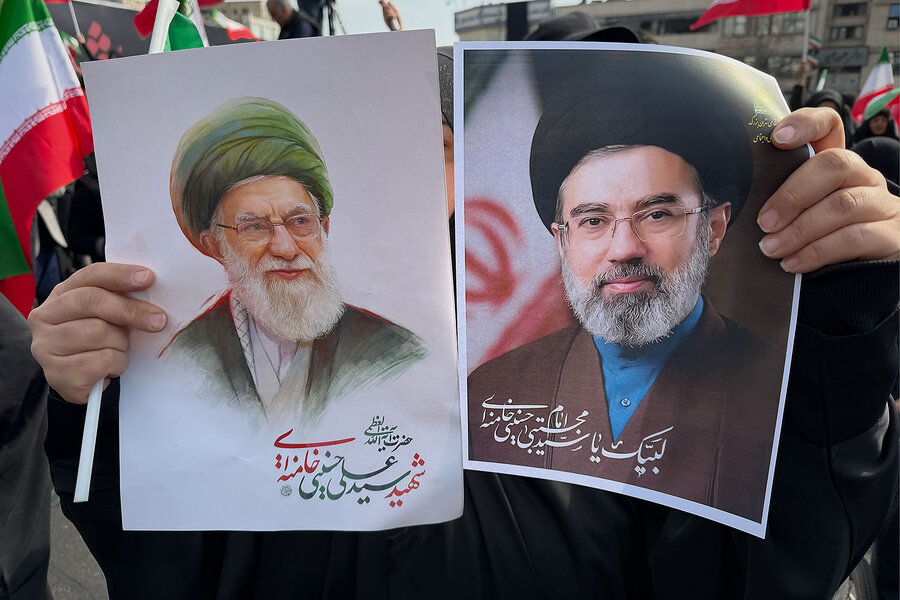
Ayatollah Mojtaba Khamenei is the son of the slain hard-line supreme leader, Ayatollah Ali Khamenei, who led Iran with the official title of “God’s Deputy on Earth” for 37 years. He was assassinated in Israel’s first strike of the war.
A shadowy figure with close ties to Iran’s military and security apparatus, Mr. Khamenei is rarely seen in public, but has intimate knowledge of the opaque ruling mechanisms of the Islamic Republic.
Why We Wrote This
Choosing continuity amid war, Iran named Mojtaba Khamenei to succeed his father, despite President Donald Trump’s criticism and Israel’s threats. He has a hard-liner’s pedigree, but will his tenure be confrontational, or aimed at broadening internal support for the regime?
He is widely believed to have imbibed the deep anti-American and anti-Israeli animus of Iran’s 1979 Islamic revolution, and was reportedly wounded in the same attack that killed his father, his mother, his wife, a son, and other relatives.
Regime devotees cheered the leadership announcement, as they thronged the streets in a Shiite vigil called the “Night of Destiny.” But video also emerged on social media of Iranians shouting from their apartments, “Death to Mojtaba!”
Israel, which carried out the strike that killed the elder Mr. Khamenei and other senior leaders as they met, has said that any new supreme leader will be “eliminated” in a targeted assassination.
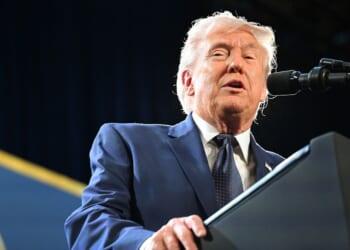
Last week U.S. President Donald Trump singled out Mr. Khamenei as a “lightweight” who was an “unacceptable” choice to lead. That elicited derisive statements from Iran’s ruling elite, who vow not to capitulate to what they consider an American imperial project.

Mr. Trump said he would personally approve any new leader in Iran, as he did in Venezuela after U.S. forces captured the anti-American president in Caracas in early January. Someone not to his liking would “not last very long,” said Mr. Trump, who has demanded Iran’s “unconditional surrender.”
Trump cast “important vote”
The election of Mr. Khamenei “is a deliberate choice to showcase resilience and resistance during war,” says Sanam Vakil, director of the Middle East and North Africa Program at Chatham House, a London-based think tank.
“And it is a gamble, because they know he is now a marked man, above all. If he survives, that will certainly be good for the regime and the deep state,” says Dr. Vakil, noting Mr. Khamenei’s close ties to the Islamic Revolutionary Guard Corps (IRGC) and his broad influence over regime-linked economic interests.
Ironically, Mr. Trump’s criticism may have played a role in selecting Mr. Khamenei, who previously has held no official posts. His father was only the second supreme leader of Iran’s 1979 Islamic Revolution, which toppled a monarchy and has always decried hereditary rule.
Mr. Trump “certainly gave Mojtaba a boost,” says Dr. Vakil. “I did not think he was a real candidate until his father was killed in this way.” His selection “was a vote of defiance, to spite Trump and showcase that the [ruling] system has resolve and will not bend the knee” to U.S. demands.
Mr. Trump “did cast an important vote,” she says.
In addition to senior military and political leaders, U.S. and Israeli targets have ranged from Iran’s nuclear and missile programs to, over the weekend, refineries, fuel depots, and even a coastal desalination plant. In the first eight days of the war, the United States and Israel carried out an estimated 4,500 strikes.

Iran has struck back, with some 3,500 missiles and drones launched at Israel and at U.S. bases and the Arab nations hosting them.
Oil prices Monday surged to near $120 per barrel as facilities across the Middle East shrank production, Iran kept the global energy choke point of the Strait of Hormuz closed, and as expectations grew of a prolonged conflict.
IRGC pledges “obedience”
In a statement early Monday, the IRGC was the first to declare their “profound respect, devotion, and obedience to the chosen one,” Mr. Khamenei. The choice, it said, brought a “renewed dawn and the beginning of a new phase” after the “painful sunset of the great and exalted” elder Mr. Khamenei.
The IRGC said the leadership transition “has proven to all that the movement of the Islamic system does not halt,” and is “not dependent on any individual.”
Mojtaba Khamenei’s allies within the IRGC – spearheaded by Hossein Taeb, a Khamenei confidante and former chief of the IRGC Intelligence Organization – were key to his success, according to Amwaj.media.
“This push, one senior political insider alleged, ‘was against Ayatollah [Ali] Khamenei’s written will,’” and Mr. Trump’s statements “undoubtedly … provided fodder for Taeb and other hardliners pushing for their candidate,” the news site reported.
Analysts say that the loss of so many of Mojtaba’s Khamenei’s close family members could shape a vengeful and confrontational tenure, which is bent on consolidating and entrenching the most hard-line elements of the Islamic Republic.
Indeed, among religious teachers mentioned on posters listing the new leader’s pedigree is Ayatollah Mohammad Taghi Mesbah-Yazdi, an ultra-conservative cleric who long advocated extreme violence, and was linked to past killings of regime opponents. He died in 2021.
The Islamic regime “follows its goals by force of arms,” Mr. Mesbah-Yazdi once said, because it derives its legitimacy straight from God.

But Mr. Khamenei, as the son of a revolutionary stalwart, could also follow a different path, and use his pedigree to make changes and reforms of the Islamic Republic that might broaden its popular base beyond the estimated 15% of the population who are regime loyalists.
Need for internal unity
Whatever his trajectory, the fact of Mr. Khamenei’s elevation to the top slot is meant to minimize infighting among factions, while the U.S. and Israel present an existential threat.
“In terms of security protocols, there will be some measures in order to make sure [Mr. Khamenei] will be in a safe and secure place,” Abas Aslani, a senior research fellow at the Center for Middle East Strategic Studies in Tehran, told Al Jazeera English television.
Mr. Khamenei is seen as a “rejuvenated version of his father” who is “well aware” of the security and political challenges Iran faces, he said.
“The country needed that leader in order to unite different factions, and maybe to stop the internal and domestic competition … to elect a new leader,” said Mr. Aslani. “They now need to be focused on an external enemy, so leading through this difficult time needed somebody who could make important decisions. … That’s why, despite the threat of assassination, it was more important to have a new leader in place.”
Most Iranians only heard Mojtaba’s Khamenei’s voice for the first time when a grainy video emerged Sunday night, recorded for his students in 2024, saying that he would withdraw from teaching to focus on other duties. Since then, largely out of sight, Mr. Khamenei served as de facto manager of his father’s office.
“It certainly matters that they are defying the views and precedent [opposing hereditary transfer of power] of two previous leaders,” says Dr. Vakil at Chatham House. “But this is a ruling system that adapts, particularly in stressful times. For me, this is much more about defiance and preserving key interests of hard-liners and the regime, above all.”
But can Iran’s security services keep Mr. Khamenei safe?
“That is the $10 billion question,” she says.