In the parish churches of Protestant England in 1566, prayers were offered for “the preservation of those Christians and their countries” threatened by the Ottoman invasion of the Habsburg lands. In a service specially composed by Matthew Parker, Archbishop of Canterbury, and published “by the authority of the Queen’s majesty”, the blessing of Almighty God was asked upon “the Emperor thy servant, and all the Christian army now assembled with him”. Elizabeth was the hope of Protestant Europe. The Habsburg emperor, Maximilian II, while tolerant in his religious policies, was head of one of the great Catholic powers of Europe. Despite these confessional differences, and with the bitter debates of the Reformation still raging, Protestant England prayed for the Emperor, his subjects, and his armies as fellow Christians.
The prayers published for use in English parish churches in 1566 speak of an identity greater than the confessional differences of the Reformation and Counter-Reformation era. They refer to the populations of the threatened Habsburg lands — Catholic, Lutheran, and Reformed — as “other Christian men, our brethren and neighbours”. In his preface to the prayers, Archbishop Parker described the Kingdom of Hungary as “a most strong wall and defence to all Christendom”. In other words, the very real differences of the Reformation and Counter-Reformation had not destroyed the vision of Christian Europe, of Europe as Christendom. And so the Protestant Kingdom of England prayed for the protection of the Catholic Habsburg Emperor and his subjects, “our brethren and neighbours”.
Pope and King are, in a quietly prophetic manner, recalling Europe to its Christian roots
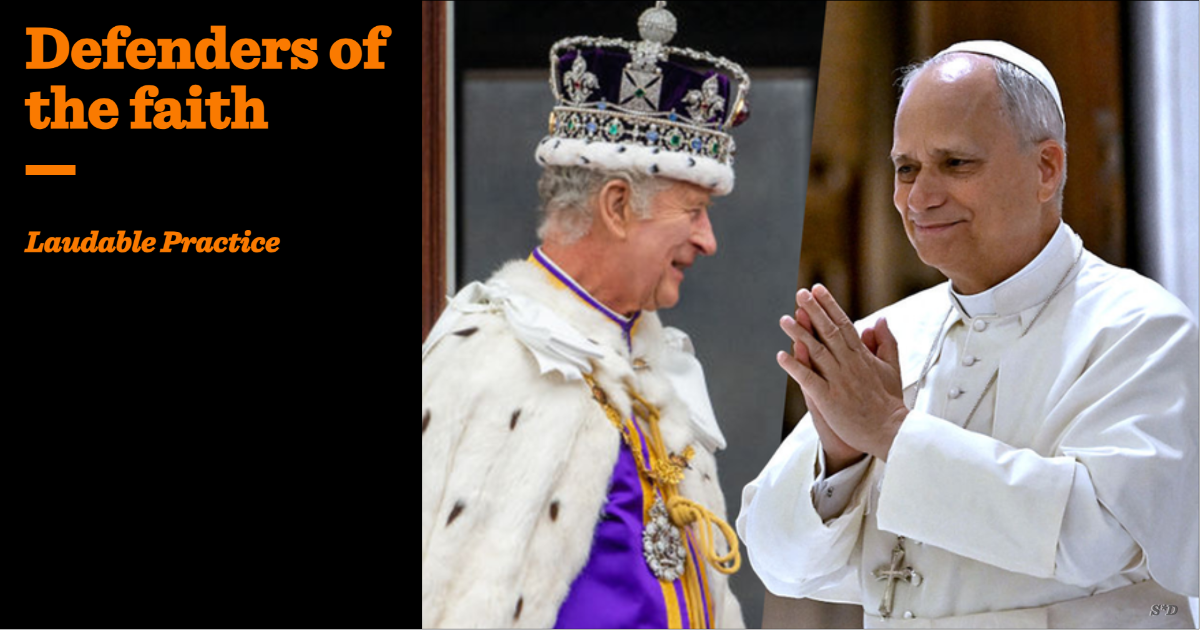
We can see something of such a fraternal vision demonstrated during this week’s State Visit to the Holy See by the King and Queen. At the invitation of Pope Leo XIV, the King will be formally named as “Royal Confrater” of the Papal Basilica and Abbey of St. Paul’s Outside the Walls. Traditionally, the four papal basilicas in Rome had a Royal Confrater, a Catholic monarch who acted a “protector”. According to a papal spokesperson, the office is “a sign of honour and spiritual communion”. A special chair, decorated with the King’s coat of arms, will be used during the ceremony and will remain in the basilica’s apse.
The significance of the King becoming a Royal Confrater is, of course, because he is Supreme Governor of the Church of England, who vowed at his Coronation “I am a faithful Protestant”, and was anointed and crowned by the Archbishop of Canterbury. It is not an overstatement to suggest that this invitation to become a Royal Confrater, and its acceptance, is one of the most significant ecumenical acts in Anglican-Roman Catholic relationships. While the two communions have been in serious theological dialogue since the 1960s, papers produced by theological commissions do not have the same force as the Supreme Governor of the Church of England being honoured in this way, and accepting a historic role in relation to a papal basilica.
There is also a sense in which this embodies the best traditions of both communions. With the Basilica of Saint Paul is an ancient Benedictine Abbey. The monastic order founded by Saint Benedict in the 6th century established communities of prayer, study, wisdom, labour and economic creativity across Europe. Appropriately, Benedict is one of the patron saints of Europe. When Joseph Ratzinger became Pope Benedict XVI in 2005, he explained that his choice of papal name reflected how Saint Benedict’s “life evokes the Christian roots of Europe”. The prayer, liturgy, teaching, spiritual wisdom, and communities of the Benedictine tradition continue to be one of the great gifts of the Catholic Church.
Likewise, the King represents the best of Anglicanism. As Patron of The Prayer Book Society, his love for the traditional Anglican liturgy is well-known: its words, he said while Prince of Wales, “do sink into your soul something extraordinary”. He is an advocate and patron of the Anglican choral tradition. The fact that the Children of the Choir of His Majesty’s Chapel Royal and the Choir of St. George’s Chapel, Windsor will be accompanying the King and Queen to Rome and singing alongside the Sistine Chapel choir indicates something of this. The simple words the King used when addressing leaders of other faith traditions at his accession speak of a devotion to Anglicanism that is not always evident in the hand-wringing tone sometimes heard from its episcopal leadership: “I am a committed Anglican Christian”.
This points to how ecumenical relations are best conducted: by fraternal, mutual celebration and affirmation of the spiritual riches of our traditions and inheritances, rather than by the uninspiring documents of committees.
The King becoming a Royal Confrater of a papal basilica also has relevance for the “Quiet Revival” of Christian faith that seems to be occurring across Europe. Pope and King are, in a quietly prophetic manner, recalling Europe to its Christian roots. Against the naked public square of the technocrats, the ideological self-hatred of the nations of Europe promoted by its cultured despisers, or the dark gods of blood and soil, we might regard this act by King and Pope as echoing Burke: “The nations of Europe have had the very same Christian religion, agreeing in the fundamental parts, varying a little in the ceremonies and in the subordinate doctrines. The whole of the polity and economy of every country in Europe has been derived from the same sources”. This, Burke declared, made Europeans “citizens of the great commonwealth of Christendom”.
Without this fraternity rooted in Christianity, rather than revolutionary violence or racial hatred, Europe has lost its way, its common life bereft of transcendental meaning, its empty square filled with banalities which cannot satisfy the soul, and its relationships with those amongst us from the other great religious traditions fatally weakened by the inability to recognise the significance of faith. In such a time, it is fitting that an anointed Christian monarch should become a Royal Confrater of a papal basilica, telling us of another way, at once old and new, the roots of Europe holding the promise of a renewal of our common life as “brethren and neighbours”.