Iranians have protested the appointment of the Ayatollah’s son as their new Supreme Leader by shouting ‘death to Mojtaba’ from their houses.
Mojtaba Khamenei, 56, a hardline cleric viewed as even more extreme than his tyrannical father, was confirmed as the regime’s leader on Sunday after being selected by an 88-person assembly.
He has close links to the brutal Iranian Revolutionary Guard Corps and has been described as ‘vengeful’ and likely to seek revenge on the US or even ordinary Iranians following the death of his father and wife at the beginning of the war.
The Ayatollah was said to be opposed to his ascension to Supreme Leader because hereditary rule would resemble the US-backed Shah monarchy which was overthrown in the Iranian Revolution of 1979.
But thousands of Iranians gathered in major squares and streets across the country on Monday to ‘pledge allegiance’.
Thousands took part in a rally at Tehran’s Enghelab Square, chanting ‘Death to America, death to Israel‘ and ‘God is greatest’.
Meanwhile, those opposed to the regime could be heard shouting ‘Death to Mojtaba’ from their balconies, copying chants used against the Ayatollah during protests in January.
One video shows residents appearing to curse the dictator from the balcony of their tower blocks in Tehran.
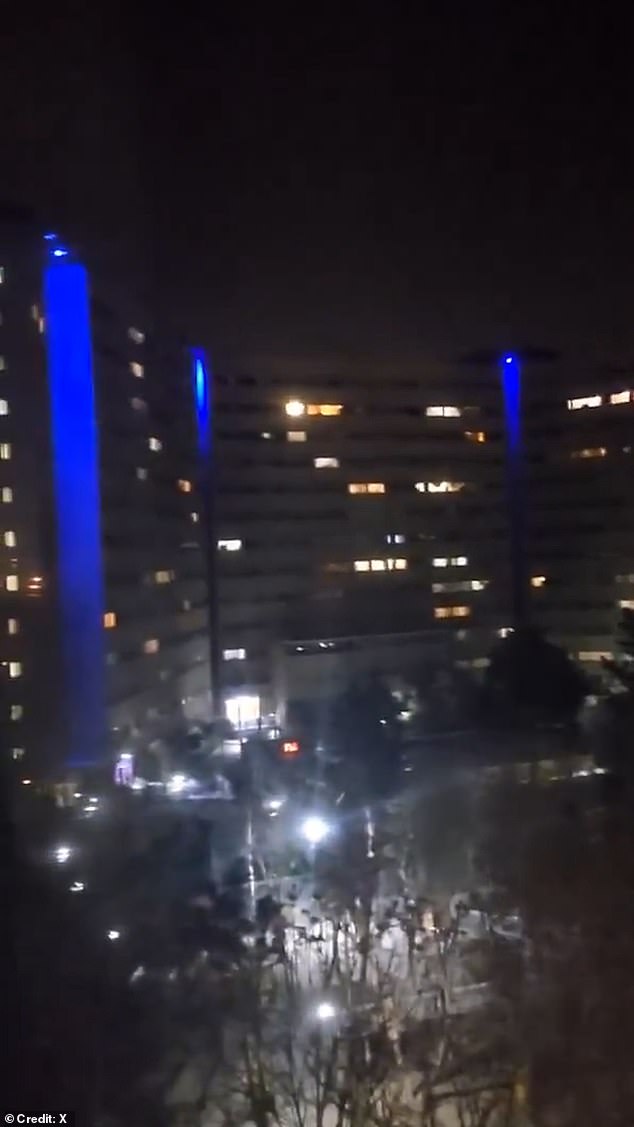
Residents can be heard appearing to curse the dictator from the balcony of their tower blocks in Tehran
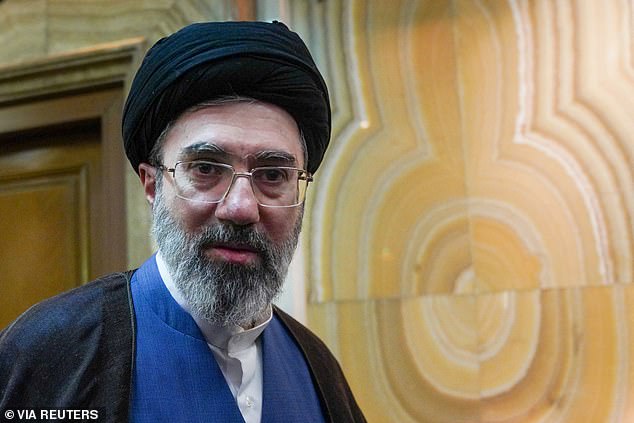
Long before he took his father’s mantle as the Supreme Leader of Iran, Mojtaba Khamenei (pictured) was involved in the merciless crackdown of the Iranian people in several major mass protests
Dissent against the regime is clamped down against brutally, with thousands of citizens slaughtered by the state during anti-government protests in January.
Israel has marked Mojtaba for assassination after it vowed to ‘eliminate’ whoever succeeded the slain Ayatollah, having killed him and Mojtaba’s wife Zahra Haddad-Adel in strikes on the first day of the conflict.
Mojtaba has already been wounded, with Iranian state TV reporting describing him as ‘janbaz’, or wounded by the enemy, in the ‘Ramadan war,’ which is how media in Iran refer to the current conflict.
Mr Trump said Mojtaba’s appointment is ‘going to lead to just more of the same’.
While the Israeli Foreign Ministry posted a picture of Mojtaba and his father with blood on their hands, captioned ‘the face may slightly change, the terror regime does not. Mojtaba Khamenei inherits his father’s legacy of repression and bloodshed.’
Long before he took his father’s mantle as the Supreme Leader of Iran, Mojtaba was involved in the merciless crackdown of the Iranian people in several major mass protests.
And he has cultivated an important role in the regime over his lifetime.
He has used this to carry out his father’s wishes by suppressing the population, developing deep relationships with the country’s military and paramilitary forces and even taking on decision-making roles related to intelligence.
In 2009, Mojtaba was said to have taken control of the Basij, a paramilitary group with an estimated 600,000 members, during mass protests that year.
He is accused of overseeing the slaughter of dozens of people protesting the results of that year’s presidential election.
Critics accused then-president Mahmoud Ahmadinejad, seeking re-election, of committing widespread election fraud that led him to taking home 62 per cent of the votes.
On his inauguration day, opposition protesters clashed with hundreds of riot police outside of Iran’s parliament building.
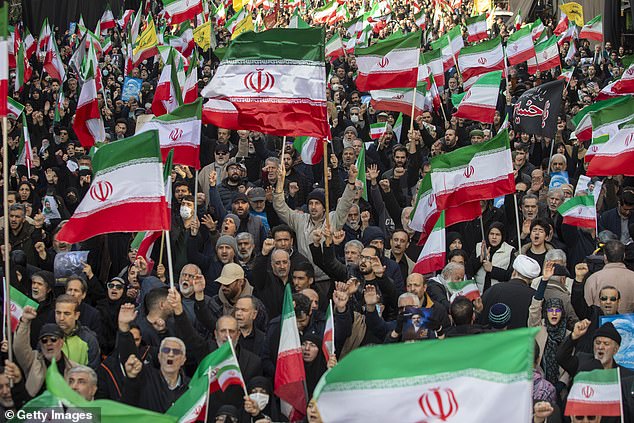
Thousands took part in a rally at Tehran’s Enghelab Square, chanting ‘Death to America, death to Israel’ and ‘God is greatest’
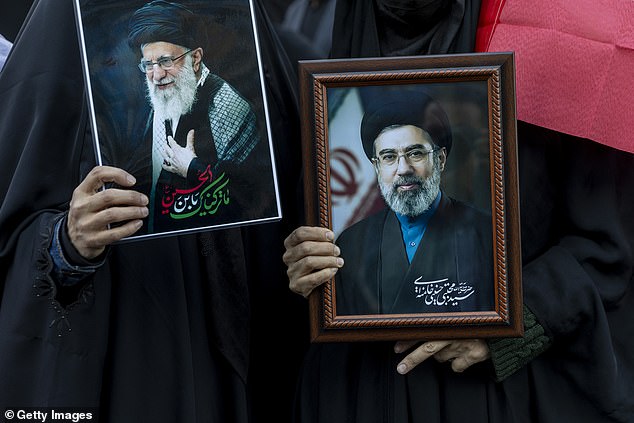
The Ayatollah was said to be opposed to his ascension to Supreme Leader because hereditary rule would resemble the US-backed Shah monarchy
And Basij members took to the streets to suppress opposition, with Mojtaba orchestrating them.
An Iranian politician told the Guardian that year: ‘Mojtaba is the commander of this coup d’etat. The basiji are operating on Mojtaba’s orders, but his name is always hidden in all of this. The government never mentions him.
‘Everyone is angry about this. The maraji [Iran’s most senior ayatollahs] and the clerics are angry, the conservatives are very angry and strongly critical of Mojtaba. This situation cannot continue with so many people on the top against it.’
Basij forces were also used to crack down on dissidents in 2022 during the Mahsa Amini protests, which began after a young woman was kidnapped and beaten to death by Iran’s morality police for refusing to wear a hijab on public transport.
These protests, which began in September 2022 and carried on until the following spring, saw security forces kill over 500 people, including 68 minors.
Mojtaba is also believed to have taken a significant role in the IRGC itself. Iran international reported that before he took office, he played a significant role in deciding which senior officials should hold places in the military’s intelligence wing.
He was, in 2019, sanctioned by the US for acting as the Supreme Leader of Iran without every being elected.
He was also placed under sanctions for working closely with the commander of the Quds Force, an Iranian military branch that specialises in military intelligence and unconventional warfare.