Ninety-nine per cent of lawyers give the rest of us a bad name. This is particularly true of those who end up in politics. The problem with lawyers-turned-politicians is that they stop reading the law as a set of constraints and begin treating it as an invitation to interpretation aligned with political goals. As common-law restraint and the golden rule of interpretation were displaced by purposivism after the Human Rights Act 1998, law increasingly became a vehicle for preferred outcomes rather than a limit on power. What lawyers once applied, they now complete.
Rights ceased to be understood primarily as negative protections against state power and were reimagined as positive claims upon it. The task of legal professionals shifted from defending boundaries to demanding outcomes. From this emerged modern human rights lawyering, less concerned with what the law permits than with what morality can be argued to require. This form of lawyering trains its practitioners to see politics as a series of justiciable wrongs rather than contested choices.
Human rights lawyering excels at identifying grievances and articulating moral claims. It is far less adept at deciding priorities, managing trade-offs, or accepting the legitimacy of loss. Yet this mode of thought now sits at the heart of modern governance, not only in the UK but across much of the Commonwealth.
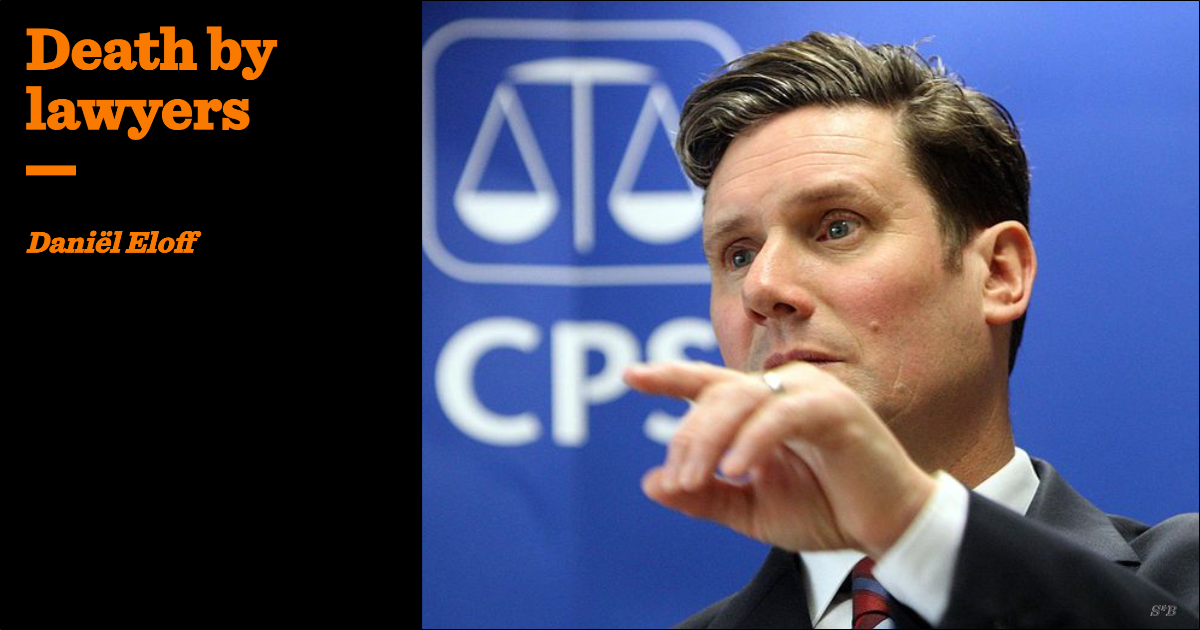
The Prime Minister, Keir Starmer, is a human rights lawyer. The Attorney General, Richard Hermer is a human rights lawyer. The Mayor of London, Sadiq Khan, is a human rights lawyer, as is Shami Chakrabarti, the former shadow attorney general. Even Cherie Blair, wife of a former Prime Minister, belongs to the same professional ecosystem, albeit as a more conventional member of the Bar. Helena Kennedy, David Lammy and various others.
Elsewhere in the former colonies, Robert Mugabe also read law.
If financiers, entertainers, and career apparatchiks have already revealed the limits of technocratic and theatrical leadership, recent experience suggests that governments led by human rights lawyers descend faster still.
And Britain produces lawyers at an astonishing rate. There are more practising lawyers in the UK than in France and Spain combined. Japan, often caricatured as obsessively rule-bound yet remarkably orderly, has roughly thirty times fewer lawyers per capita than Britain. Japan is governed largely through norms and institutions, as Britain once was.
The rise of a lawyer-led political class has coincided with a widening gap between governors and governed. Human-rights law, procedural ambiguity, and ideology have fused into a style of rule fluent in elite moral language but increasingly tone-deaf to democratic constraint and the instincts of ordinary citizens.
It was human rights lawyers who gave the UK the Human Rights Act 1998, the Climate Change Act 2008, and the Equality Act 2010 — statutes that convert moral aspiration into justiciable obligation and, in doing so, entangle democratically mandated reform of immigration, policing, and welfare in litigation and procedural vetoes.
To see where this trajectory can lead, one can look to Pretoria.
South Africa’s post-apartheid settlement is often described as one of the great constitutional success stories of the late twentieth century: a negotiated transition that avoided civil war, a liberal constitution enshrining rights and dignity, and an independent judiciary promising restraint after decades of authoritarian abuse. For a time, it appeared to offer precisely what Britain’s human-rights culture aspires to — moral seriousness embedded in law.
The South African Constitution was drafted in a moment of profound moral urgency, shaped both by the imperative to break decisively with apartheid and by the post–Cold War triumphalism that followed the fall of the Berlin Wall, when liberal constitutionalism was widely assumed to be not merely preferable, but final.
Alongside this settlement, however, emerged transformative constitutionalism as a legal philosophy that quietly rewired the state and swung the political pendulum far beyond redress into permanent social engineering. The theory of redress contained in the Constitution evolved into a programme of permanent social reconstruction
The idea sounds admirable. Who would oppose transformation in a society scarred by racial injustice? But rather than treating the constitution as a framework that limits power and enables pluralism, it was reimagined as a mandate for social reconstruction. The constitution was no longer merely to be upheld but it was to be fulfilled through continuous transformation and government intervention.
Ironically, the South African Constitution — unlike Britain’s, a single written text — does not contain the word “transformation” at all. Not once. A simple Ctrl+F confirms it. It speaks instead of equality, dignity, freedom, and non-racialism. It does not instruct the state to reorder society along demographic lines or to privilege outcomes over opportunity. That instruction was supplied not by voters or legislators, but by lawyers through interpretation, jurisprudence, and advice supplied by lawyers.
From this interpretive leap flowed a comprehensive political ideology. Black Economic Empowerment reshaped ownership and employment through racial classification, to the detriment of economic growth. Preferential procurement prioritised demographic targets over price and competence. Quotas were imposed on national sports teams, often at the expense of performance. These measures at redress hardened into permanent policy, supported by the interpreted transformation mandate rather than by explicit democratic mandate or measurable success.
The cumulative effect was not transformation as ordinary people understand it — such as with rising living standards, functioning institutions, or social mobility — but a permanent state of moral urgency that achieves little when it comes to improving people’s lives. Success was defined symbolically rather than materially. Failure could always be explained as insufficient transformation.
The results are grim — one of the highest unemployment rates in the world at 37 per cent; nearly two decades of rolling electricity blackouts, collapsing municipal services, endemic violent crime, with some of the highest murder and rape rates globally and a state increasingly unable to perform even its most basic functions. Yet the language of transformation persists — insulated from consequence by an all-encompassing legal ideology administered by professionals trained to contest meaning rather than build institutions.
Human rights governance systematically transfers risk downward
What is tragic is that none of this was inevitable for South Africa. The Constitution did not require courts to embrace transformative constitutionalism, nor did it mandate permanent redress divorced from outcome or time. A different path was available. But ultimately because revolutions often simply mean the replacement of one elite with another the new elite’s language of continuous liberation persisted.
Human rights governance systematically transfers risk downward. Moral authority, reputational insulation, and legal protection accumulate upward among the professional classes who design and administer the system. Material consequences accumulate below. Elites encounter failure as procedural friction like another court challenge, another policy refinement or another interpretive debate. Communities encounter it as unemployment, crime, electricity blackouts, and collapsing services in South Africa, and as strained policing, unmanaged migration, housing shortages, and declining public order in the UK. This asymmetry explains the widening gap between governors and governed better than ideology alone. Those most fluent in the language of rights are also the least exposed to the costs of governing by them.
Rob Henderson’s term “luxury beliefs” describes ideas embraced by elites that impose costs on others. Transformative constitutionalism in South Africa is a textbook example — with one essential difference. These luxury beliefs were not merely expressed, they were enforced. They became procurement rules, hiring criteria, and regulatory thresholds. Their costs were borne by the poor (overwhelmingly black) while their moral prestige accrued to the professional classes who designed them.
The language of transformation comforts those who speak it … but it does not fix roads, keep the lights on, or build capable institutions
This might be called a form of jurisprudential toxic compassion: the prioritisation of emotional reassurance over long-term consequence. The language of transformation comforts those who speak it — signalling virtue and absolving guilt — but it does not fix roads, keep the lights on, or build capable institutions.
Moreover, systems built on procedure and moralism alone also become intolerant of dissent. In South Africa, opposition to Black Economic Empowerment is treated not as a policy dispute but as apartheid apologism. Evidence-based objections to the transformation project are dismissed as bad faith. Likewise, the UK’s debates over immigration, policing, and speech are filtered through legalised moral frameworks. South Africa shows where this way of thinking leads.
A political and media class marinated in human rights dogma has grown fluent in moral language while steadily losing contact with how ordinary people experience the state. This is as true in Newcastle, KwaZulu-Natal as in Newcastle upon Tyne. For communities dealing with problems such as crime, overcrowded schools, failing infrastructure, and stagnant wages, the question is no longer whether a policy sounds compassionate, but whether it works.