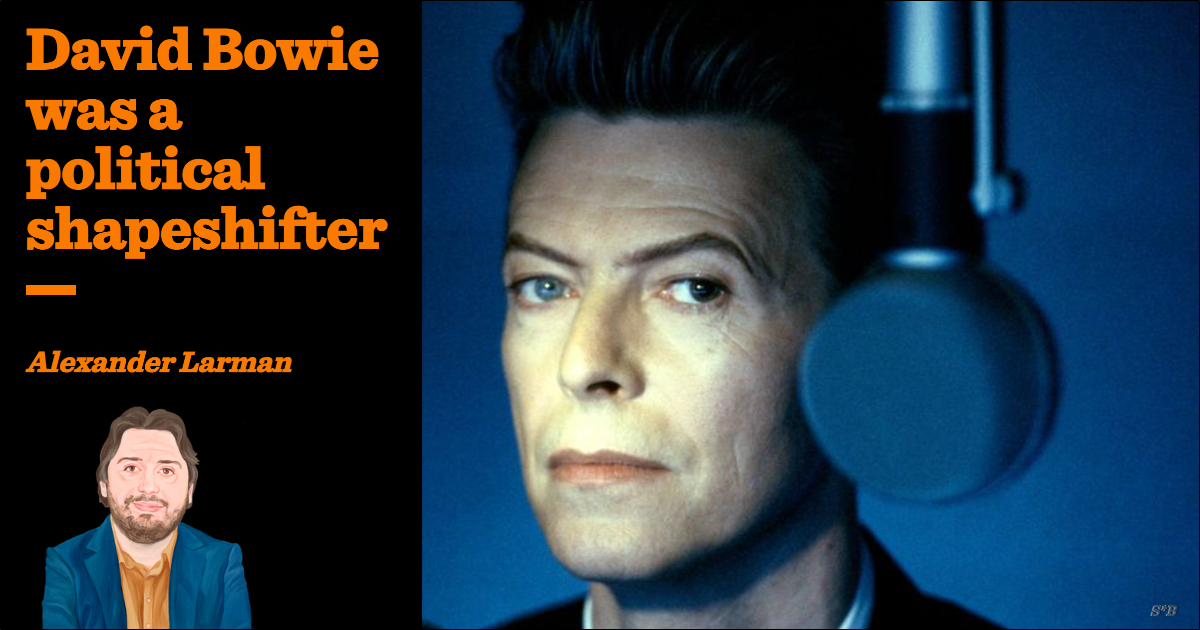

Ten years after his death, the musician, actor and one-time internet pioneer David Bowie continues to fascinate and beguile his millions of admirers. While the other leading rock and pop stars who died the same year — Prince, George Michael and Leonard Cohen — are still much-beloved and mourned, the Bowie afterlife stems from the sheer level of enigma that the one-time Ziggy Stardust manifested.
Despite an apparently accessible, even matey persona that he liked to adopt in interviews, especially the latter-day ones, “David Bowie” was a carefully constructed façade that few, if any, were able to penetrate. Perhaps the most rigorously maintained example of this façade was his approach towards politics, which had something for everyone, regardless of how they voted.
As far back as 1972, Bowie seemed to present himself as a studiously apolitical artist, singing on “All The Young Dudes” — admittedly a song he initially wrote for the band Mott the Hoople — that “We never got it off on that revolution stuff/What a drag, too many snags”. It was a not-so-implicit rebuke to Bowie’s friend John Lennon, who was nothing if not a left-wing rabble rouser, but a few years later, Bowie had come to a rather different realisation. As he created perhaps his darkest public persona, the Aryan, icily cold Thin White Duke, he gave a series of interviews that almost immediately became notorious and would define him for years.
He told the young journalist Cameron Crowe — later to become an acclaimed filmmaker — that “I believe very strongly in fascism” and “Adolf Hitler was one of the first rock stars …[he was] as good as Jagger at working an audience”. This may or may not be true, but it followed on from a press conference that he gave in Stockholm in early 1976 when he declared “As I see it, I am the only alternative for the premier in England. I believe Britain could benefit from a fascist leader. After all, fascism is really nationalism.” Arriving back at Victoria station in May that year, he directed what might — or might not — have been a Nazi salute to his waiting fans from a waiting Mercedes. Unfortunately for him, some eagerly waiting photographers, who duly published the damning and potentially career-threatening image.
Bowie was many things, but he was not an idiot. He swiftly denied giving a fascist salute, and by 1980, he was contrite about the whole affair, calling himself “out of my mind totally, completely crazed” on drugs and saying that, while he understood that accusations of racism had “quite inevitably and rightly” been levelled at him, there was no basis for them. He instead blamed the Thin Duke White persona for developing a mind of its own, sighing that he had come under the influence of one of his “own fucking characters”.
Therefore, for much of the rest of the decade, Bowie began to resemble an ex-con who was only too eager to go straight. He popped up in Smash Hits in 1987 to offer his views about the forthcoming general election, saying “my tendency would be towards a Labour vote and it would be kind of nice if Labour got in — but of course I know that Thatcher will get in…(sighs).” Perhaps in an attempt to curry favour with a youthful left-wing audience, Bowie now embarked on a series of well-intentioned but embarrassing flirtations with right-on politics. When he was part of the ill-fated hard-rock band Tin Machine, he wrote the song “Under the God”, with dismissive lyrics about “White trash picking up Nazi flags” and “Right wing dicks in their boiler suits.” It is not considered one of his finest works.
Tin Machine were a niche concern at best (when asked in one interview whether their first album was underappreciated, Bowie shot back “how about unheard?”) yet his big 1993 comeback record Black Tie White Noise saw the star attempt to explore issues of racial harmony and dysfunction against the backdrop of the then-recent Rodney King riots in Los Angeles. When he performed a duet about racism with the rapper Al B Sure! on the title track, his intentions might have been noble, but the egregiously poor execution of his agitprop intentions meant that many would have preferred the Thin White Duke to re-emerge and the ill-thought-through hectoring to be left far behind.
Black Tie White Noise was a commercial hit, topping the charts in Britain, but it also represented the last time that Bowie would attempt to “do” politics in this fashion. He briefly formed a friendship of sorts with Tony Blair in the mid-90s, dining at Chequers and collecting a BRIT award from him at the ill-fated 1996 ceremony (the one with Jarvis Cocker disrupting Michael Jackson’s performance), but Bowie never again sought to ally himself with any particular ideology or movement.
Many assumed, without clear evidence, that if he was anything, he was a wealthy transatlantic liberal, the kind of man who would be at home with Blairism and Clintonian democratic government, if more sceptical about the right-wing Republican administration ushered in by George W. Bush at the turn of the millennium. Yet he gave no statements that supported this supposition, and even his performance at the post-9/11 Concert for New York City, where he played a barnstorming version of his signature tune “Heroes”, was as apolitical as might be imagined — unless, of course, you wanted to suggest somehow that 9/11 was anything other than A Bad Thing.
Asking Bowie for consistency or sincerity was always a mistake
After his death, the tributes to Bowie included warm words from the likes of Blair and noted fan David Cameron. His last public statement on any political matter was when he sent Kate Moss to the BRITS to accept a lifetime achievement award on his behalf in 2014, and apparently on a whim, asked her to say “Scotland, stay with us”; a comment on the then-looming independence referendum that did not endear him to the Cybernat community, but led Cameron to let out “a little cry of joy”.
Whether the musician believed what he was saying, or simply threw it in as a final provocation, remains uncertain, but asking Bowie for consistency or sincerity was always a mistake. If you wanted an earnest political singer-songwriter, Billy Bragg remains available, but if you are more interested in a shape-shifting enigma, the artist formerly known as David Jones did it better — or at least more entertainingly — than anyone else. And that, surely, is a greater legacy than knowing how he voted in 1974.
Alexander Larman’s new biography, LAZARUS: The Second Coming of David Bowie, is out now from New Modern Books (£25)