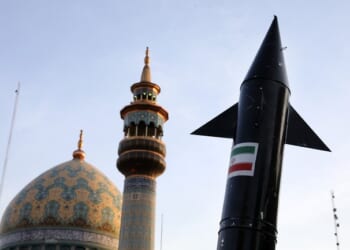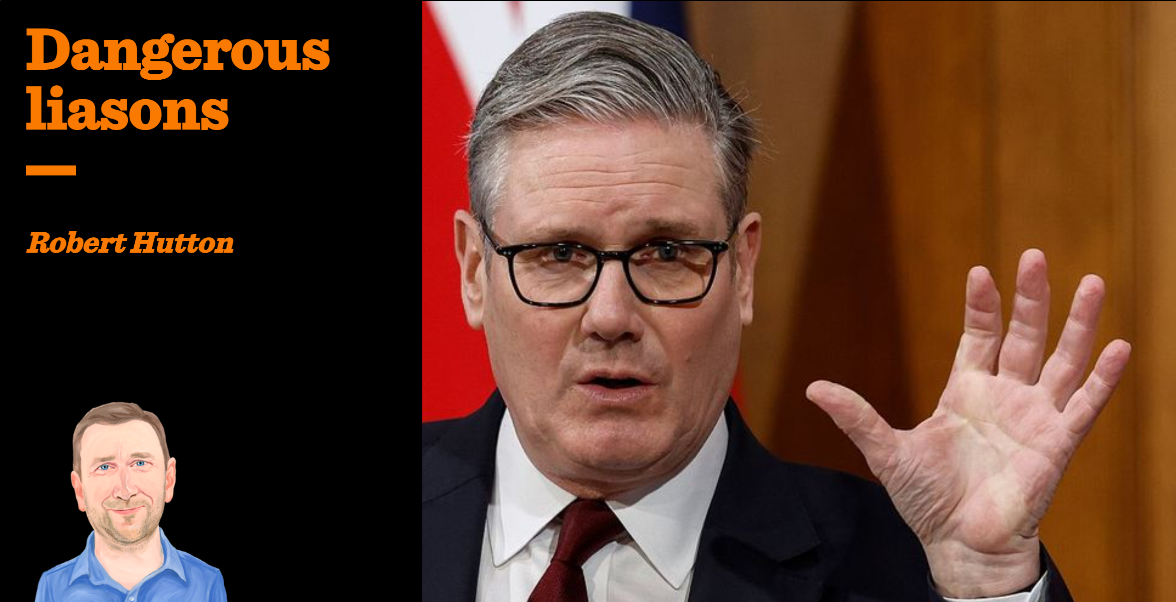

“Five, four, three, two, one…” Meg Hillier, chair of Parliament’s Liaison Committee, likes to count down to the start of sessions, like NASA Mission Control, or someone preparing to launch a missile at Tehran. Opposite her sat Keir Starmer, braced for 90 minutes of explaining that the proper processes need to be followed.
The subject was foreign affairs. Is there much going on? Liam Byrne asked what the government “central planning scenario” was for the Hormuz Straits blockade. How long would it last? “It’s hard to answer that question, if I’m honest,” Starmer sighed. We are at the mercy of a crazed autocracy that might prefer apocalypse to defeat. And the Iranians aren’t much better.
Over the weekend, Donald Trump had gleefully shared a sketch from the new British edition of Saturday Night Live, which suggested that Starmer is scared of him. For some satirists, this would be a moment to rethink their life choices, but the show’s bosses may take it as a win. Their own attitude to the president is so courageous that in a whole hour, SNL UK offered only a single passing joke about him.
Perhaps they couldn’t think of anything funny to say. The rest of us are luckier. On Monday morning Trump executed a classic chickening out, backing down from his threat to destroy Iran’s power plants, and claiming that the US was in talks with Tehran. But even fans of the Great Orange One are beginning to twig that sometimes he says things which are a bit, well, made-up. Were these talks real, or had the president been conducting negotiations with the toaster in the Mar-a-Lago kitchen? In this context, Starmer’s announcement to the committee that he had been aware of the discussions in advance of the announcement was probably reassuring.
The prime minister said he wanted a “swift resolution” to the crisis, one which “puts tough conditions on Iran”. Is it too much to hope for one or two applied to the US as well?
Tanmanjeet Singh Dhesi, who chairs the Defence Committee, is temperamentally a Labour loyalist. However, there are growing signs that he has been radicalised by exposure to the Ministry of Defence. He wanted to know why Britain hadn’t been better prepared for this conflict, and whether Iranian missiles could hit us. Starmer tried to smother that idea, but Dhesi is already demanding a UK missile defence dome. Another year in the job, and he’ll want his own aircraft carrier.
Labour’s dominance of Parliament means that Liaison Committee grillings are less painful for Starmer than they might be. Tories chair only eight of the 31 committees, and on Monday, only one of them had shown up. This was Bernard Jenkin, doggedly determined to hold the government to account on every subject, like Horatius at the bridge, had he been unable to find anyone to stand on either hand.
Before Jenkin spoke, we’d had half an hour of largely friendly questioning on points of detail, which the prime minister addressed with relish. Emily Thornberry, who as Foreign Affairs Committee chair would usually lead on such matters, was absent, “on a long-planned visit to Greenland”. Presumably she’s busy mining runways against the possibility of US invasion.
The closest Starmer came to a memorable quote was when he set out his position on Iran: “This is not our war, and we’re not getting dragged in.”
Suddenly, just as some of us were nodding off, Jenkin erupted. The government’s defence position was “utterly ludicrous”, he declared. “The Treasury does not realise that we are already at war!” This was a reference not to Iran but Russia’s invasion of Ukraine.
Starmer sputtered at this. He was doing his best, he said, “cleaning up the mess I inherited.” There had been a long-running “underfundment” of the military. He was now waiting for the results of the “zero-based review” of defence.
Jenkin was having none of this. “Churchill had a mess to clear up,” he fumed. “Thatcher had a mess to clear up.” He had more. “How many defence reviews were there in the Second World War?”
The prime minister shook his head, irritated. “I don’t know.”
“The answer is none!” Jenkin spat.
Hillier tried to coax some rhetoric out of the prime minister, but it’s not his thing. Perhaps his team can work something out for him:
“We shall conduct a zero-based review on the seas and oceans, we shall finalise the investment plan with growing confidence and growing strength in the air, we shall keep it under review, whatever the cost may be. We shall have a statutory process on the beaches, we shall operate that process on the landing grounds, we shall action discussions in the fields and in the streets, we shall take the appropriate action in the hills; we shall set out what we mean by that in due course.”