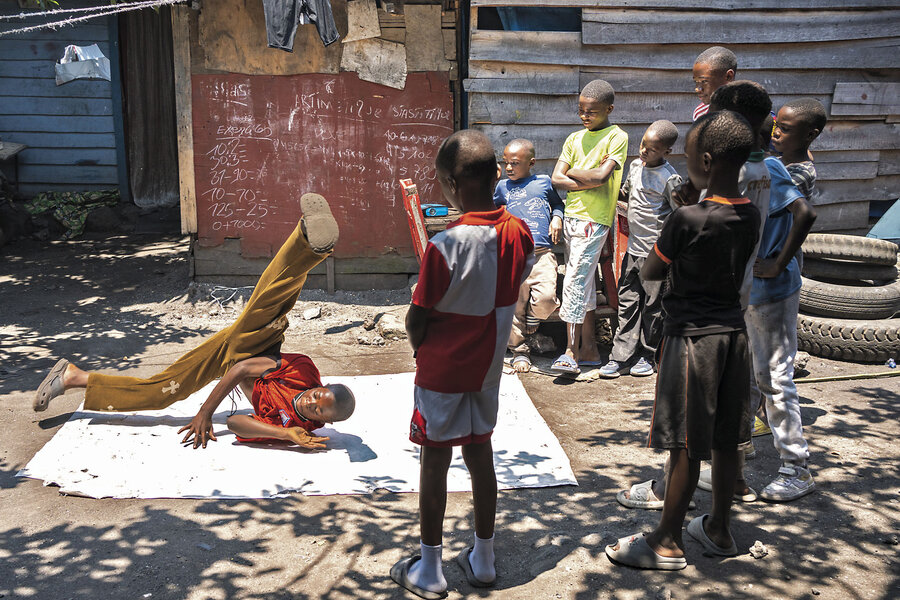
At the end of a dirt alley in Katindo, a working-class neighborhood of Goma in the Democratic Republic of Congo, Jonathan Bitonde waits in front of a metal gate. Soon, a dozen children ages 11 to 17 stroll through it, arm in arm. They smile with the easy camaraderie of those who know one another well.
The group listens intently as Mr. Bitonde, a teacher with Congo Street Breaking Art, starts his address.
“Today, we’re going to talk about anger and sadness,” he says. “And we’re going to see how dance can help us express these feelings.”
Why We Wrote This
Economic insecurity and a violent conflict fueled by the resurgence of the M23 armed rebel group have racked the city of Goma. But the children there have found a lifeline in dance.
The children, growing up in a city riven by economic insecurity and a violent conflict fueled by the resurgence of the M23 armed rebel group, are there to learn the art of breaking, also known as breakdancing. The dance workshop has been operating since 2008.
For a 15-year-old who calls himself B-Boy Issa, dance has been a lifeline. The teen’s father was taken by M23, and he had to stop studying because his mother could no longer afford school fees.
He trains in the workshop space every weekday. On weekends, when the space is closed, he helps his mother make food that she sells on the street in hopes of eventually affording school tuition for him.
“Dance is my only hope in life; I hold on to it with all my strength,” he says. “I learn dance, effort, painting, sharing, and brotherhood there.”