A common plant found abundantly in the tropics could be the secret to regrowing your hair.
Scientists in Taiwan formulated a serum containing caffeine, panthenol (a moisturizer commonly found in many shampoos), fibroblast growth factor 7 (a protein that helps maintain hair-producing cells), and insulin-like growth factor 1 (a protein that stimulates hair follicle development).
They also included extracellular vesicles, tiny, bubble-like structures that all living cells naturally produce and release that carry important proteins, fats, and genetic instructions that act like chemical messages, from a plant species called Centella asiatica.
Researchers conducted a 56-day clinical trial with 60 healthy men and women who were not balding to test the new scalp serum. They were divided into five groups, each using a slightly different version of the serum once daily.
The groups tested a placebo; a base formula with caffeine and panthenol; the base plus engineered growth factors; the base plus Centella asiatica cells; and a ‘full’ serum containing the base, growth factors and plant cells combined.
The most effective formula was the full combination serum. After eight weeks, this group showed significantly better results than all others. The complete formula more than doubled the improvement seen with the placebo, increasing both hair thickness and density by 101 percent.
People using the full formula with every ingredient experienced an additional 3.5 cm of cumulative hair growth in 56 days and also saw improved scalp health.
The research team’s approach using natural plant communication signals alongside lab-engineered protein generators proved significantly more effective than any single component alone, offering a promising new strategy for hair loss, which affects more than 80 million Americans.
Researchers from Taipei, Taiwan tested a serum combining caffeine, panthenol (a common moisturizer), fibroblast growth factor 7, a protein that supports hair-producing cells, and insulin-like growth factor 1, a protein that promotes follicle development (stock image)
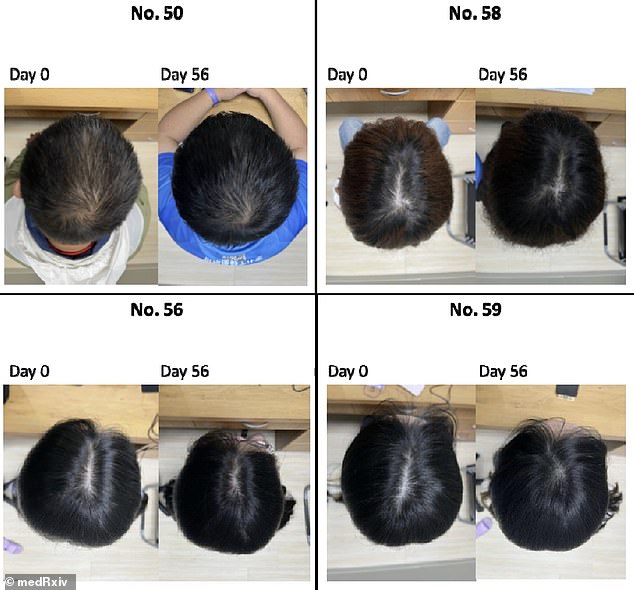
Scalp photographs from Day 0 (left) and Day 56 (right) show the results for participants using the complete serum—a blend of growth factors, plant vesicles, caffeine, and panthenol. The after images reveal enhanced hair coverage and density, most notably at the vertex (crown of the head).
The researchers used a combination of specialized tools and standardized tests to measure changes in hair and scalp health at five points over the 56-day study.
Scalp oil was measured with a device that analyzes oil absorption on a specialized tape. Hair growth was tracked using an AI-powered digital microscope that automatically counts hairs, measures thickness and monitors growth length.
Hair shedding was assessed by a combing test, where hair was combed 60 times over a clean surface. Shed hairs were collected and counted manually.
Clinical before-and-after photos of the crowns of people’s heads provided visual proof of changes in overall hair coverage and density.
The study, published in medRxiv, showed that all active formulas improved hair thickness and density more than the placebo after 56 days.
When the ingredients’ contributions were measured individually, researchers found that the growth factors were the single most powerful ingredient, increasing thickness by 67 percent and density by 95 percent over the placebo on their own.
The base formula of caffeine, panthenol and the plant vesicles also provided solid benefits, each improving thickness and density by roughly 45 to 70 percent over placebo.
However, the full combination of all ingredients, including the base, growth factors and plant vesicles, delivered the best results.
The group using the full formula saw hair growth nearly 17 percent faster than the placebo group, producing an additional 3.5 cm of new hair over 56 days.
Their hair also became twice as thick, a 101 percent greater increase, and nearly twice as dense compared to the placebo.
They experienced 47 percent less hair shedding and a 25 percent greater reduction in scalp oil than the placebo group. While other formulas showed some improvement, none matched the full formula’s across-the-board results.
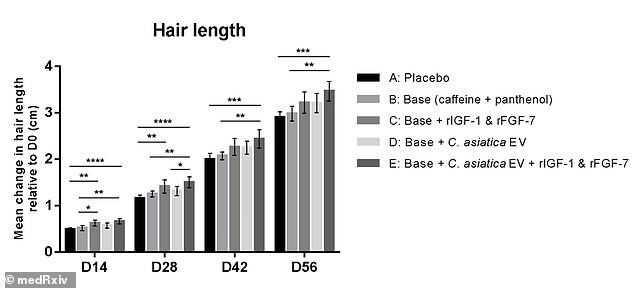
The graph tracks new hair length over the study period. The bars for Group E (full active serum) rise more steeply than others, showing a faster growth rate that resulted in 3.5 cm of growth by Day 56, a significant increase over the placebo
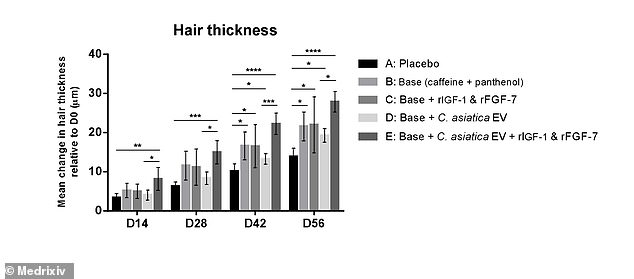
The bar graph compares the final increase in hair shaft thickness across treatment groups. Group E (full formula) shows the most substantial gain, more than doubling the improvement seen with the placebo, indicating a strong thickening effect from the combined active ingredients
The study, while promising, had some notable limitations. The healthy volunteers did not have a history of pattern baldness and a more expansive subject pool including people with diagnosed pattern hair loss is needed.
Additionally, the eight-week study period is too short to fully observe the complete hair growth cycle. A full hair cycle, from growth to shedding, can take up to seven years and the study could not assess if the benefits were sustained long-term.
The participants were relatively young, with an average age of 36 and 80 percent of them were women, limiting how applicable the results are to older populations, where hair follicles are less regenerative, and to men, who often experience a different, more progressive pattern of hair loss.
And the small groups of 12 make it difficult to perform meaningful subgroup analyses, such as comparing results by age, gender or severity of hair loss or to detect rarer side effects.
This research was funded by the same company that created the hair serum being tested. This is a common setup, but it can be a conflict of interest, though the researchers said the company did not control the data.