The London-educated son of the late Libyan dictator Colonel Gaddafi has been murdered by gunmen in his home country.
Saif al-Islam Gaddafi, 53, was attacked by unidentified men who broke into the garden of what was meant to be a high-security compound in Zintan, in north-west Libya, on Tuesday.
Abdullah Othman Abdurrahim, a friend of the Gaddafi family, said: ‘Four armed men stormed the residence of Saif al-Islam Kadhafi after disabling surveillance cameras, then executed him.’
Saif al-Islam’s cousin, Hamid Kadhafi, said he had ‘fallen as a martyr’, explaining that the address of the compound was meant to be a secret.
Following the assassination of his father, Muammar Gaddafi, in 2011, Saif al-Islam was seen as the most powerful figure in the oil-rich North African country.
As the second son of the dictator and his second wife, Safia Farkash, Saif Al-Islam had been part of his father’s inner circle, performing diplomatic roles on his behalf.
The fluent English speaker completed a PhD at the London School of Economics, and was always seen as a likely successor to his father.
He assisted the West in making sure Libya abandoned its weapons of mass destruction and negotiated compensation for the families of those killed in the bombing of Pan Am Flight 103 over Lockerbie, Scotland, in 1988.
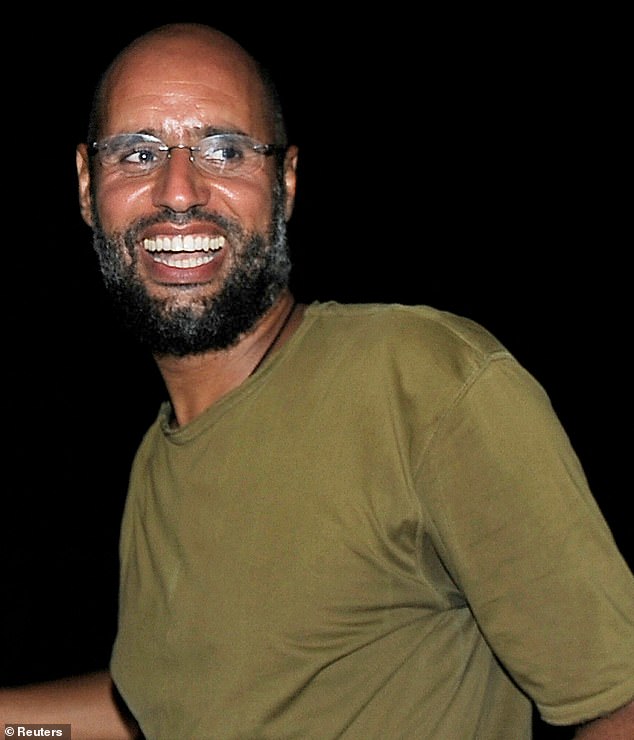
Saif al-Islam, the son of Libyan leader Muammar Gaddafi, has been murdered in Libya. He is pictured here in 2011
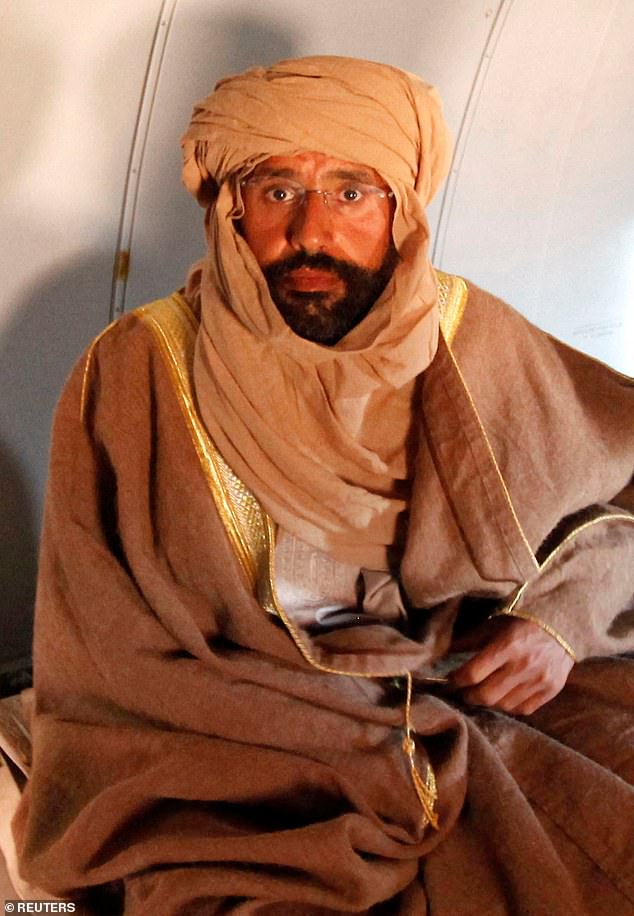
Following the assassination of his father, Muammar Gaddafi, in 2011, Saif al-Islam was seen as the most powerful figure in the oil-rich North African country
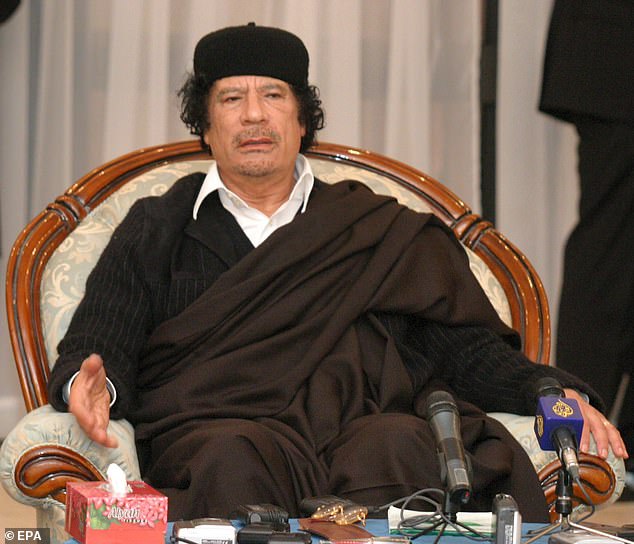
Pictured: Muammar Gadaffi as he talks about African affairs during the signing of a treaty of reconciliation between Chad and Libya in Tripoli in 2006
Saif Al-Islam called himself ‘a reformer’, and campaigned for a Libyan constitution and respect for human rights.
This was before British and French planes were among a force that bombed Libya during the Arab Spring of 2011, ensuring the end of Colonel Gaddafi’s dictatorship.
After rebels took over Tripoli, Saif al-Islam fled to neighbouring Niger dressed as a Bedouin tribesman.
The Abu Bakr Sadik Brigade militia captured him on a desert road and flew him to the western town of Zintan about one month after his father was hunted down and killed.
Saif al-Islam was helped in prison, and in 2015 sentenced to death for war crimes by a Tripoli court.
He was also wanted by the International Criminal Court (ICC) at The Hague for such crimes.
The ‘reformer’ went underground in Zintan to avoid assassination after he was released by militiamen in 2017 under an amnesty law.
Saif Al-Islam then travelled to the southern city of Sabha in 2021 to file his candidacy for the presidential elections.
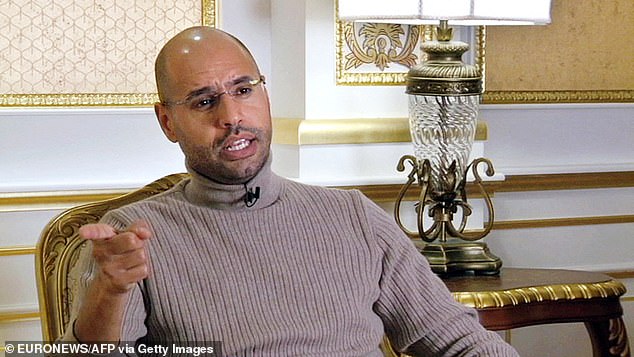
Saif Al-Islam called himself ‘a reformer’, and campaigned for a Libyan constitution and respect for human rights
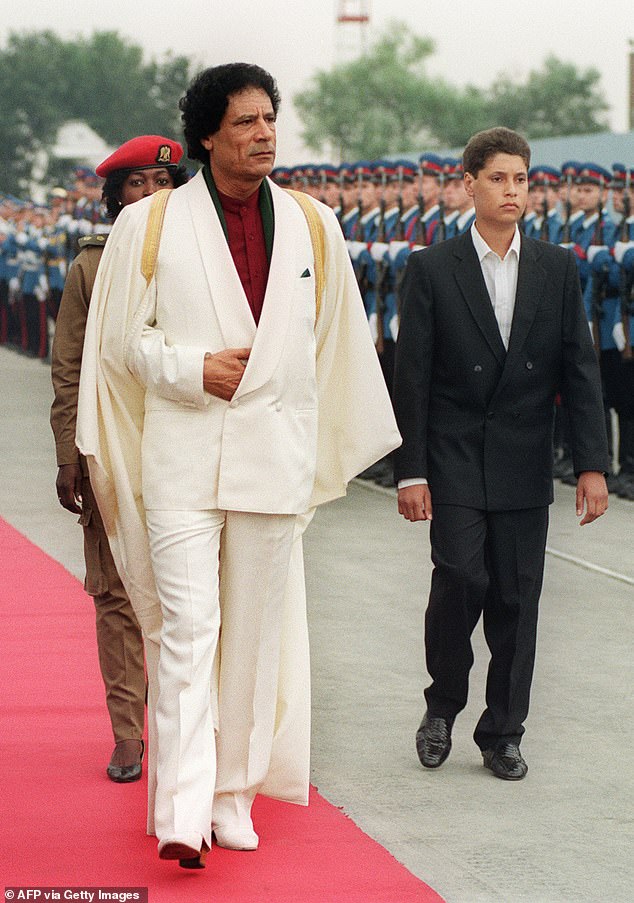
Father and son in 1989
But his candidacy was hugely controversial, and opposed by many enemies of the Gaddafi family in a Libya that had become a basket case.
There were numerous unconfirmed rumours about Saif Al-Islam’s personal life, including one that he had married and had a daughter.