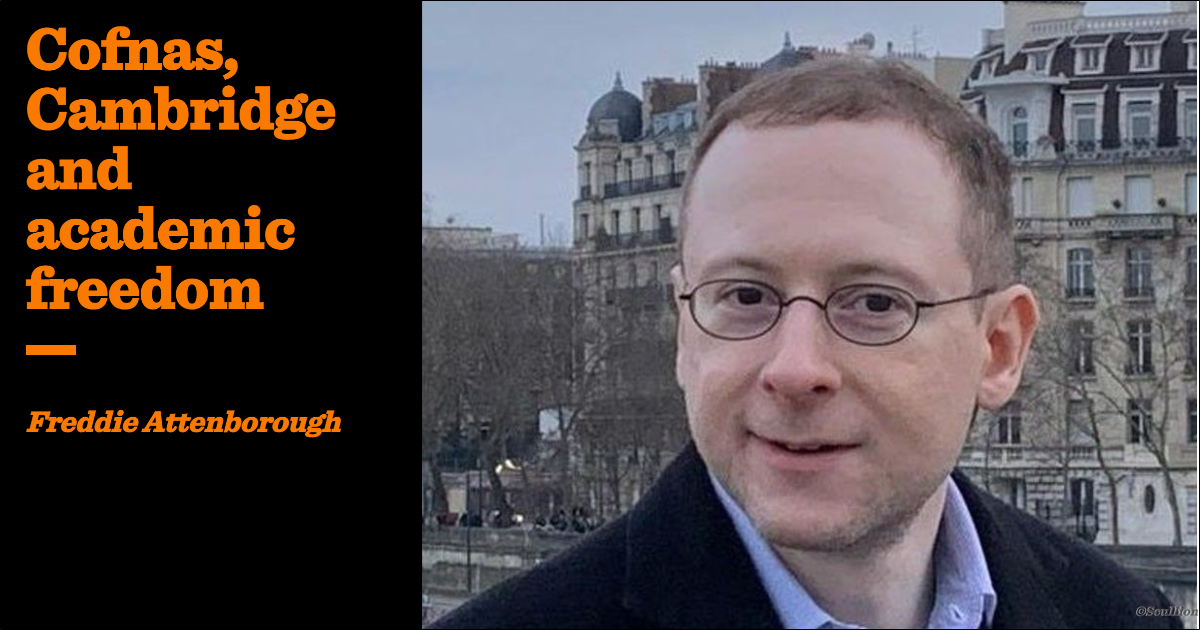
In one of the most closely watched campus free speech cases in recent years, the County Court has delivered a mixed verdict on a claim brought by Cambridge academic Dr Nathan Cofnas, confirming that “anti-woke” beliefs can qualify as protected philosophical beliefs under the Equality Act while also affirming universities’ wide discretion to act when their expression is deemed “harmful”.
That tension — between tolerance of controversial beliefs on campus and institutional control over how they are expressed — lies at the heart of the ruling in Cofnas v Emmanuel College, Cambridge. It is also why Cofnas lost, and why the judgment raises difficult questions about whether the Equality Act is an adequate vehicle for employment claims in which what is really at stake is academic freedom.
The controversy began in February 2024, when Cofnas — then a post-doctoral researcher in Cambridge’s Faculty of Philosophy and a College Research Associate (CRA) at Emmanuel — published a blog post titled A Guide for the Hereditarian Revolution. In it, he argued that “any realistic path to victory over wokeism requires widespread acceptance of hereditarianism among the elites”. There’s rather a lot to unpack there, of course, but the basic contrast is simple enough. Faced with disparities in socioeconomic outcomes between groups, the “woke” look to environmental causes — above all, “white racism” — before embarking on an all-consuming crusade to root out invisible discrimination and unconscious bias. Hereditarians, by contrast, hold that at least some of those differences reflect underlying genetic variation between populations.
Hence Cofnas’s claim that, under a colourblind admissions system based solely on academic qualifications, “blacks would make up 0.7% of Harvard students”, the number of black professors “would approach 0%” and “[b]lacks would disappear from almost all high-profile positions outside of sports and entertainment”.
Elsewhere in the blog, this perspective leads Cofnas to sound much as you might expect ChatGPT to sound if prompted to articulate the Republican Southern Strategy in the style of Richard Nixon addressing a campaign rally in Alabama circa 1968. “Whites are the ones who brought blacks out of Africa and created the conditions where they failed to develop a culture of homework, respect for the law, and strong nuclear families”, he declares, before warning that “we’ll need to take increasingly extreme measures to fix the ‘culture’ that produces bad outcomes in certain groups”.
The post triggered an immediate backlash within and beyond Emmanuel, particularly among black students, many of whom said it made them feel belittled, unwelcome, and as though their place at Cambridge would be seen as unmerited. In early exchanges with Emmanuel’s Master, Doug Chalmers, Cofnas stressed that the blog was about the US, not Britain, but that distinction did little to calm the reaction in a college with both British and American students. As one complainant put it: “As a Black student at Emma (more specifically, a Harvard-educated American Black student, which is the group [Cofnas] targets specifically in his meritocracy statement), I’m disturbed that this person is affiliated with our College.”
Publicly, Chalmers struck a careful note, stressing the College’s commitment to freedom of thought and expression while also emphasising the right of all members to be “treated with dignity and respect” in a “safe, welcoming and inclusive community”. But as complaints mounted, and after meetings with students who said they found the term “blacks” derogatory and dehumanising and the overall tone of the blog “threatening”, the College’s position hardened.
The affair then took an uglier turn. On 18 February, ROAR, a student magazine, carried a piece by a student under the heading: “The Rs in ROAR stand for Racial Equalities”. Apropos of nothing, the article suggested Cofnas was in a homosexual relationship, and went on to claim that he was setting up the “Emma Skinhead Society”, where “he would ‘scientifically prove’ in his ‘research’ that ‘in a meritocracy all black friendship groups at Emmanuel… will be replaced by skinhead gangs’”. It concluded: “I for one am proud of Nathan for graduating from Victorian-era racism to 1960s racism. Progress is progress, lads.”
What later mattered in the proceedings was that the student had sent the draft to Chalmers in advance, asking whether he had “any issues” with what he’d written. It’s difficult to believe anyone could rise to a position of real pre-eminence within Cambridge’s collegiate system without also being capable of immediately spotting at least a dozen elementary defects of narrative coherence, style, tonal discipline and comic timing. But even allowing for a certain tactfulness on the Master’s part when touching on questions liable to wound the literary ambitions of a student author in possession of prose that — to borrow a phrase beloved of boxers when describing a rival’s recent performance — so obviously “stunk the place out”, what about the College’s Culture of Respect policy, binding on all members, which states that “belittling, derogatory, humiliating, or inappropriate language” has “no place here”? Quite apart from its historical incoherence, doesn’t likening a fellow member of the College, in print, to a gay neo-Nazi on the basis of something perfectly lawful he had written create one or two “issues”?
In the event, however, Chalmers replied that the writer had done a “superb job” in satirising the affair, added that this was “exactly what ROAR was for”, and thanked him for “taking it on”. At trial, he accepted that parts of the article were “on the line, if not over the line”, and agreed that the skinheads line was “disgraceful” and should have been checked more carefully.
Perhaps unsurprisingly, the ROAR article was followed by threats from several students. On 21 February, Cofnas sent two senior academics screenshots from a group chat in which one student suggested he could be found at the College “for anyone who wants to idk maybe drive by to fuck him up”. Another group member helpfully advised that students wear ski masks when they “jumped him” and “beat the shit out of him”, while a third referred to plans to hang flyers bearing his image around Sidgwick Avenue, home to the Philosophy Faculty — plans later carried out. Cofnas was advised to avoid Sidgwick, and ultimately withdrew from all contact with students.
By early March, Emmanuel had moved from informal reassurance to formal process, suspending Cofnas’s College privileges and referring the case to the Fellowship Committee. On 8 March, Chalmers wrote to him setting out the complaints and inviting representations. Cofnas replied on 15 March. The Committee met on 25 March and concluded that he had written in a “careless” and “reckless” manner, adopting a “confrontational and aggressive” tone and style. Emmanuel terminated his College Research Associate status on 2 July 2024.
The College’s position never fully aligned with that of the University. Whereas Emmanuel came to treat the affair as one of “harm” to its own community, the University later concluded that Cofnas’s published views did not breach the law or its own free-speech rules.
That’s why Cofnas brought a claim against Emmanuel, arguing that it had discriminated against him on the grounds of his beliefs. But because Emmanuel wasn’t his employer, his legal team first had to bring the College within the scope of the Act, arguing that it qualified as an “association” under section 107(2), so that its dealings with members and affiliated researchers were subject to it.
His case was that several of the beliefs pleaded in the litigation, including the “anti-woke belief” and the “hereditarianism belief”, were protected philosophical beliefs within section 10(2) of the Equality Act, and that the termination of his CRA status amounted to less favourable treatment because of those beliefs, contrary to section 13.
In court, hereditarianism was defined as the view that genes play a “non-trivial role” in group differences, and should be researched and discussed even if controversial. The related “anti-woke belief” was the view that hereditarianism needed to be promoted because it undermines a core premise of “woke” ideology, namely that disparities favouring whites are to be explained by white racism rather than by genetic differences between groups.
During the hearing, Cofnas’s legal team suggested it was an “inescapable conclusion” that he had been treated less favourably, and that the attempt to “thread the College’s conduct through the needle of manifestation” — in other words, to recast the decision as a response not to his beliefs but to the way he had expressed them — could not succeed in light of the written and oral evidence of Chalmers and other senior members of the College.
They pointed, in particular, to the way his views were described as “pseudoscientific”, “Victorian”, and a “false narrative”. The “negative attitude” held by the College could also be seen in its response to those opposing Cofnas: the initial reaction to the ROAR article was to treat it as “superb”, while a College student who had, in effect, incited violence against him was dealt with merely via a “reflective conversation” with a College tutor.
Emmanuel’s answer was that the problem lay not in Cofnas’s beliefs as such, but in the manner they had been expressed. The tone and style of the blog, it said, had created a “hostile, intimidating, unwelcoming and degrading environment for members of the College”. There was therefore no animus on the part of Chalmers or anyone else. The Master was dealing with what the College described as a “crisis in the student community”, and his role was to “support that community and bring it back together again”. Nor, Emmanuel argued, did Chalmers’s response to the ROAR article prove hostility to Cofnas’s beliefs. It was, the College insisted, “a reaction (since regretted) to a poorly written student magazine in which humour was used as a way of dealing with very real hurt”.
In one important respect, Cofnas’s case succeeded. Both hereditarianism and “anti-woke” belief could, “with some reservation”, qualify as protected philosophical beliefs. But that wasn’t enough to win the case, since the central question was whether Cofnas had been treated less favourably because of those beliefs. On that issue, the judge accepted Emmanuel’s case. The College, he held, had not been animated “solely or predominantly” by hostility towards Cofnas’s views. Nor did the court accept that Emmanuel’s handling of the ROAR article, or of the threats made against Cofnas, demonstrated the requisite animus.
Ultimately, the case turned on a distinction, already implicit in the parties’ arguments, that has become increasingly important in recent free speech litigation. Following Higgs v Farmor’s School, the question was whether Emmanuel had objected to Cofnas’s beliefs themselves, or to the way he had expressed them and, if the latter, whether its response was proportionate. As the judge put it, there is “no material difference” between the Equality Act analysis and the Articles 9 and 10 analysis under the European Convention on Human Rights. In plain terms, that means questions of academic freedom are folded into a more general proportionality exercise, taking account of matters such as content, tone, reputational risk, and any power imbalance between the speaker and those affected.
On that basis, the judge accepted that the blog’s tone and style were confrontational, that its impact “was immediate and significant”, that harm and reputational damage had occurred, and that “there is necessarily a power imbalance between undergraduates and a post-doctoral researcher”. In those circumstances, the termination of Cofnas’s CRA affiliation was held to be proportionate.
For anyone concerned with academic freedom, the problem with that framework is that it treats the university less as a distinct intellectual space, in which robust engagement with controversial, cutting-edge and sometimes deeply unsettling ideas is part of the institutional function, and more as an ordinary managed environment in which speech is balanced against competing interests of the sort more familiar from everyday workplace disputes. As far as the logic of the ruling is concerned, Cofnas may as well have been a middle manager at a regional window glazing manufacturer headquartered just off the M4 near Swindon as an academic philosopher writing on his research speciality at one of the world’s oldest and most prestigious universities.
So while claimants in the higher-education sector may succeed in using the Equality Act to establish an ever-expanding range of protected philosophical beliefs, that “protection” may offer little shelter once they try to actually express them on campus. Like some giant legalistic version of Chomskian linguistics, the world according to this legislation and associated case law allows one to be competent in one’s beliefs but is far less forgiving about their performance once a court turns to questions of tone, style, and that great incontestable of our age – perceived “harm”.
All of which leads to a slightly unsettling conclusion: so long as this remains the principal route for academics challenging speech-based sanctions, the beliefs most likely to survive unscathed are not those that are genuinely challenging or capable of awakening others from their dogmatic slumber, but those most easily rendered in the anodyne idiom of the professional-managerial class or the moralising slogans of the campus majority.