George H.W. Bush, trying to discredit then-Massachusetts Gov. Michael Dukakis in the 1988 presidential race, christened Boston Harbor as the “dirtiest harbor in America.”
The unsavory title stuck. By the time Mr. Bush delivered his rebuke from a boat in the harbor, Americans nationwide already knew the waterway for its filth. It had, in 1966, inspired the hit song “Dirty Water” by The Standells. In 1989, Boston was pumping some 480 million gallons of raw sewage into the harbor daily. Mr. Bush, then the vice president, gave the harbor another nickname during the campaign: “The Harbor of Shame.”
“It was embarrassing,” says Jim Costin, a longtime resident of Winthrop, which sits on the harbor. He also owns Belle Isle Seafood, a local eatery.
Why We Wrote This
Boston is joining the list of cities that are achieving results after sustained harbor cleanup efforts. Some towns will soon see the return of recreational shellfishing, a New England tradition.
As of January, Mr. Costin and others can take pride in the harbor.
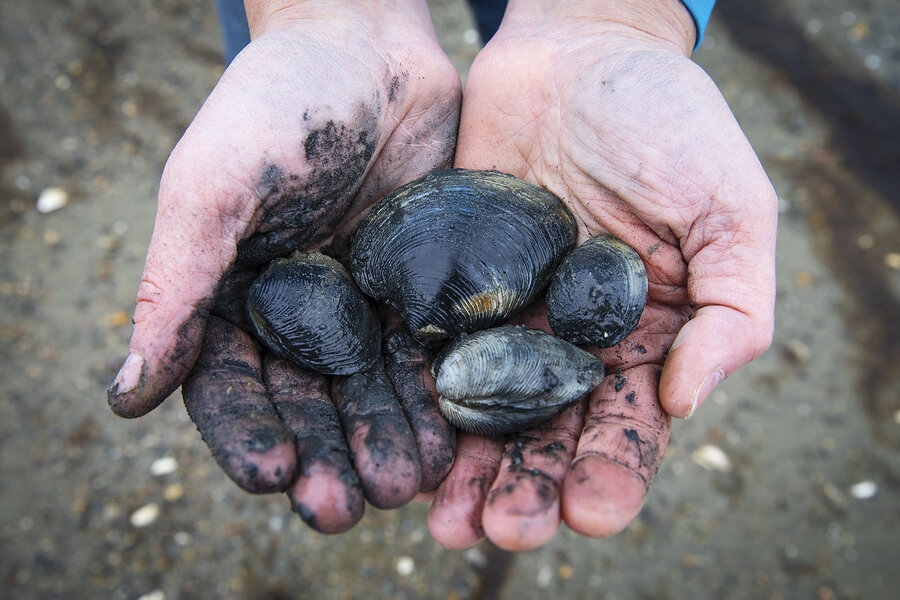
The Massachusetts Division of Marine Fisheries has declared parts of Boston Harbor clean enough for recreational shellfishing for the first time in a century. Since many shellfish are filter feeders that pump water through their gills, waterborne contaminants tend to build up in their bodies, making them bellwethers for overall water health. If the shellfish are free of pollutants, it’s a sign the water is cleaner.

Melanie Stetson Freeman/Staff
Shellfishing will soon be allowed in some areas off the coasts of Winthrop, just northeast of the city, and in Hingham and Hull, two towns on the southern end of the harbor. Residents will have to wait for the towns to create regulations, and shellfishing might still be prohibited during times of low water quality, such as after heavy rains. Still, a region with a legendary reputation for fresh, high-quality seafood has reason to celebrate. (Try an authentic clam chowder recipe.)
“It speaks a lot to all of the hard work that was done to clean up the harbor, to make quality of life [better] for not only the people that live here, but also the marine life,” says Joanne Coletta-Levine, a spokesperson for Schooner’s, a seafood restaurant in Hull.
Cities and states across the country have worked to clean up waterways since 1972, when the Clean Water Act made it illegal to discharge pollution into water without a federal permit. Between 1972 and 2001, the share of U.S. waterways clean enough for fishing increased by more than 10 percentage points, according to a 2018 study in the Quarterly Journal of Economics that analyzed some 50 million water samples.

Melanie Stetson Freeman/Staff
The act also provided cities with billions of dollars to build or improve water treatment facilities. Cities such as Portland, Oregon; New York; and Baltimore have also seen success cleaning up their harbors.
Yet the level of triumph has varied, says Brad Campbell, president of the Conservation Law Foundation in Boston. Though Massachusetts invested billions into cleaning up the harbor, other municipalities have struggled to take care of toxic waste from industrial facilities. Many cities – Boston included – still face challenges from sewage pollution that flows into waterways during storms. Nevertheless, Mr. Campbell says Boston stands out.
“With the cleanup, it’s become an enormously attractive place for people to live, work, and play,” he says.
Decades of work on the harbor
Massachusetts all but banned shellfishing in Boston Harbor in 1925, amid growing nationwide concerns about the safety of oysters. The state limited shellfishing there to specially licensed commercial harvesters. The shellfish had to be purified at a plant in Newburyport, about 40 miles north of Boston, before they could be safely eaten.
For clean-harbor advocates, it’s taken decades to get from that point to cleaner waters. Three lawsuits in the early 1980s attempted to force the Metropolitan District Commission, a state agency that managed water supply and sewage in Boston, to clean up the harbor. At the time, two MDC water treatment plants were dumping some 350 million gallons of minimally treated wastewater into the harbor each day, according to a 2018 study by University of Massachusetts Boston and Woods Hole Oceanographic Institution.
In 1985, U.S. District Judge A. David Mazzone ordered that the Massachusetts Water Resources Authority, which replaced the MDC in 1984, build a new water treatment facility. Since then, the MWRA has spent about $6.6 billion cleansing the harbor, says Stephen Estes-Smargiassi, the agency’s director of planning and sustainability. He has been working on the cleanup for nearly 40 years.
The resource authority’s spending includes opening a new treatment plant on Deer Island near Winthrop, cleaning up urban beaches, and building a pipe system to funnel treated wastewater to the ocean where it can be diluted. While other municipalities funded new or upgraded treatment plants with federal grants, the Deer Island plant largely used money from consumers’ water and sewer bills.
The plant on Deer Island now treats about 365 million gallons of wastewater daily. In contrast to prior treatment plants, all of its discharges are treated to legal standards.

Melanie Stetson Freeman/Staff
Challenges remain, says Chris Mancini, executive director at Save the Harbor/Save the Bay, which has advocated harbor cleanup since the 1980s. Like many older cities, Boston uses a combined sewage overflow system, meaning that wastewater and stormwater collect into one pipe. Normally, this water safely flows to a treatment plant. But heavy rains can overwhelm the system and cause untreated water to flow into nearby waterways.
Still, the cleanup has reduced such overflows and led to quality of life improvements – such as making the harbor swimmable. It has also spurred economic growth, says Emilly Schutt, a staff scientist at Save the Harbor/Save the Bay.
“This is a working waterfront,” she says. “People are making their livelihood being on the water, and so having a clean system for them to do that is providing jobs.”
A return to local seafood
And, now, the cleanup has revived the age-old New England tradition of digging up your own seafood.
“It’s good news for the residents of the town, and also for residents of the commonwealth,” says Kurt Bornheim, Hull’s harbormaster. “This is going to open up a lot of opportunities.”
Harbormasters such as Mr. Bornheim enforce marine laws, manage boat passage, and maintain water infrastructure like docks. They’re primarily responsible for designing a web of rules to regulate shellfishing in their communities. For Hull, that includes developing a permitting process and hiring an additional employee to help patrol the beach.

Melanie Stetson Freeman/Staff
Mr. Bornheim, who has served as Hull’s harbormaster for nearly three decades, is taking the new challenge in stride. He has enrolled in classes at Cape Cod Community College to renew his certification as a shellfish constable, municipal officers charged with enforcing shellfish regulations. Mr. Bornheim says the primary catch for Hull’s recreational shellfishers will be softshell and surf clams – though he hopes residents will soon be able to cultivate oysters, too.
Hull residents might soon be able to enjoy those same clams in local restaurants. Ms. Coletta-Levine, the spokesperson for Schooner’s, says the restaurant is looking forward to serving more local catch.
“We’d love to support our local economy and the people that live here,” she says. “What’s not to get excited about local, fresh seafood?”
Mr. Costin, the owner of Belle Isle Seafood in Winthrop, doesn’t anticipate the announcement changing how he runs his business. He already sources many clams locally – though, for now, they are treated at a purification plant. Yet, as a Winthrop native, he is excited to see the harbor cleaner than it was when he began working at Belle Isle as a teenager.
Back then, the waters of the harbor were brown, polluted by sewage, and fishless, he says. Mr. Costin envied those living on Cape Cod, who had long waded into the waters of the Atlantic to dig up their own dinner.
Now, he says, his Winthrop neighbors can do the same.