Europe on the Edge (BBC)
When mother-of-three Maria Chindamo told her husband Nando that she wanted a divorce, she sealed both her own fate and his.
Unable to cope with the separation, Nando killed himself in 2015.
Neighbours and his relations in their remote part of Calabria, in the toe of Italy, began putting pressure on Maria to quit her farm.
When she refused, she was killed — her body fed to a herd of pigs and her bones crushed under the caterpillar tracks of a digger.
Her complete obliteration, leaving her family with no grave, is an ancient punishment called lupara rosa, a grim tradition of the local ‘Ndrangheta crime gangs.
The only trace remaining was the blood and hair smeared inside her car, left with its engine running and the radio still playing, Maria’s brother Vincenzo told reporter Katya Adler, in the opening instalment of her three-part documentary Europe On The Edge.
The story is horrific, and one that Adler investigated with thoroughness and sensitivity.
But it struck an oddly macabre note in a round-up that included a tour of a Murano glass factory and a visit to Siena to enjoy the build-up to the historic Palio horse races.
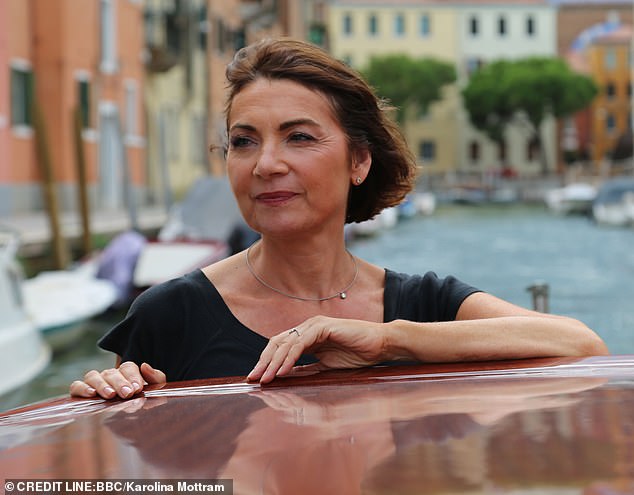
BBC’s Europe editor Katya Adler pictured in her three-part documentary Europe On The Edge
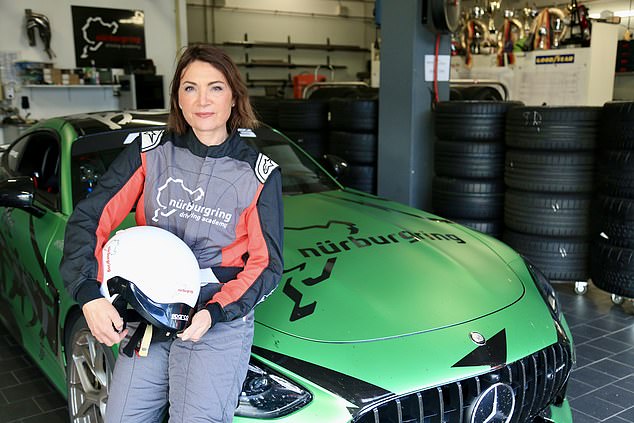
In her latest series for BBC Two, Katya Adler travels around Italy, France, Spain and Germany
Though a theme of political tensions ran through most of the segments, this was a disjointed collection of reports that veered from travelogue to economics and crime to eccentrics.
In Germany, Adler took a ride in a 150mph sports car around the former F1 circuit at the Nurburgring, to illustrate how this part of the world has a renowned motor industry.
Once we’d had a chance to absorb that insight, she went on to explain: ‘Of course, they’re not all race cars.’
Apparently, the Germans also build family vehicles.
To prove it, she took us to the Volkswagen plant in Wolfsburg, and stood inside a vast tower with a multi-storey lift for stacking cars.
Global competition and the impact of U.S. tariffs have undermined Germany’s economy, Adler said, to the point where its roads are crumbling and its mobile phone coverage is unreliable.
Exactly like the UK, then.
Outside Munich, she met a man named Klaus who is building a house for his family, with a nuclear bunker in the basement.
With its own electricity generator and air purifier, a stockpile of food and water, and an iron blast door as thick as a castle wall, the bunker can hold out against Russian attack for up to three months.
To make it more homely, Klaus plans to put ‘a nice panorama of the sea and forests’ on one wall.
Adler accepted his explanation at face value that Munich ‘is a strategic attack point’ and ‘it is easy for things to escalate’.
How he expects to live in a nuclear wasteland, when he emerges after three months, we didn’t hear.
More to the point, Adler also forgot to ask what Mrs Klaus thinks about all this.