Amadeus (Sky Atlantic)
The formula for Amadeus, airing nightly till Christmas, is simple: take the multiple Oscar-winning 1984 movie of the same name as a template and turn every dial up to 11. This version is louder, cruder, gorier, angrier, flashier and raunchier.
But that doesn’t necessarily make it better. Its most vulgar moments seem an outright desecration of Wolfgang Amadeus Mozart’s sublime music.
Our first glimpse of the composer comes as he staggers out of a carriage and vomits in front of his landlady and her daughters.
Later, we see his arch-rival Antonio Salieri (played by Paul Bettany), alone at his harpsichord, pleasuring himself.
And then there’s the scene in which Mozart does something unmentionable with a strawberry. Put it this way: any food hygiene inspector is going to be appalled.
The original movie was also criticised for its coarseness. Screenwriter Peter Shaffer, who based the film on his 1979 stage play, insisted that Mozart was notorious for his puerile sense of humour and his sexual appetite.
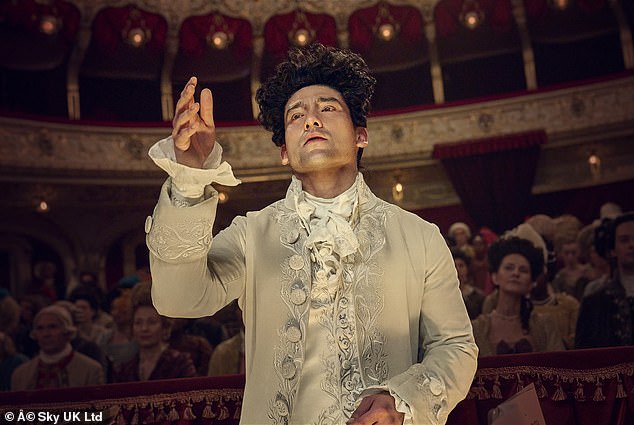
WIll Sharpe With his wild black hair, he looks nothing like the conventional image of the powder-pale, blue-eyed Wolfgang
He loved to shock Viennese aristos with scatological jokes, and his breeches were up and down like a conductor’s baton.
Today’s viewers are less easily outraged than Hapsburg courtiers, but we’re also less eager to be impressed by musical genius. Will Sharpe, who plays Mozart, cannot rely on winning our admiration and sympathy simply because his music has been revered for more than two centuries.
Come to that, are we even supposed to appreciate Mozart these days? Radio 3 seems more interested in broadcasting Gambian kora music and Soweto jazz.
Mozart represents much of what the current fad for ‘decolonising the curriculum’ despises. He was white, male, the nepo-baby son of a successful composer, and his patron was the emperor.
Perhaps this was a consideration in casting Will Sharpe, whose mother is Japanese. With his wild black hair, he looks nothing like the conventional image of the powder-pale, blue-eyed Wolfgang.
But Sharpe, a writer and Bafta-winning actor, does not naturally exude a playboy recklessness. When we see him fall down the stairs with a bottle in his hand, it’s obvious that he’s acting drunk, not actually plastered.
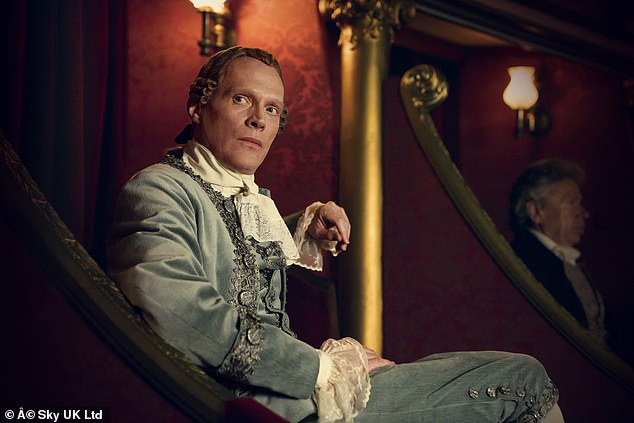
Mozart’s arch-rival Antonio Salieri (played by Paul Bettany) is the real focus of Amadeus – his envy, malice and cruelty turn the story from broad farce to tragedy
And he’s prone to overplaying the outward signs of genius. When inspiration strikes, at the dinner table or in church, and his head fills with music, Sharpe adopts a daft grin and his eyes dance around like a child watching fireworks.
When the original movie was being cast, Kenneth Branagh, Mark Hamill (aka Luke Skywalker) and even David Bowie were among those considered for the role.
Eventually, Mozart was played by Tom Hulce, best-known till then for the college-boy comedy Animal House.
Hulce was convincingly manic, immature, sex-obsessed and infuriating. He was nominated for a Best Actor Oscar – and lost out to his co-star F. Murray Abraham as the murderous court composer Antonio Salieri.
It’s Salieri who is the real focus of Amadeus – his envy, his malice, his cruelty turn the story from broad farce to tragedy. It begins with his failed suicide attempt as an old man, before he embarks on a long confession of how he set out to ruin and destroy his brilliant rival.
Bettany achieves what Abraham never intended: he makes us feel sorry for Salieri.
This second-rate composer and court flunkey is pathetic, but he’s well aware of it and that makes his machinations forgivable. At first, he’s in awe of Mozart’s musical brilliance, and tries to overlook the spoilt brat’s arrogance and rudeness.
It’s only when he realises that he is being personally mocked that he hatches a plan for vengeance. Even then, his eyes are full of pain and self-pity, not wickedness.
Shaffer’s dialogue is filled with lines that still scintillate, almost half a century on.
This version is faithful to his mischievous wit. Constanza, one of the daughters of Mozart’s landlady, warns what will happen if they can’t pay the rent: ‘I will have to sell my things and prostitute my sisters. And I really like my things.’
In Shaffer’s wonderful phrase, Salieri is ‘the patron saint of mediocrity’.
It’s his mediocrity, not Mozart’s genius, that holds our attention in this Amadeus. And in the 2020s, when we’re meant to be ashamed of everything our brilliant imperial ancestors created, that’s very apt.