They all stared into the cameras and begged for their missing loved ones to come home.
Some sobbed, some furrowed their brows, some choked over their words.
All were later convicted of their loved ones’ murders.
It’s a disturbing, though not rare, spectacle for killers to parade in front of the cameras, hold press conferences and TV interviews, and put on what they believe is a foolproof show of grief and concern following the disappearance of the family member they have just murdered.
But, to top experts in body language and behavioral analysis, the show is far from convincing.
Instead, these TV appearances shine a spotlight on unusual behaviors or cues – including mismatches in verbal and non-verbal cues, excessive self-soothing behaviors, and inappropriate stress responses – and reveal that all is not what it seems.
The Daily Mail asked three leading experts in body language and behavioral analysis to analyze the public appeals and TV appearances made by some of America’s most infamous killers and suspects.
Here’s what they noticed:
Chris Watts

Chris Watts played the grieving husband after murdering his pregnant wife Shannan and their two children

Chris Watts on the porch of the family home where he played the concerned husband and father
In August 2018, Chris Watts played the role of worried husband and father when his pregnant wife Shanann and their daughters Bella, four, and Celeste, three, disappeared in Frederick, Colorado.
He gave several TV interviews pleading for their return.
But his story quickly unraveled.
Days later, Watts confessed to murdering his family, leading police to an oil field where he had buried Shanann in a shallow grave and dumped their children’s bodies in tanks. Watts was having an affair at the time of the murders and wanted to start a new life with his lover.
Scott Rouse, behavior analyst, body language expert and host of The Behavior Panel, told the Daily Mail he noticed multiple cues during one TV interview on the porch of Watts’s home.
When Watts crosses his arms and sways back and forth, he is showing what is known as adapting – an attempt to get rid of built-up stress and tension.
There’s also a mismatch in behavior with Watts appearing calm, with a flat affect when talking about his missing family.
At one point, Watts even smiles and laughs.
‘This is known as Duper’s Delight. When someone is being deceptive and believes they are getting away with it, that micro-expression of pleasure will leak out,’ Rouse said.
Often, Rouse said the cues are more about what’s missing than what is present because people struggle to fake natural human expressions.

Another moment also raised a red flag: Watts learned that a neighbor’s security footage contradicted his story about the day his family went missing. Watts then covered his head – an innate, primitive response when someone feels threatened
For example, when someone is grieving, the grief muscle in the brow forms an upside down shape. ‘It doesn’t form at all here,’ Rouse said of Watts.
‘From a neurological perspective, when you’re really grieving, the sides of your mouth will also come down, your chin comes up like a little child’s – it’s called the chin boss. You can do that by yourself, but it doesn’t look the way it’s supposed to – it’s not as dominant or as deep. They’re a little thin. That’s how you know somebody’s faking that.’
Killers like Watts pull expressions that they believe show sadness and grief but fall short because ‘they don’t understand the way emotions affect facial expressions or behavior,’ he said.
Joe Navarro, former FBI agent, founding member of the bureau’s National Security Behavioral Assessment Program and author of ‘What Every BODY is Saying’, also noticed the absence of chin dimpling in Watts’s appearances.
Watts did however show lip compression and heavy eyelids – behaviors associated with psychological discomfort. But what is important is when that appeared.
‘It was when he was asked a question about ‘when was the last time you saw your wife?’ which could be a problem,’ he said.
Another moment also raised a red flag: Watts learned that a neighbor’s security footage contradicted his story about the day his family went missing.
‘He turns away from the information. An honest person would physically get closer to that information but he turns away from it,’ Navarro said.
Watts then covered his head. That, Navarro explained, is an innate, primitive response developed in humans thousands of years ago when someone feels threatened. ‘It indicates he thinks that footage is a threat to his life.’
Scott Peterson

Scott Peterson murdered his pregnant wife Laci Peterson and their unborn son Conner in 2004
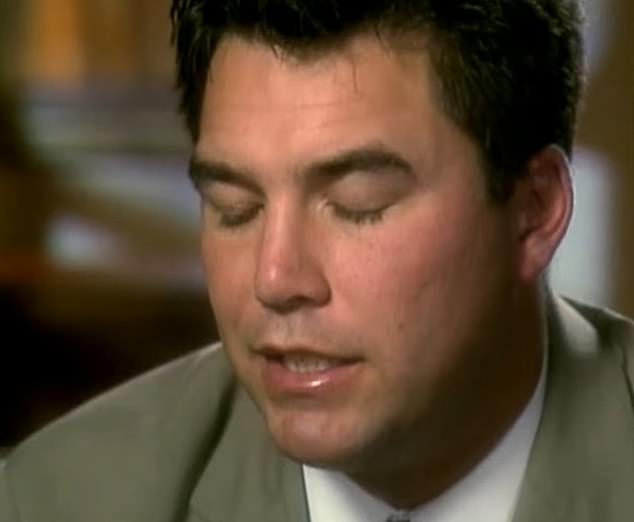
Before his arrest, he appeared on TV. Body language experts have revealed the clues in his TV appearances that raised red flags
It was Christmas Eve 2002 when eight months pregnant Laci Peterson disappeared from Modesto, California, where she lived with her husband Scott Peterson.
For some time, Scott avoided the media while Laci’s other family and friends made public appeals for help.
As suspicion mounted, Peterson finally sat down with the cameras.
Dr. Abbie Maroño, an author and behavioral scientist who trains federal agents in behavioral analysis, said the element of control was key for Peterson, ‘because he didn’t get involved publicly until his reputation was on the line.’
When he finally appeared on TV, he was ‘very calm, composed, measured and emotionally contained.’
‘During really high-pressure moments, you would expect someone who is suffering to allow emotions to slip out because it’s very difficult to control your behaviors when you’re grieving. But he was very emotionally contained. He had a very calm, flat affect,’ she said. ‘It contrasts very sharply with what we would expect from someone whose wife and unborn child are missing.’
Peterson also focused on himself, she added, speaking about his reputation rather than what his wife could be enduring.
In one interview, there was a moment when Peterson’s phone rang and he quickly turned it off.


Scott Rouse, behavior analyst, body language expert and host of The Behavior Panel, and Dr. Abbie Maroño, an author and behavioral scientist who trains federal agents in behavioral analysis weigh in on the cases
At the time, Laci was still missing and he was supposedly waiting for news about her whereabouts.
Those actions, Maroño said, are a mismatch between the words and feelings.
‘It is not what you would expect from someone frantically searching for their loved one. It’s a slip of behavior,’ she said.
Peterson was convicted of murdering Laci and their unborn son. He continues to appeal his conviction and claim his innocence.
Susan Smith
It was October 1994 when Susan Smith claimed she was carjacked by a man who drove off with her two sons Michael, three, and Alex, one.
Tearful press conferences and media appearances followed. The nation was gripped and horrified.
Rouse remembers watching Smith’s TV interviews and press conferences in real time – and instantly believing she was lying.
‘All of us analysts were calling each other and saying: “I think she did it”,’ he said.

Susan Smith gives a tearful press conference pleading for the return of her two sons

In October 1994, Susan Smith drowned her two sons Michael, three, and Alex, one, in a lake
The cues that stood out to him was the lack of the grief muscles, lack of engagement in the brows, as well as a verbal slip where she referred to her children in the past tense.
Maroño also found Smith’s performance showed overacting and a mismatch between the emotion and her expressions.
‘She does appear emotional and tearful and distraught. But it isn’t natural. We tend to switch between different facial expressions very quickly. If you’re trying to fake a facial expression, you hold it too long,’ she said.
‘It felt very artificial – like she was playing a role.’
It was all a lie. Smith had rolled her car into a lake to drown her children.
She confessed and was sentenced to life in prison. She will be eligible for her second parole hearing in November.