The way grizzled rocker Chris Rea told it, Driving Home For Christmas wasn’t just a celebration of seeing his family at the end of a long journey.
It was also about an unexpected present that saved his career – and his home. No wonder it remains the ultimate radio heartwarmer for many people.
The fact that Rea, who was 74, has died in the week of Christmas is particularly poignant.
But, as he was the first to acknowledge, after four decades of serious health battles – including pancreatic cancer when he was just 33 – every day was a bonus.
His death yesterday morning was announced in a statement: ‘He passed away peacefully in hospital following a short illness, surrounded by his family.’
In his last social media message, on Sunday, he posted a photo of a motorway sign that read, ‘Driving home for Christmas with a thousand memories’, with the caption: ‘Top to toe in tailbacks.
‘If it’s a white Christmas, let’s hope the journey’s a smooth one.’
He really was driving home, with his wife Joan in the passenger seat of their Austin Mini, heading up the M1 from London’s Abbey Road studios, when the tune for his Christmas megahit occurred to him.
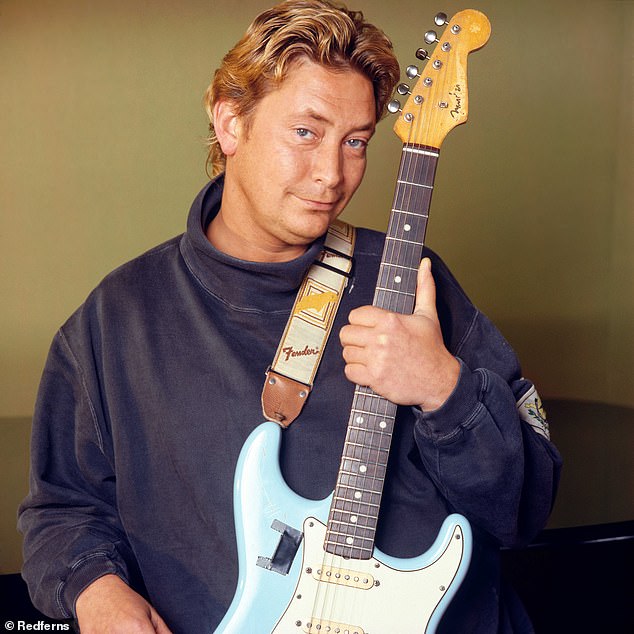
Chris Rea died at the age of 74 on Monday, his family announced in a statement
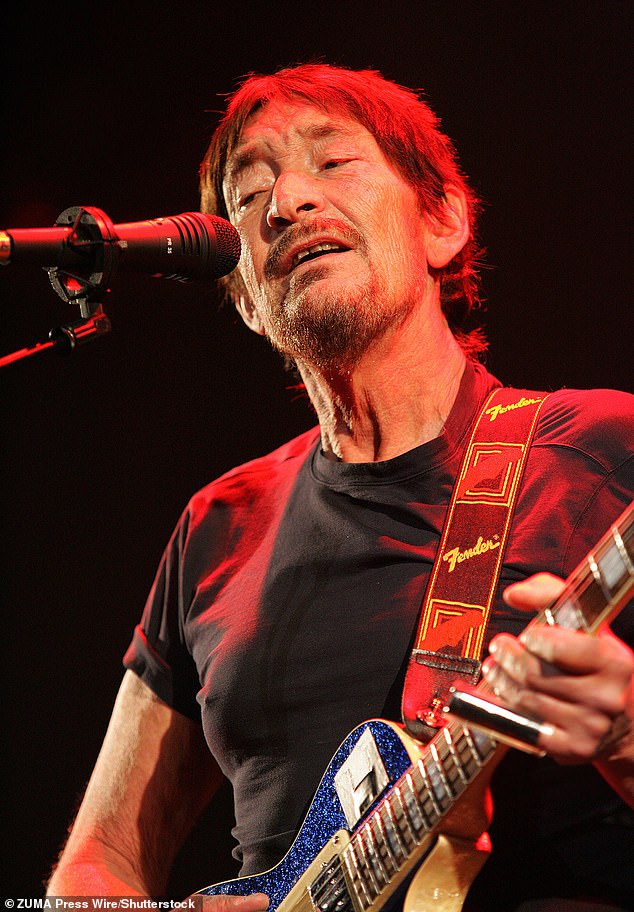
Rea suffered a major health scare during his career when he was diagnosed with pancreatic cancer at the age of 33 (He is pictured in Sheffield in 2012)
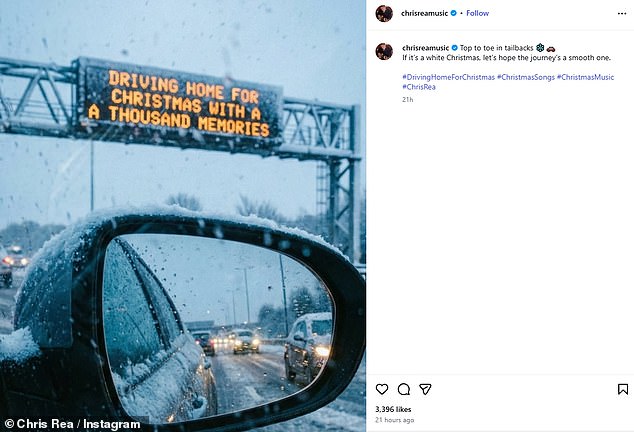
Rea’s final social media post featured a car on a snowy motorway with a road sign reading: ‘Driving home for Christmas with a thousand memories’
‘I wound the window down at the lights and wished this person next to us a happy Christmas,’ he remembered.
This was 1978 and Rea’s hopes of international success as a rock singer and musician were stuttering.
His record label didn’t know what to make of him. They’d just released his first album, and it barely scraped into the Billboard top 50 in the US.
Perhaps the title didn’t help: Whatever Happened To Benny Santini? – a sarcastic dig at the Sinatra-style crooner persona that Rea’s PR machine tried and failed to foist upon him.
Worse still, the publicists in California had the idea he was a piano player, not a blues guitarist. Rea’s friends thought this was hilarious, and dubbed him Elton Joel – a mixture of Elton John and Billy Joel.
The LP did have one strong single on it, a song he wrote called Fool (If You Think It’s Over), but it sank without trace in the UK.
Heading towards his hometown of Middlesbrough in nose-to-tail traffic that evening, Rea hummed the beginnings of his Christmassy tune to Joan. It might suit Van Morrison, he suggested. Maybe he could turn his attention to writing songs for other people.

Rea is seen at the age of 22 promoting his new single So Much Love
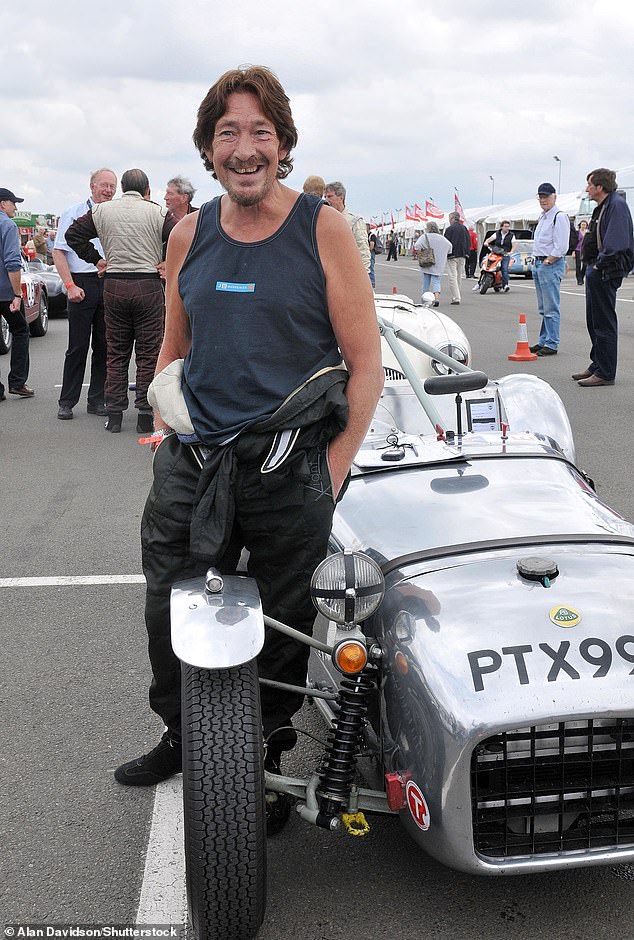
Rea is pictured with his Lotus Mk6 at Silverstone Classic Racing Festival in 2010

Rea is seen in his recording studio in 2005. His death yesterday morning was announced in a statement
And if that failed, they could always open a restaurant. But they were going to have to find some money from somewhere, because right now they couldn’t pay the mortgage.
Much later, telling the story on BBC’s The One Show, he said: ‘What I always remember is, we opened the door of the house, and the snow fell into the hall and it didn’t melt – it was that cold. And there was one letter on the floor.’ The envelope contained a royalty cheque.
Fool (If You Think It’s Over) was a hit on adult-oriented rock (AOR) stations across America and was even heading up the Billboard Hot 100 chart.
Americans didn’t care whether he was a piano player or a guitarist. They just loved his music.
That was the way he wanted it to stay. Chris Rea refused to play the fame game and bristled when journalists called him a rock star.
‘I’m not a reluctant rock star,’ he said. ‘I am not one at all. I haven’t an ounce of rock star in me.
‘What I despise about the rock-star lifestyle is the lack of music in it. The average day is spent travelling to hotels, giving interviews, being nice to people you’re told to be nice to and maybe, if you’re lucky, you might squeeze a bit of music in.’
His contempt for anyone who started believing their own pop publicity was boundless. ‘You try and get Sting to do something without 15 advisers. These boys are like Russian princes.

Rea’s breakthrough came with a pair of multi-million-selling albums in the mid-1980s
‘They’re bothered about their hair. They’re constantly having something done to their face. It’s narcissistic. I’m not.’
Born in 1951, as one of seven children, he struggled at school and was expected to make a living in his father Camillo’s ice-cream factory, though he had dreams of being a journalist. Instead of doing either, he bought a guitar.
Tuning the instrument to an open chord, like his Chicago blues heroes, he taught himself to play slide guitar by running one of his sisters’ nail varnish bottles up and down the strings.
In 1973, he joined a local band, Magdalene, whose claim to fame was that their ex-vocalist, David Coverdale, had joined Deep Purple.
He had little time for the hedonism of the rock party circuit. His only psychedelic experience, he liked to say, occurred at the age of ten, and it didn’t involve drugs – his parents took the family to Italy, which was a mindblowing explosion of colour after the drabness of the north-east.
But his loathing of the rock-star machinery did his career no favours. After the boost of that first hit, Fool, and Elkie Brooks’s cover version, a series of underperforming albums followed.
His band took to wearing T-shirts emblazoned with a photo of Rea smiling… because he was always looking grumpy.
His breakthrough came with a pair of multi-million-selling albums in the mid-1980s, On The Beach and Dancing With Strangers, plus another hit single, Let’s Dance. And then came the release of Driving Home For Christmas, eight years after he wrote it. It went triple platinum in the UK alone.
The song never grew stale, he said, even when Stacey Solomon covered it in 2011. ‘I can’t knock it. I always think, if I don’t hear Driving Home For Christmas, it means I can no longer go on holiday.’
But success was always kept in perspective by his serious health problems. In 1984, he had an operation to remove part of his pancreas after a cancer diagnosis.
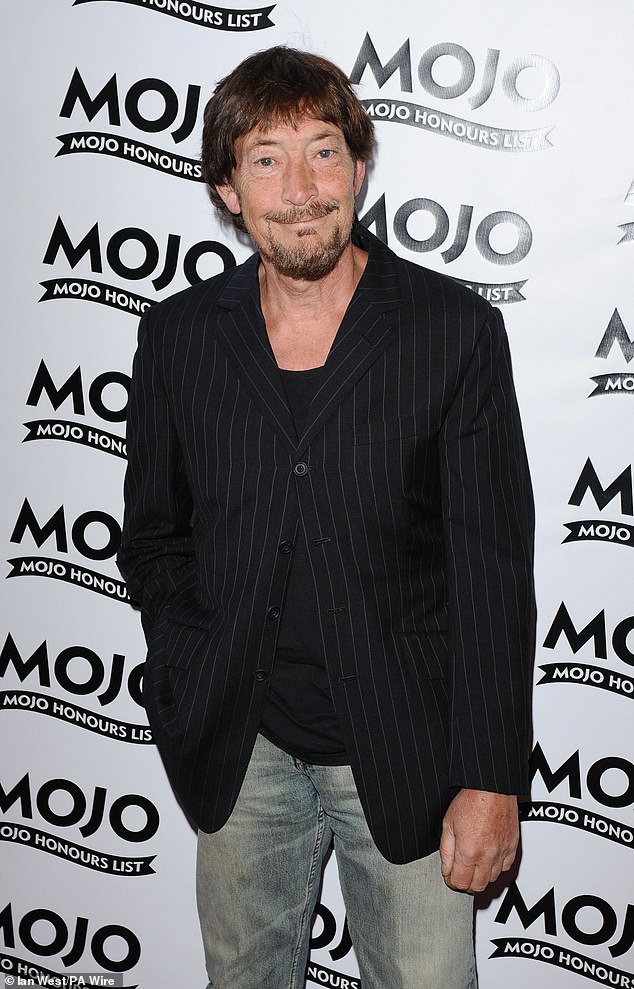
Rea is survived by his wife and two daughters (the star is pictured in 2009)

Chris Rea is seen shortly before he collapsed on stage while performing in Oxford
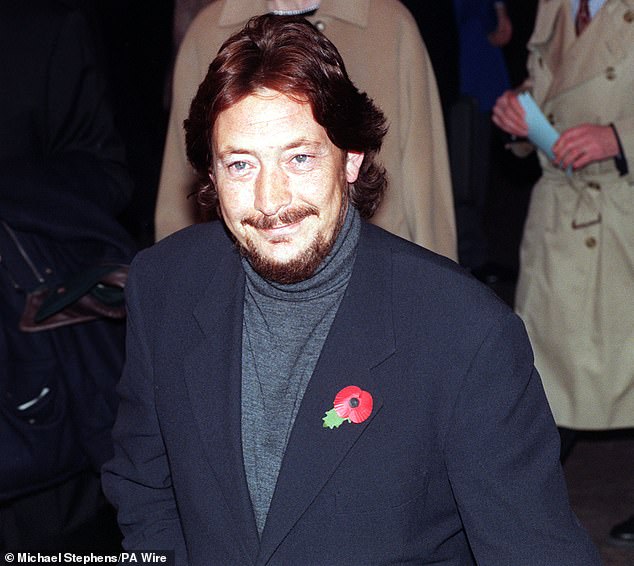
Rea arrives at the Odeon Leicester Square for the opening of the London Film Festival in 1996
This left him with lifelong diabetes, treated with seven daily insulin injections. In 2016, he had a debilitating stroke, and he also suffered further bouts of cancer throughout his life.
‘The original illness hit me hard,’ he said. ‘I almost had a nervous breakdown with the shock of it.
‘That was the Mount Everest to climb. Everything was going well in life. Then, suddenly, I didn’t feel too good after eating certain spicy foods, like curry. I began to feel tired.
‘But when they said it was pancreatic cancer, I could not believe it. They did not think I would recover from the first operation, but I was determined to do so for my wife and my girls, Josephine and Julia.’
When his record company asked him to tour America, he refused, choosing to spend the time with his family. Anyone who questioned that decision was told gruffly that he preferred growing tomatoes to touring.
Driving Home For Christmas gave him that freedom. It also enabled him to pursue his other passions, such as collecting sports cars. His daughters, he claimed, grew up thinking he was a mechanic, not a musician.
Occasionally he felt guilty about spending a fortune on Ferraris. His friend and fellow petrolhead, the Pink Floyd drummer Nick Mason, told him: ‘Stop trying to make excuses… It could have been heroin. But it’s red cars.’
Sometimes it irked him that, when he did take a high-performance supercar out on the road, he’d get stuck in traffic.
That inspired another big hit, The Road To Hell. But for most of us, when we think of Chris Rea in a car, he’ll be forever Driving Home For Christmas.