Everywhere you look on the roads today there are cars with new and unfamiliar names and badges you may not have seen before. And chances are they’re Chinese.
The rise in popularity of Chinese electric cars has been meteoric – and unprecedented.
Chinese brands are capturing huge shares of the British market that took foreign brands, such as Kia, 25 years to crack.
Experts tell me it’s a matter of when – not if – they take over our roads in the UK. There may soon be a time when you seldom see a British – or even German – car on our streets.
There has previously been a stigma around owning a Chinese car – as they have been sometimes perceived as the cheaper, knock-off version of European favourites.
But their quality is now undeniable. And with familiar faces like Daniel Craig now fronting these brands as ambassadors – and effectively giving them the James Bond stamp of approval – any snootiness is quickly fading.
Sales have been rocketing. Almost one in ten new models delivered in the UK in 2025 was sold by a Chinese company – twice as many as the previous year, according to car registration figures. That’s around 196,000 cars, compared to 98,000 units delivered in 2024.
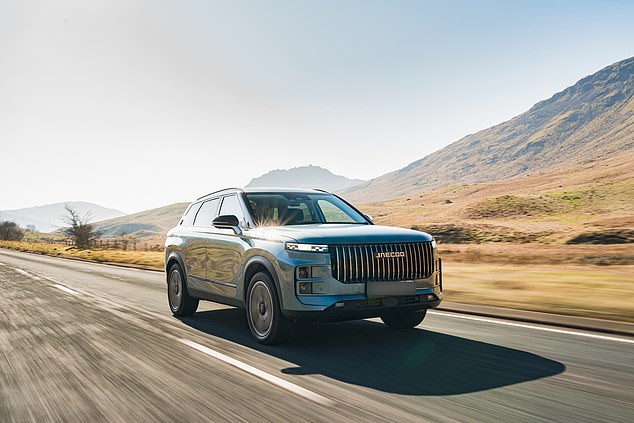
The attraction for buyers is that they offer all the bells and whistles of expensive German or British cars but for a fraction of the price. A Jaecoo 7, for example, starts from £29,210 and comes with a full-length panoramic roof, heated front seats and 540-degree panoramic parking camera as standard. A VW Tiguan – a similar-sized SUV – costs £10,000 more and has none of those features as standard.
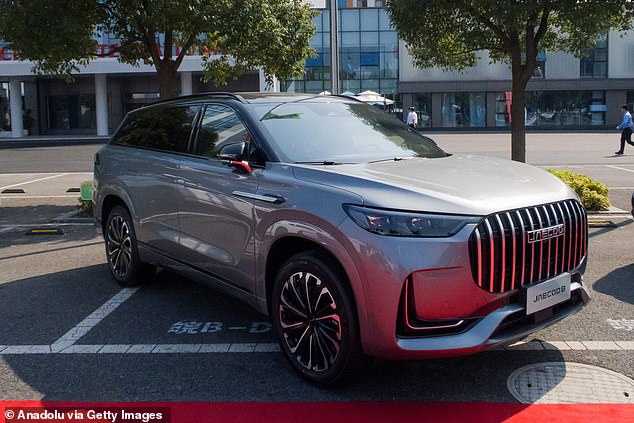
A Jaecoo 8 SUV hybrid. The price for the car typically starts around £45,500 – £47,500
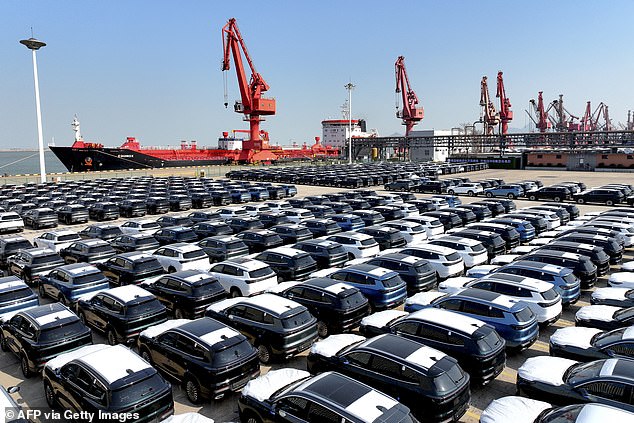
Almost one in ten new models delivered in the UK in 2025 was sold by a Chinese company – twice as many as the previous year, according to car registration figures
European car makers face serious consequences. Former chief executive of Nissan, Andy Palmer, warns that European brands not investing enough in electric cars are facing an existential crisis.
An unstoppable force
Wind the clocks back five years and there was just one mainstream Chinese car maker selling in Britain: MG, a badge steeped in British heritage but that’s been under Chinese stewardship since 2005.
Today, there are more than a dozen Chinese brands to choose from – and leading experts in the industry tell me, there are many more on the way.
Two Chinese powerhouses have emerged in recent years to drive the surge in sales: BYD and Chery.
BYD, standing for Build Your Dreams, is famed for overtaking Tesla as the world’s largest EV maker last year. It entered the UK market in 2023 and already has 10 cars in its line-up. This year, it’s launching its Denza sub-brand, which includes the first electric car to charge in less than 10 minutes using one of the company’s ‘Flash’ chargers.
Rival Chery has three car brands – all of which have been launched in Britain the last 18 months. Its Jaecoo brand – with its impressive ‘super hybrid’ 7 SUV, which is a Range Rover lookalike for half the price – is the fastest-growing automotive brand the UK has seen for a decade. It also has its namesake Chery brand, as well as Omoda and this year launches Lepas.
Both BYD and Chery have been tremendously quick to turn the heads of British drivers.
Autotrader says Chery achieved 5 per cent market share in less than two years, and BYD in under three.
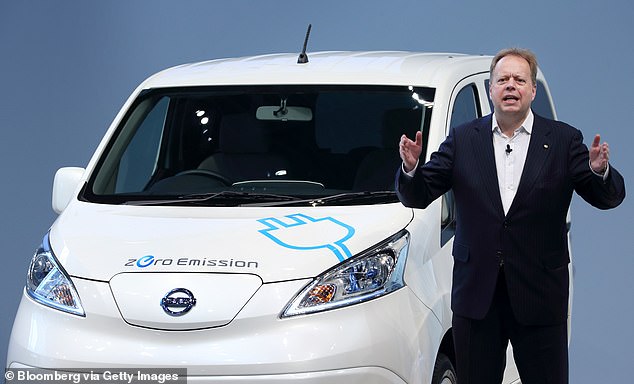
Former chief executive of Nissan, Andy Palmer, warns that European brands not investing enough in electric cars are facing an existential crisis
It took Korea’s Kia more than 25 years to reach that milestone – and its sister brand Hyundai around 40 years.
In total, China will absorb 15 per cent of the UK car market this year and 20 per cent in 2027 with the arrival of more brands, namely Geely, Changan and Aion, according to Autotrader forecasts.
Registrations figures for March – one of the busiest months of the calendar for car sales due to the arrival of the new number plate age identifier – shows that 15 per cent of orders completed were Chinese models.
But China’s influence is even greater if you take into consideration the volume of UK-delivered cars that are built in China.
But even the European badged cars on your driveway may be less European than you thought due to partnerships between Chinese brands and major companies including BMW, Dacia, Volvo and Mini.
The Society of Motor Manufacturers and Traders says that almost one in seven (13.5 per cent) car sales in Britain last year were models manufactured in China, which is more than 270,000 of the two million cars delivered. And hundreds of thousands more are using Chinese parts.
In contrast, just over 187,000 UK-made cars were registered in Britain last year. It means we already buy more Chinese made motors than vehicles that are produced here.
Stuart Masson, editor of The Car Expert and one of the motor industry’s most vocal pundits, says this is why the UK is more vulnerable to a Chinese takeover than other European markets.
The reputation of Chinese cars has improved in recent years as more UK consumers look to brands such as Chery and BYD
He says: ‘Only about 9 per cent of cars sold in the UK are made in Britain. In Germany, around a third of what is bought is manufactured in Germany, and it’s a similar story in France with French-made vehicles.
‘Clearly, Britons don’t care as much about buying their own cars as other European countries. And this leaves the door wide open for China.’
And open doors isn’t something Chinese brands are short of.
Despite only breaking into the UK market a matter of months ago, they’re amassing enormous showroom networks.
With many established brands turning their backs on traditional dealerships and bringing sales operations online, Chinese groups are absorbing vacant sites to bolster kerb appeal.
BYD now has 132 dealerships in the UK. That’s almost as many as Vauxhall. Jaecoo-Omoda has 124. Chery, which only arrived here in August, already has 58.
‘It’s no surprise that the two groups that have seen the most growth in the UK are the two with the most dealerships,’ says.
‘To the average customer, being able to walk into a showroom, to see a car and sit in it, is still a huge thing. Having this visibility breeds confidence in the product. Potential buyers know exactly where to go if they were to have any questions or issues.
‘If you get rid of a third of your dealers, like Ford and Vauxhall have done, you’re making it harder for customers to find you.’
Rising fuel prices driving Chinese growth
Andy Palmer, former chief operating officer at Nissan and chief executive of Aston Martin, says he’s not surprised by the rapid growth of Chinese cars in Britain.
Palmer, who now runs an automotive consultancy business and energy storage company, says: ‘I’ve been warning about it for a long time. That might sound like an “I told you so” but I’ve been around the industry long enough to have seen it happen before.’
He says there was a similar takeover in the aftermath of the oil crisis of the 1970s – a pertinent reference given the ongoing conflict in the Middle East has once again triggered surging oil and fuel prices.
He adds: ‘The crisis sparked a dramatic rise in popularity of Japanese cars in the UK, which at the time offered low costs, high reliability and great fuel consumption compared to the 1970s status quo. It wedged the door open to people who wouldn’t have previously considered a Japanese car.
‘What I fear is that history will repeat itself.’
There has been a surge in the number of searches for and sales of electric cars since Trump’s war with Iran began and sent pump prices soaring.
And growing appetite for EVs gives Chinese makers a greater advantage, Palmer says.
‘They have the economy of scale because half of China’s market is already electrified. They have the biggest domestic market in the world and a policy dating back to the early 1990s to concentrate on new energy vehicles.
‘This means China already has the capacity in its battery and car factories. European manufacturers, on the other hand, simply don’t have that scale.’
In fact, we’ve seen several major manufacturers in recent months hit the brakes on their electric transition after disappointing sales in Europe took huge chunks out of their profitability.
Audi, Ford, Mercedes and Vauxhall’s parent group Stellantis is among the major car firms to have delayed EV intentions for a few years until we get nearer to Europe’s 2035 ban on new combustion cars.
But Palmer says this could be a grave error if an ongoing fuel crisis ensues and motorists become more willing to buy electric cars.
He says: ‘If more drivers begin to notice that Chinese EVs cost no more than an equivalent petrol car and they are much cheaper to run before the 2035 deadline, it’s going to be a bloodbath for those European car makers that haven’t invested in EVs.’
But Masson says China firmly has an upper hand, irrelevant of fuel type.
‘In terms of the ceiling for Chinese manufacturers, there isn’t one. The only limit on their growth is how fast they’re prepared to go and how much they want to invest to make it happen sooner.
‘If they are prepared to really push it – which I think they will – they will outlast some of the major European brands.’
No more Chinese car stigma
Chinese cars are typically cheaper than their European counterparts, thanks largely to considerable support from the Chinese government.
Beijing has backed its manufacturers with an estimated $230billion worth of incentives between 2009 and 2023, according to a 2024 study by the Centre for Strategic and International Studies.
But it’s not just competitive pricing that’s driving sales.
Palmer says: ‘Chinese cars, surprisingly, are really, really good. And it’s their battery technology and software stack that’s putting them ahead of rival markets.’
‘[European manufacturers] simply don’t have that level of sophistication. They’re probably five to 10 years behind.’
Gary Lan, UK chief executive of Jaecoo, Omoda and Lepas, says solid technology was identified as one of the biggest ‘unmet needs’ of motorists in Britain when his Chinese brands strategised their entry to the UK market.
He explains: ‘Traditionally, the best technology was sitting in very high-priced brands, so we wanted to bring what we called ‘equal rights’ to technology. That’s why even for our entry priced models, we have no compromise on technology.’
Industry expert Masson confirms: ‘The value proposition is just significantly better with Chinese cars.
‘You are getting heated and ventilated seats, sunroofs and wireless charging on base models or at a much lower price than you’d pay for the same car from a mainstream manufacturer.
‘Most people use cars for basic commuting from A to B – it’s not about getting the best driving performance. Customers want something that is comfortable, quiet and well-equipped – and that’s what Chinese brands are delivering.’
Stuarts also points out that long warranties (seven years for Chery cars and eight years for their high-voltage batteries) are building confidence, especially given the typical ownership cycle through finance and leasing is no more than three years.
Five tips when buying a Chinese car
1. Pick one with a long warranty
If you still have reservations around the quality of Chinese cars, pick one with a long warranty. Chery models (Chery, Jaecoo and Omoda) all come with a seven-year/100,000-mile (whichever comes first) warranty for the cars, and eight years/100,000 miles for the high-voltage battery packs in electrified models.
BYD has a shorter warranty of six years/93,750 miles (150,000km) for its cars, although the batteries are covered for eight years and 125,000 miles.
2. Massive dealer networks means you can find one close by
If you’re looking for additional confidence, choose a brand with a dealership close by. With Chery and BYD boasting more than 250 showrooms between them.
Other Chinese brands have partnered with European manufacturers to piggyback onto their existing dealer networks. Leapmotor, for example, has struck a deal with Stellantis – this is why you will find their cars on display at Citroen, Fiat and Vauxhall dealerships across the country,
Having a local dealer gives owners confidence that they can quickly nip into a showroom to ask questions about their cars and also have nearby access for repairs and maintenance.
3. A hybrid might be more cost effective than EVs
Chinese car makers are extremely advanced in the development of EVs and batteries, but they are also leading the way with plug-in hybrid technology, offering longer electric-only ranges than you might think.
For instance, a Jaecoo 7 with a Super Hybrid System is said to be good for 56 miles, which is more than adequate for a daily commute. In comparison, a twice-as-expensive Range Rover Velar PHEV has an EV-only range of just 30 miles.
Plug-in hybrids will be cheaper too and offer the safety net of a petrol engine for longer journeys.
4. Check with your insurer
A recent study by Carwow found that some insurers are either refusing to underwrite some Chinese cars or charging hundreds of pounds more than they would to cover models from established mainstream manufacturer from Europe, Japan, Korea and the US.
Carwow’s analysis shows that a lack of familiarity with brands and somewhat limited parts availability is making them difficult to repair – and this means insurers are not currently in the position to underwrite them.
As a result, motorists tempted by the lower price of Chinese cars are faced with less choice when buying insurance – and when they do, the premiums can be sky high.
5. Do a comparison of standard equipment
One of the biggest selling points of Chinese car makers is that they are offering a bounty of equipment even on the cheapest versions of their models.
But they’re not all the same, with some brands only providing gadgets and plush items for higher trim levels than the ‘entry’ version.
Do your research and choose a model that has all the equipment you want.
Have you bought a Chinese EV and are you happy with it? Let us know: money@mailonsunday.co.uk