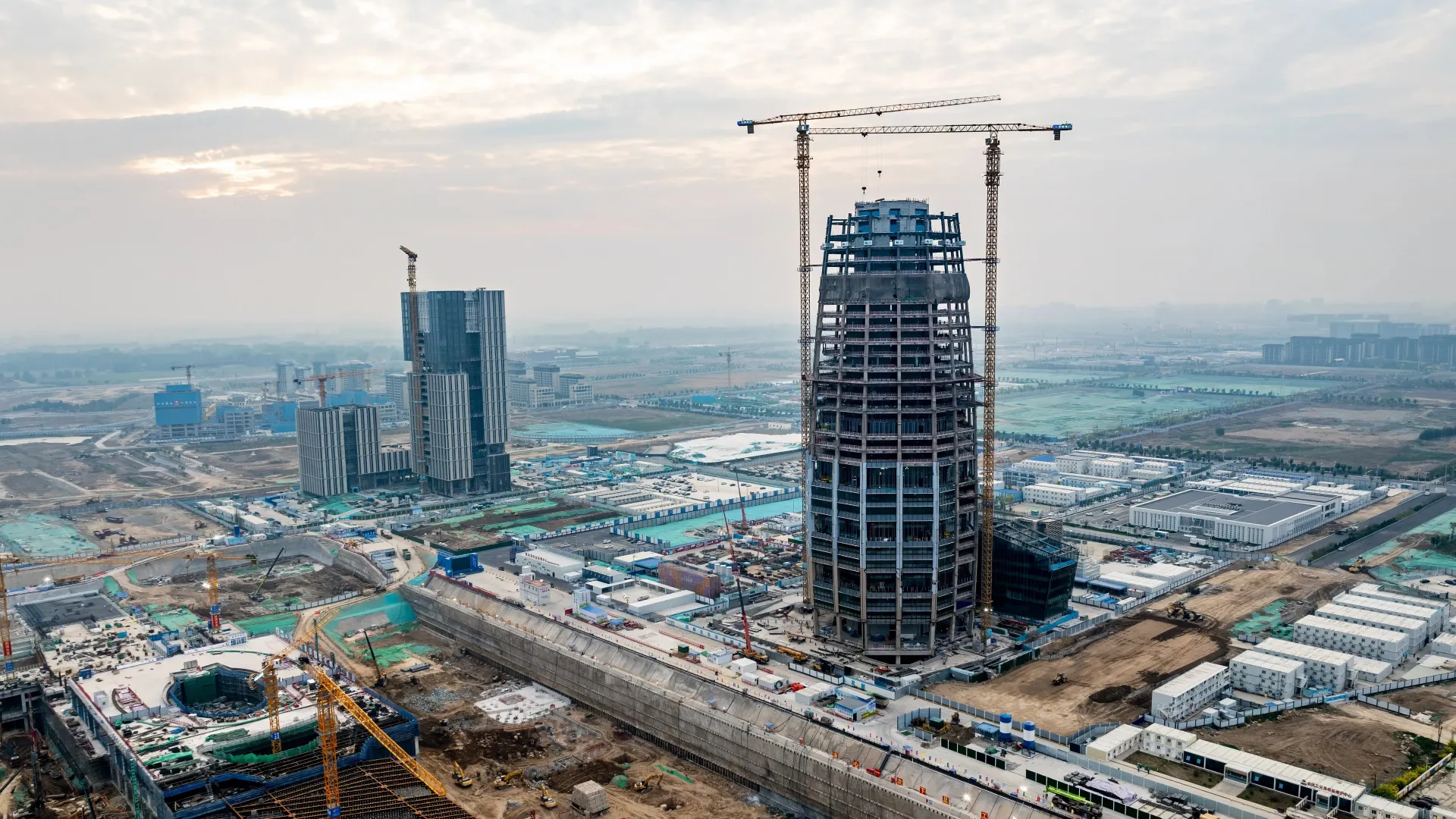
ACROSS China, vast cities of silent high-rises stretch across the horizon – empty, unfinished, and uninhabited.
These so-called “ghost cities” are haunting reminders of the country’s breakneck economic rise over the last 30 years – and the bumpy landing that followed.
No country has ever built so much so quickly and it means ghost cities – also known as metropolises that have yet to come to life – lie in every corner of China.
Dozens of skyscrapers pop up overnight and chilling pictures show the vacant – and sometimes half-finished structures – which have been deserted by developers.
Rows of post-apocalyptic housing estates tower over visitors – and impressive attractions and shopping malls gather dust without any residents or tourists stepping foot inside.
Built on a mountain of debt, Gulcin Ozkan, from King’s Business School, told The Sun that China’s property “downturn” has sparked “significant turmoil”.

“The shock is large for China,” she says.
According to Insider, around 65 million homes stood empty in China in 2020 – enough to house the entire population of France.
Despite the eerie silence, almost all of the homes are owned.
Many were never meant to be lived in. Instead, investors bought these properties as a store of wealth.
“When 70 per cent of household wealth is tied up in property, as in China, the entire economy becomes exceptionally vulnerable to the housing market,” Ozkan says.
The story of China’s ghost cities began in the late 1990s, when Beijing deregulated housing.
State-owned land was sold off, and local officials discovered large-scale construction was the fastest way to boost growth figures.
Farmland was rapidly transformed into vast new towns, built at astonishing speed.
With few alternatives for investing, people poured their savings into real estate as a foolproof way of investing their cash and making a profit.
They also snapped up the properties for their future spouses, kids and grandchildren, or as a retirement pot.
Real estate became the backbone of middle-class wealth.
This is why nearly all the properties in ghost cities are owned – but no one lives there, and some homeowners might never live there.
Max Woodworth, an expert in Chinese urbanisation, said developers and buyers have “tremendous faith” that the value of their property will steadily creep up – and prices won’t crash.
He told The Sun: “Even people who purchased homes in so-called ghost cities, in my experience, rarely express regrets.
“They have come to believe time is on their side and these cities will fill out over time and keep the home values steadily rising.”
Michael Pettis, professor of finance at Peking University, said everyone in China, including developers, had “made the same bet” on exponentially rising property prices.
He told The Guardian: “The problem of course is if property prices ever stop rising, because everyone has made the same bet everyone’s balance sheet starts unravelling at the same time, and it immediately becomes a systemic problem.
“That is what has happened in China.”
Governments also get massive sales revenue from leasing the land out to developers.
“It remains a cornerstone of local economies,” Woodworth said.
“The land system in China produces strong incentives for city governments to promote real estate and land development as a way to raise to revenue and generate economic growth.”
Developers raced ahead, selling homes before they were even built.
For years, the speculative cycle helped drive China’s growth, with real estate accounting for nearly 30 per cent of GDP.
Then Beijing slammed on the brakes. Tighter rules on borrowing and speculation meant the model began to unravel.
Pre-sales dried up, demand plummeted, and construction screeched to a halt.
Prices crashed, leaving half-finished buildings and bankrupt developers in their wake.
The collapse of Evergrande – once China’s biggest developer – became the symbol of the crash.
Buried under $300billion in debt, it left 1.5million unfinished homes and dozens of stalled construction sites nationwide.
Roger Garside, Associate Fellow at the Henry Jackson Society, previously told The Sun that China is facing a “debt mountain”.
Mr Garside said: “The Communist regime has known full well for over a decade the risks that have been building in its economy.
“Its return on investment has been steadily declining. More and more of its economic activity has been unprofitable.”
The Collapse of Evergrande
- Evergrande was once China’s biggest real estate giant, built on rapid expansion and heavy borrowing.
- By 2021, it had accumulated more than $300 bn in debt.
- Its business relied on pre-selling apartments and using that cash to fund new projects.
- Trouble began when China introduced borrowing limits.
- As sales slowed and funding dried up, Evergrande struggled to repay creditors.
- It missed key payments in 2021, triggering a default that sent shockwaves through global markets.
- The collapse exposed wider weaknesses in China’s property market, with multiple developers being sucked into the crisis.
- Millions of homebuyers were left waiting on unfinished properties.
- After failed restructuring attempts, a Hong Kong court ordered Evergrande’s liquidation in 2024.
In cities like Ordos, Tianducheng, and Chenggong, vast neighbourhoods of empty streets tell the story.
Ordos was built for one million residents – by 2016, just 100,000 had arrived.
Tianducheng, outside Hangzhou, was meant to be China’s version of Paris.
Complete with a scale replica of the Eiffel Tower and fountains inspired by the Luxembourg Gardens, few residents ever arrived.
Today, its plazas are more often filled with day-trippers posing for photos than people who call it home.
In Chenggong, years of inactivity forced authorities to relocate universities there in a bid to breathe life into its deserted districts.
Elsewhere, projects simply collapsed.
In 2021, 15 skyscrapers in the Sunshine City II complex were demolished after standing unfinished for seven years.
The developer reportedly ran out of cash back in 2013.
Worryingly, China’s property woes go beyond empty buildings.
Unpaid wages and undelivered homes have sparked fears of unrest.
The central bank has promised to protect buyers and inject more cash into the system, but confidence remains shaky.
Ozkan warns the bigger risk may be economic drag rather than financial contagion.
A sharp slowdown in domestic spending could weaken global growth – and new demographic realities are making matters worse.
“China developed new districts on the assumption of endless population and urbanisation growth,” Ozkan says.
Falling birth rates, a shrinking workforce, and slower migration mean the demand needed to fill them “is no longer assured”.
This has left a lasting housing oversupply, weaker prices, and strained local government finances that once depended heavily on land sales.
Writer Wade Shepard first noted the nation’s ghost cities in the early 2000s after making a wrong turn at a bus station in Tianti, Zhejiang and finding miles of empty high-rises.
However, some once-empty cities have begun to come to life.
Dantu, in Zhenjiang, struggled for years but slowly began filling up from 2013.
It now has around 286,000 residents.
Even Tianducheng’s population tripled by 2017.
Pudong, once mocked as a ghost district, is now Shanghai’s thriving financial centre with more than 5.6 million residents.
New projects like Xiong’an – Xi Jinping’s flagship “smart city” – show both the ambition and the risks of China’s urban vision.
Still unfinished, it already houses over a million people. a sign patience may be key to understanding the ghost city phenomenon.
Ultimately, China must change its course.
“The country now needs growth driven by productivity, innovation, services, and consumption,” Ozkan says.
This is an especially difficult transition when household wealth in locked away in property and confidence is fragile.
As for fears families could lose everything, Ozkan says: “The government is likely to do almost anything necessary to avoid this scenario. A complete wipeout of savings is unlikely.”
Critics argue these towns were victims of overdevelopment and poor planning.
Between 1984 and 2010, China’s urban land grew five-fold.
From 2011 to 2013, the country used more concrete than the United States did in the entire 20th century.
Inevitably, construction outpaced demand.
Now, as China’s population begins to shrink for the first time in decades, the question is no longer how to build – but how to fill what’s already there.
Whether these empty skylines will become thriving communities or permanent warnings remains unclear.
For now, China’s ghost cities stand as towering reminders of both the promise – and the peril – of growth at all costs.