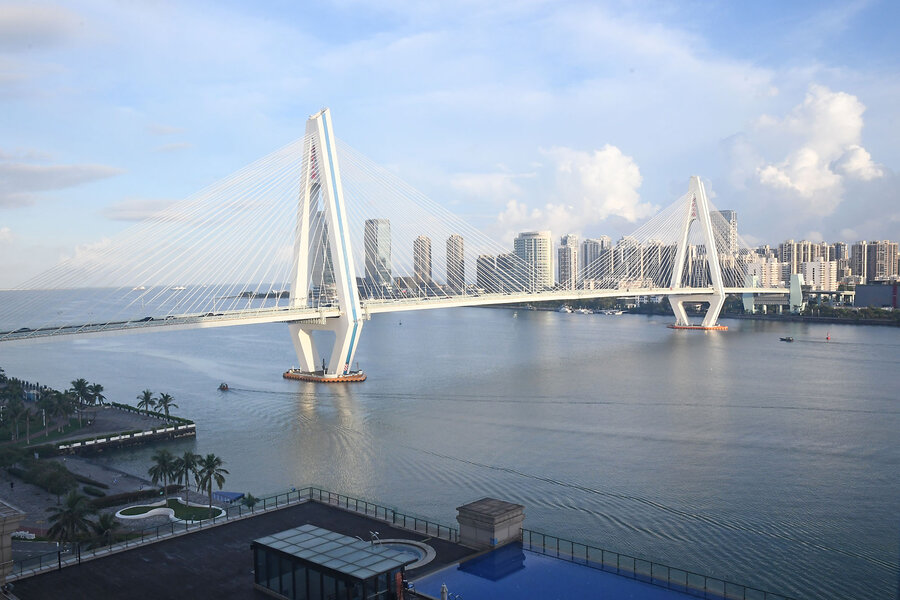
Turquoise waves from the South China Sea sweep along the southern tip of China’s Hainan Island, as tourists in flip-flops pose for photos under palms. Long a lonely place of exile for banished Chinese court officials, this tropical island of 10 million people has transformed in recent decades into a resort-studded vacation spot.
Now, Chinese leader Xi Jinping aims to turn Hainan into the world’s biggest free-trade port – leapfrogging ahead of the rest of the country in terms of economic openness and integration with the world.
On Dec. 18, this island the size of Belgium will officially become a separate customs zone from the rest of China, with tariffs eliminated on most imports. Coupled with low taxes and tax exemptions, the “systematic opening” of Hainan represents China’s “determination and courage to open up in today’s environment,” says Cai Qiang, Director-General of the Hainan Provincial Department of Finance.
Why We Wrote This
A large tropical island off China’s southern coast will gain independent customs status on Dec. 18 – a move Chinese leaders hope will jump-start development in Hainan and pioneer new levels of openness for the rest of the country, despite the rise of protectionism.
Yet Hainan’s free-trade development plan faces significant headwinds, making it an important test for China’s long-term economic reforms.
Amid a global wave of protectionism, many countries are increasing tariffs on China and prioritizing domestic industry. Hainan also remains relatively underdeveloped compared with established commercial powerhouses such as Shanghai. It’s heavily dependent upon tourism and natural resources, and ranks lower than most Chinese provinces for gross domestic product per capita.

Ann Scott Tyson/The Christian Science Monitor
On top of these challenges, Mr. Xi’s prioritization of national security could offset the benefits of a free-trade hub, even as Hainan’s geographic isolation makes it a natural choice for piloting potentially risky reforms.
Hainan “provides a litmus test of the country’s willingness and actual commitment to explore liberalization and regional economic integration,” writes Scarlet Xu Ni, a researcher at the National University of Singapore’s Centre on Asia and Globalisation.
Expanding economic policies
At an oceanside aquarium in the southern city of Sanya, women in flowing mermaid suits dive among stingrays, whitespotted bamboo sharks, and hundreds of other marine species, wowing visitors. Hou Wen and her girlfriends, meanwhile, scout an upscale duty-free mall for deals on Gucci, Burberry, and other foreign luxury brands.
“We’re looking for backpacks, skin care products, and makeup,” says Ms. Hou, an office clerk making her first trip to Hainan from China’s eastern city of Suzhou. She plans to return with her family. Hotel service is top-notch, she says, and “the sunshine is great, too.”
Hainan’s duty-free zones have attracted large numbers of mainland shoppers in recent years, especially when foreign travel was curbed during the pandemic. The province is hopeful that turning the entire island into a free-trade entrepôt will attract new business investment, advanced industry, and commerce to Hainan.

Ann Scott Tyson/The Christian Science Monitor
Hainan’s separate customs zone, to take effect on Thursday, will expand the categories of tariff-free imports from 1,900 to 6,600. These goods can circulate tax-free within the island, and some can flow tax-free into the mainland, as long as they have been processed in a way that adds value of more than 30%.
“This will help enterprises lower their costs,” says Mr. Cai.
Among the beneficiaries is Hainan Ausca International Oils and Grains Co. Ltd. In the northwestern city of Danzhou, their factory churns out big bottles of soybean, peanut, and other vegetable oils bound for the mainland.
“We were one of the first companies to set up in Hainan since the free-trade port project was announced” in 2020, says deputy general manager Cao Youhua. “Everything happened very fast.”
Local companies also benefit from Hainan’s relatively low tax burden. The general corporate tax in Hainan is 15%, compared with 25% in mainland China. For individuals, Hainan’s highest income tax rate is 15%, versus 45% in the mainland, according to Hainan officials.

Ann Scott Tyson/The Christian Science Monitor
The policies have already shown some success in boosting foreign investment and trade, which have grown faster in Hainan than the national average. Its proximity to Southeast Asia is yet another advantage.
Hainan, which lies 200 miles from northeast Vietnam, saw bilateral trade with the 11 member states of the Association of Southeast Asian Nations grow from 23 billion yuan ($3.2 billion) in 2020 to 57 billion yuan ($8 billion) in 2024, says Tian Tao, deputy director of customs for Hainan’s capital city.

Gateway to the world?
At Haikou Meilan International Airport, workers in orange vests perform maintenance tasks on an Airbus airliner inside a hangar. Hainan’s one-stop aircraft maintenance base has serviced more than 2,400 jets – including from Southeast Asia and the Middle East – since it opened in 2022.
“This is our gateway to the Indian Ocean and Pacific,” says Wang Haiye, general manager at Haikou Airport Aircraft Engineering Co. Ltd. “We want Hainan to be a place where Chinese rules match with international rules,” she says, noting that the base has secured maintenance certificates from 17 countries.

Ann Scott Tyson/The Christian Science Monitor
To be sure, China’s Hainan experiment takes inspiration from places like Hong Kong and Singapore. Yet it lacks an independent legal system, convertible currency, and other key institutional features of these more established trade hubs.
“Unlike mature global free ports,” writes Ms. Xu, Hainan “faces the challenges of liberalizing … while toeing the line of socialist mandates.”
Without systemic reforms in law and finance, Hainan “is unlikely to rival Hong Kong any time soon,” writes Zhang Xiaoyang, a law professor at Beijing Foreign Studies University, in a blog. He describes the Hainan Free Trade Port as “an ambitious experiment in controlled liberalization.”
But indeed, the signs of cultural and economic liberalization are there.
In recent years, Hainan’s entry policies have expanded to allow passport holders from more than 80 countries to visit visa-free. The island’s government also surprised Chinese fans by inviting once-banned U.S. rappers such as Kanye West to hold concerts here.
In another first for China, Hainan in 2023 allowed an overseas university – Germany’s Bielefeld University of Applied Sciences and Arts – to establish and operate a campus independently. Mr. Xi personally backed the plan, says Judith Peltz, vice president for personnel management and finance. “If you want to attract industry, you need to have a university to provide talent,” she says.
For China’s leaders, Hainan offers the opportunity to test more open economic policies while buffering the mainland against foreign influence.
“The more China opens its doors,” Mr. Xi said during a visit to Hainan last month, “the more important it is to balance development and security – and firmly safeguard the bottom line of security.”