China has fired a chilling warning to the US as it unleashed massive live-fire war games around Taiwan, deploying troops and warships in exercises that include rehearsals for sealing off the island’s vital ports.
Beijing‘s foreign ministry struck a defiant tone as the drills got underway, declaring: ‘Any act of provocation on the Taiwan issue will surely be met with a firm counterattack from the Chinese side’.
Asked whether recent US arms sales had triggered the manoeuvres, officials doubled down, insisting: ‘China’s defence of national sovereignty, security and territorial integrity is unswerving’.
The exercises – branded Justice Mission 2025 – began on Monday as Taiwan scrambled its own forces and showcased US-made military hardware in a show of readiness to repel any attack.
China’s Eastern Theatre Command said it had concentrated forces to the north and southwest of the Taiwan Strait, carrying out live firing and simulated strikes against land and maritime targets.
The drills are set to continue on Tuesday and will include exercises aimed at blockading Taiwan’s main ports and encircling the island.
A senior Taiwan security official told Reuters that dozens of Chinese military vessels and aircraft were operating around the island, with some ‘deliberately closing in’ on Taiwan’s contiguous zone – just 24 nautical miles from its coast.
The latest show of force marks China’s sixth major round of war games since 2022, following a visit by then US House Speaker Nancy Pelosi to the democratically governed island.
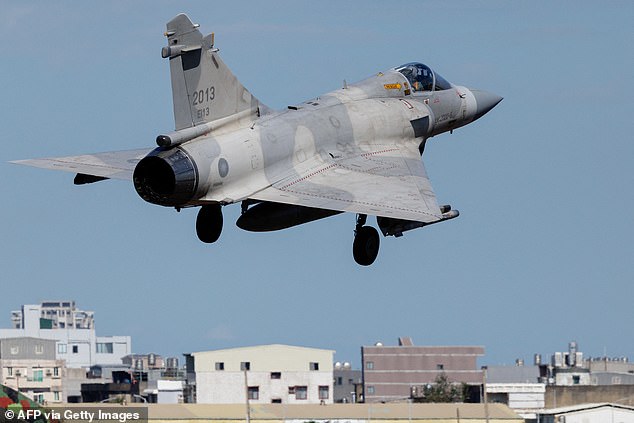
A Taiwanese air force Mirage 2000 fighter jet takes off at Hsinchu Air Base in Hsinchu on December 29, 2025
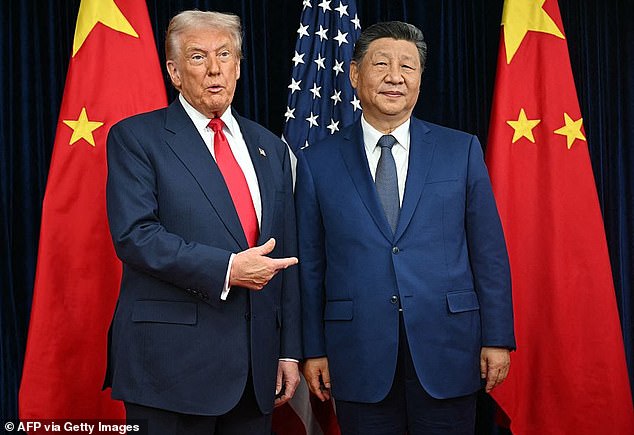
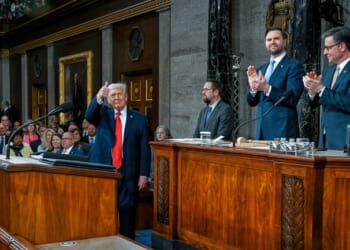
President Xi Jinping told US President Donald Trump in November that Taiwan’s ‘return to China’ after World War II was central to Beijing’s vision of global order
It also comes amid a sharp escalation in rhetoric after Japanese Prime Minister Sanae Takaichi suggested a hypothetical Chinese attack on Taiwan could prompt a military response from Tokyo.
The drills began just 11 days after Washington announced a record $11.1billion arms package for Taiwan, drawing protests from China’s defence ministry and warnings that the military would ‘take forceful measures’ in response.
Analysts say Beijing is increasingly blurring the line between routine military exercises and preparations for a real assault – a strategy designed to leave the US and its allies with minimal warning.
‘This (the drills) serves as a serious warning to ‘Taiwan Independence’ separatist forces and external interference forces,’ said Shi Yi, a spokesperson for the Eastern Theatre Command.
Taiwan’s government condemned the drills, while its defence ministry released a video on Facebook showcasing weapons, including US-made HIMARS rocket systems – mobile artillery with a range of around 300km that could strike targets in China’s Fujian province in the event of conflict.
Taiwan’s coast guard said it had dispatched large ships in response to Chinese activity near its waters and was working with the military to minimalise disruption to shipping lanes and fishing grounds.
The island’s aviation authority added that China had designated a ‘temporary danger zone’ in Taipei’s airspace for 10 hours of live-fire drills scheduled for Tuesday, forcing officials to seek alternative flight routes.
Taiwan’s defence ministry said two Chinese military aircraft and 11 ships had operated around the island in the past 24 hours, with its own forces placed on high alert and ready to carry out ‘rapid response exercises’.
‘All members of our armed forces will remain highly vigilant and fully on guard, taking concrete action to defend the values of democracy and freedom,’ the ministry said.
Despite the rising tension, Taiwan’s stock market appeared unfazed, climbing 0.8 per cent to a record high in morning trading.
‘I think these drills are just meant to scare us,’ said Lin Wei-ming, a 31-year-old teacher based in the capital, Taipei.
‘Similar drills have happened before … the political side of things can only be handled by Taiwan’s current government and how they choose to respond.’
Taiwan continues to reject Beijing’s sovereignty claims, insisting only its people can decide the island’s future.
The Chinese military also released a series of propaganda posters titled ‘Shields of Justice: Smashing Illusions’ and ‘Arrows of Justice: Control and Denial’, alongside a graphic showing four locations across Taiwan with targeting locks in place.
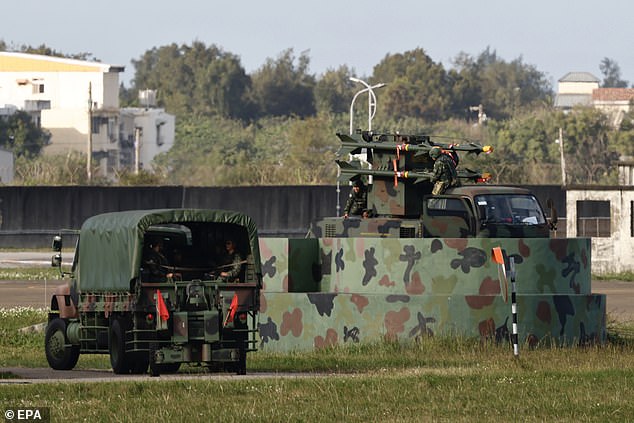
Taiwan’s military deploys an air defense missile system inside an airbase in Hsinchu, Taiwan, 29 December 2025
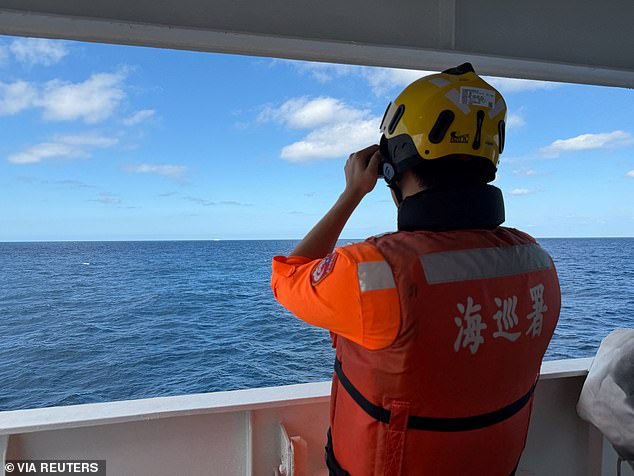
An officer on Taiwan Coast Guard patrol ship Yilan observes a Chinese Coast Guard vessel northwest of Pengjia islet, in this handout image released December 29, 2025
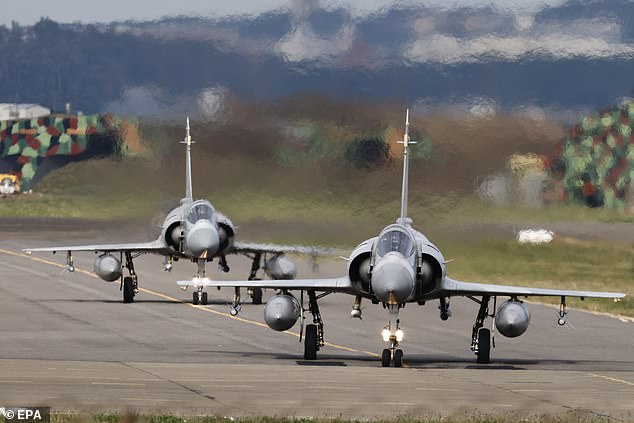
Taiwan Air Force Mirage 2000 fighter jets prepare for takeoff at an airbase in Hsinchu, Taiwan, 29 December 2025
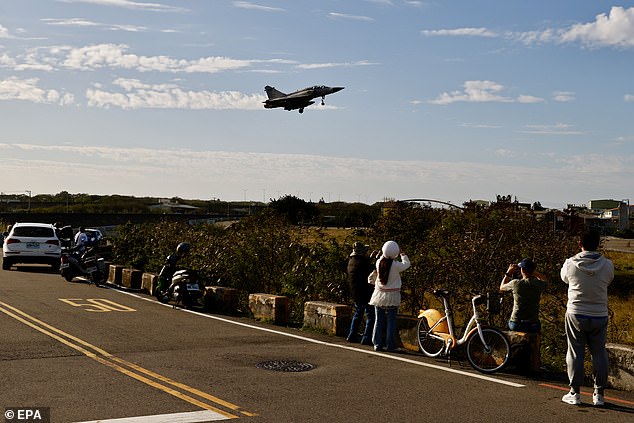
A Taiwan Air Force Mirage 2000 fighter approaches for landing at an airbase in Hsinchu, Taiwan, 29 December 2025
State broadcaster CCTV said the exercises would focus on sealing off the deep-water Port of Keelung in the north and Kaohsiung in the south – Taiwan’s largest port city.
While the PLA practised port blockades during drills last year, this is the first time it has publicly said the manoeuvres are aimed at ‘deterence’ of foreign military intervention.
The escalation follows a surge in Chinese messaging after remarks by Japan’s prime minister.
President Xi Jinping told US President Donald Trump in November that Taiwan’s ‘return to China’ after World War II was central to Beijing’s vision of global order.
One poster appeared to depict an armada of civilian ships being mobilised for a potential invasion, with ramps and open decks suited for amphibious landings.
‘Any foreign interference that touches the shield (of justice) shall perish!’ the poster read. ‘Any separatist scoundrels who encounter the shield shall be destroyed!’
‘I think their (China’s) goal is, as they said, ‘keep the island, not the people,” said Stephanie Huang, a 56-year-old interior designer.
‘They just want to save face by claiming Taiwan as part of their own country, but Taiwanese people don’t see it that way.’
‘We are who we are; they are who they are.’