This year kicked off with a sputnik moment for China.
On Jan. 20, a little-known Chinese artificial intelligence lab shocked the world by launching a cutting-edge AI tool. Its name: DeepSeek.
DeepSeek’s R1 grabbed headlines, as its use spread rapidly around the globe. It showcased how Chinese researchers, with a relatively small budget and less advanced chips, had devised a capability to rival ChatGPT and other leading U.S. models.
Why We Wrote This
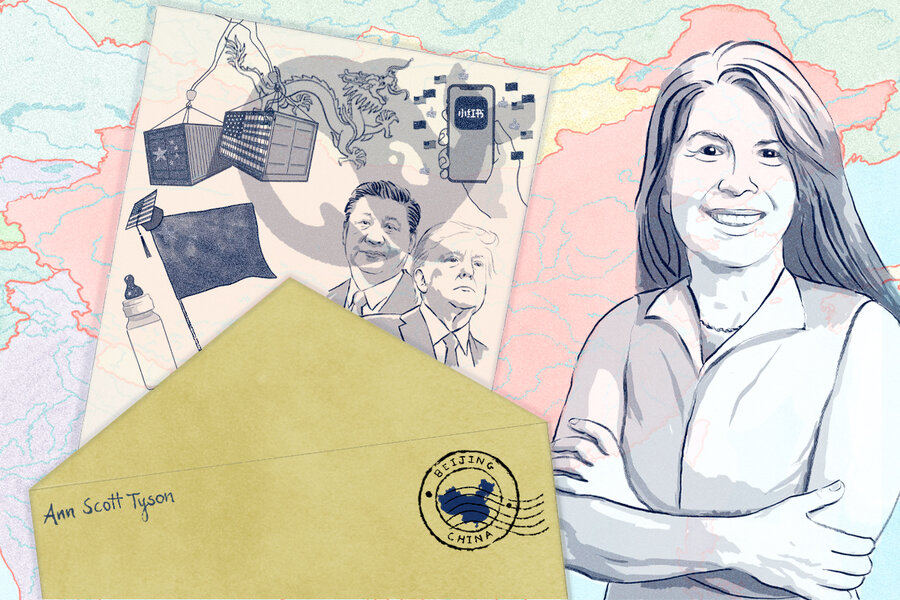
In 2025, when headlines about the U.S.-China trade war seemed never-ending, the Monitor’s Beijing Bureau Chief took an on-the-ground approach to covering China’s economy. Traveling from slick AI showrooms to warehouses full of holiday tchotchkes, Ann Scott Tyson found optimism, nimbleness, and resilience – even in the face of U.S. sanctions. Here, she offers insights on the tension between control and innovation, China’s future as a manufacturing juggernaut, and the people getting left behind as the country’s economic growth slows.
The DeepSeek splash sparked stock market sell-offs for the U.S. chipmaker Nvidia, Meta, Microsoft, and other top U.S. tech firms. Nvidia’s shares dropped 17% on Jan. 20 alone, wiping out $593 billion of the firm’s market value – the biggest one-day loss for a company ever. It took six months to recover.
What caught my eye, however, was an appearance on state-run television in Beijing of DeepSeek’s bespectacled, mop-topped CEO, Liang Wenfeng, who met with China’s No. 2 official – Premier Li Qiang.
It turned out that DeepSeek – a private company flying under the radar – was a bit of a surprise for Beijing, too. Yet China’s leadership quickly rushed to embrace Mr. Liang and hail his company as a “national champion,” eager to claim another victory for Beijing’s ambitious campaign to lead the world in critical technologies.
The moment captured the complex dance in China between innovators and authorities – one that has allowed the country to defy expectations and achieve home-grown technological breakthroughs, even amid strict government controls. Policymakers using sophisticated economic levers can stimulate industrial advances. But it’s risky. There is no guarantee that state technocrats will prove more visionary than individual private entrepreneurs, so Beijing must allow upstarts to emerge, and encourage – not stifle – their success.
China had already built the world’s largest web surveillance system – disproving U.S. President Bill Clinton’s prediction in 2000 that controlling the internet would be like trying to “nail Jell-O to the wall.” Beijing allowed internet use to proliferate, but under the watchful eye of an army of censors and behind a “Great Firewall” that blocked many foreign websites.
Now, it was harnessing AI.
“We were wrong about the barrier that censorship would pose towards China’s development of large language models,” Jeffrey Ding, a political scientist at George Washington University, told me at the time. Instead, Chinese companies have been able to enforce government censorship and innovate at the same time. AI is now being used to facilitate controls on speech, experts say.
DeepSeek and other advances also show how U.S. export controls on advanced semiconductors have slowed, but not stopped, China’s technology advances.
Inside the gleaming showrooms of Chinese companies like iFLYTEK and AISPEECH, I saw demonstrations of everyday AI uses – from smartphone voice recognition software to conversational AI in electric vehicles. iFLYTEK’s executives say the company had been relying on Chinese semiconductors since being placed on a U.S. trade blacklist in 2019.
“Our sales are increasing year by year” despite U.S. sanctions, said Duan Dawei, senior vice president of iFLYTEK. “In the future,” he predicted, “we will introduce our products to the American market.”
Frustration – and creativity – in Yiwu
A few months later, the mood for many Chinese on the front lines of manufacturing and commerce turned somber.
Steep tariffs imposed globally on April 2 by U.S. President Donald Trump quickly spiraled into a tit-for-tat trade war with China. Both sides imposed prohibitively high tariffs of more than 120%. The massive bilateral trade flow – worth $660 billion in 2024 – began grinding to a halt. Factory work stoppages and layoffs ensued.
In the ancient Chinese trading city of Yiwu, home to the world’s biggest small commodities market, I ventured into a cavernous building jammed with rows of shops for every conceivable consumer product. In a huge Christmas section, ornaments glittered, toy trains whistled, and snow globes swirled – but the mood was anything but merry.
“We are here with a lot of Christmas decorations, but we can’t export them to the U.S.,” sighed trader Fernando Lu. “With the tariffs, clients can’t afford them.”
So Yiwu merchants have to get creative. They live by the imperative that comes with China’s manufacturing might, which churns out more goods than domestic consumers can buy: Open new overseas markets, or perish.
“The U.S. will fall behind quicker because of this,” said one jade trader, who declined to reveal his name.
China’s diligent traders ultimately did open new markets. Despite a sharp decline in trade with the U.S., China’s overall exports grew 6% year-on-year in the first three quarters of 2025, driving economic growth.
Mr. Trump and Chinese leader Xi Jinping met in South Korea in October and agreed to a yearlong trade truce. Yiwu’s nimble entrepreneurs aren’t counting on it.
Tea with “auntie”
Squinting my eyes as the bitter November wind whipped up fallen leaves, I pressed ahead on the Beijing sidewalk. Suddenly, a familiar face lit up in front of me. It was my friend – I call her ayi, or “auntie” in Chinese.
My chance encounter with auntie wasn’t big news – but it underscored countless interactions I’d had with ordinary Chinese over the past year who were struggling with unemployment, low incomes, or other economic hardships.
An illiterate migrant from a village in eastern China, auntie always seemed to be switching from one menial job to another. Still, she was warm and enthusiastic.
“I live close by – come to my apartment for tea,” she urged, taking my arm and pulling me along.
We turned into an alley and soon took a long flight of steps to the basement of a modest apartment building. She led me along a dark hallway with concrete floors and a communal squatter toilet, then pushed open the door to a dim, windowless room.
“I don’t usually bring people here – as a woman living alone I don’t feel safe,” she admitted, offering me some roasted peanuts from her village. “But I know you.”
A mother of four grown children, she worked long days to support her distant family, starting at 4 a.m., washing and cutting vegetables in a restaurant. In her time off, she often walked in a park, partly to avoid her underground abode.
Hundreds of millions of Chinese like auntie are living on the margins. They lack the skills to land jobs in Beijing’s high-tech manufacturing economy. Given meager welfare benefits – especially for people classified as “rural” under China’s antiquated population control system – they must rely on creative wits and hard work to get by.
Surveys show that Chinese citizens are more pessimistic about their chances of getting ahead than in decades past, and they increasingly blame entrenched inequality and an unfair system.
Economic grievances are sparking more protests. They are also contributing to an unusual number of mass-casualty attacks on innocent bystanders, such as stabbings and car-ramming incidents – dubbed “revenge against society” attacks.
Yet China’s leadership is betting on the people’s ability to endure hardship. In auntie’s case, they will win.
“My oldest son is getting married in January!” she tells me excitedly. (I know she’s wanted this for years.) And, she confides, her first grandchild is on the way. What a motivation to get through long restaurant shifts, I reflect, as auntie fills my pockets with peanuts and sends me on my way.