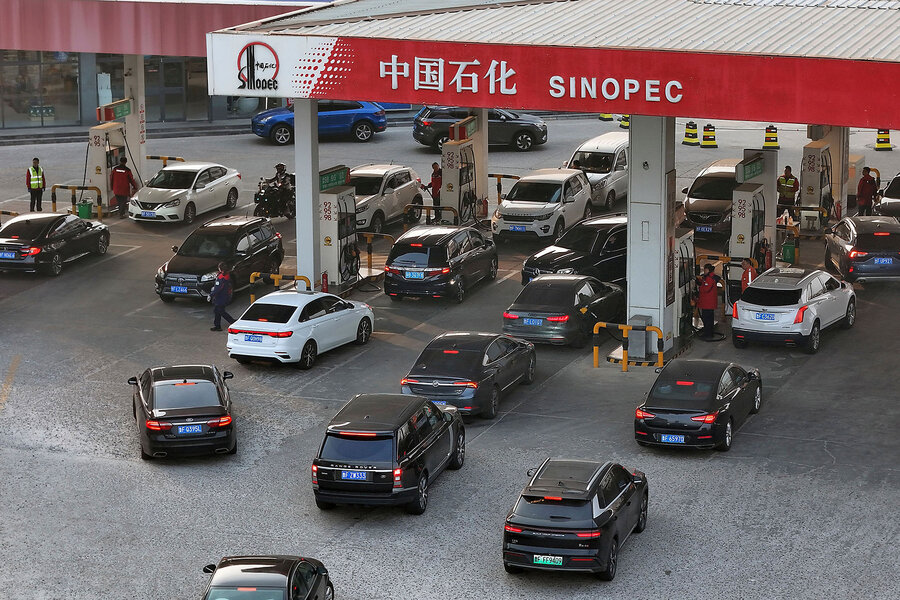
Lines of cars clogged streets near gas stations across Beijing last week as drivers scrambled to fill up their tanks before an announced price hike. Electric scooters and bicycles weaved around the idle vehicles.
“Everyone’s impacted by the increase,” sighed one fuel attendant in the red-and-blue uniform of China Sinopec, a large state-run oil and gas company, as she helped a customer fill up on Monday. She pointed to the lit-up digital pump showing the new price: about $4.90 a gallon, an increase of roughly 50 cents.
Overall, China is well positioned to buffer its consumers and economy from the oil shock sparked by the Iran war, despite its heavy dependency on imported oil. To be sure, if the war drags on and leads to a global recession, China’s growth, which depends heavily on exports, would take a serious hit.
Why We Wrote This
Asia has been hit hard by the oil shock caused by the Iran war. But the conflict could be a boon for China’s new energy sector, including renewable energy, electric vehicles, and batteries.
But barring that, signs are emerging that the war could boost China’s economic heft relative to other countries, as Beijing leverages its robust oil reserves, refining capacity, diversified energy sector, and clean-energy industry dominance.
“China has a lot of leverage because it is shielded from the shock, while the rest of the world is not,” says Alicia García Herrero, a senior fellow at Bruegel, a Brussels-based economic think tank.

China’s reserves
In recent years, China has built up sizable oil reserves, in part by importing discounted oil from sanctioned countries such as Russia, Venezuela, and Iran. Iranian oil has flowed to China through a shadow network that involves transshipments via third countries like Malaysia, payments using Chinese yuan instead of U.S. dollars, then processing by China’s small private “teapot” refineries – some with rounded tanks and spoutlike pipes.
China’s reserves totaled around 1.3 billion barrels at the start of 2026. Even with the closure of the Strait of Hormuz and the loss of imports from Venezuela, that amount of oil could still last for the next two years, according to estimates from Gavekal Dragonomics, a research firm focused on China’s economy.
Such reserves are helping the government ease the oil price shock for hundreds of millions of Chinese who drive gas-fueled cars and trucks. In a rare intervention to quell panic buying, the National Reform and Development Commission last week imposed temporary gasoline and diesel retail price controls for the first time since 2013.
The move was necessary to “mitigate the impact of an abnormal rise in international oil prices,” the NRDC said in a statement. Price violations would be punished “strictly,” it warned. The government adjusts oil prices every 10 days, and the next price change comes April 7.
For China, a little upward price pressure is actually a good thing, experts say. Unlike the U.S., where inflation is raging, China has grappled with deflation in recent years. “China can afford some increase in oil prices,” says Dr. Herrero, who specializes in emerging markets with a focus on Asia.

Bolstering energy exports
China’s large reserves and refining capacity, coupled with its diversified energy sources, also puts it in a relatively strong position compared with the rest of Asia.
In a possible sign of Beijing’s increased leverage, the Philippines and China last week reopened talks on potential joint oil and gas exploration in the South China Sea, despite their ongoing territorial disputes there, The Manila Times reported. The Philippines, which imports more than 90% of its oil from the Middle East, has declared a national emergency amid soaring fuel prices and rapidly shrinking reserves.
And Beijing’s decision in mid-March to ban jet fuel exports – a way to ration its reserves and manage surging airfare – risks shortages in countries such as Australia, which bought a third of its jet fuel from China in 2025.
“The overall situation that we’re seeing is countries are desperate in trying to secure energy supplies, be it oil or gas or other sources of energy,” says Li Shuo, director of China Climate Hub at the Asia Society Policy Institute (ASPI) in Washington.
While countries – including China – may restart or ramp up coal plants or pivot to other sources of fossil fuel in the short run, in the medium term they are also likely to promote more renewable energies such as wind and solar, says Mr. Li. “It vindicates this longstanding Chinese approach,” he says. “Many countries … are pivoting to China’s playbook.”
China’s main source of energy consumption remains coal, followed by crude oil and natural gas, and a growing share of renewables such as hydropower, solar, and wind. The country produces more wind power than any other nation by far. China also dominates key green energy industries such as solar panels, batteries, and electric vehicles.
The Iran war is likely to bolster China’s transition to electric vehicles, as well as its exports of green energy goods to the rest of the world, in particular the Global South.
“This will obviously give an extra push to China’s energy transition,” says Ma Jun, founder and director of the Institute of Public and Environmental Affairs, a Beijing nonprofit.