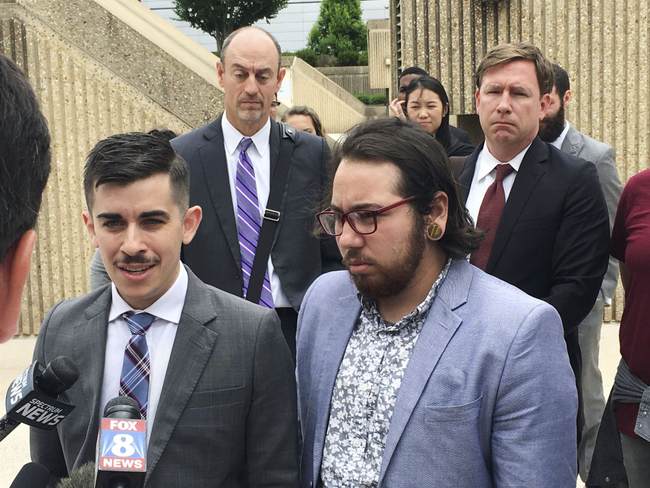
Chase Strangio is the trans attorney who has been involved in two important cases involving trans rights which came before the Supreme Court. In the first case which had to do with workplace discrimination, Strangio’s side won. In the second case, which involved a Tennessee ban on transgender care for children, Strangio personally argued the case and lost.
Last week, Strangio sat down for an interview with Ross Douthat and of course one of the issues that came up was trans women competing with women in sports. Strangio argued for a middle ground.
Douthat: In the United States, we have, in high schools and in colleges, sports that are sex segregated. Is that a good idea?
Strangio: Yes, I am in favor of sex separated sports in most circumstances…
Now, do I think that we need to have sex separated sports because of some concern about women not being able to have access to sports teams if they’re not sex separated for the reasons that you identify? Yes. I accept the premise that, in the aggregate, men have athletic advantages in a majority — though not all — sports and that one of the ways that sex separation has worked is to ensure those opportunities for women.
Douthat: I will tell you a story, which is that a school in my general vicinity, during the peak of what we call wokeness nowadays, had a field day that had traditionally had separate sports for men and women, and they decided they needed to put the girls and boys together.
And the reports from the girls the next day was that they were absolutely miserable because, of course, the boys won — I don’t want to say all — but won most of the games…
You’re objecting to categorical bans, but what is the case by case approach that you’re imagining?
Strangio: Well, it depends on the context. But if we’re talking about competitive high school athletics, my view is that it should be left to the athletic associations to come up with a rule that balances inclusion —
Douthat: That’s a cop out. You’re in charge of the athletic association. What’s your rule?
Strangio finally admits that there’s an alternate compromise involving hormone treatments that could be adopted. Why won’t anyone compromise with trans activists, Strangio wonders.
Strangio: Well, my rule is not a rule that you probably agree with.
Then I’ll give you a rule that I think would be the appropriate compromise. Because I’m in favor of talking about compromise.
So, my rule would be that you have to undergo hormone therapy for a period of time that is studied for the age group, and then at that point you can participate.
We don’t test individual athletic anything in order to participate on a team for boys and girls. I think that we come up with a rule, it’s applied. Once you meet the threshold, then you can participate. I think that balances equity, inclusion, and concerns about athletic advantage. That would be my proposal.
What I don’t understand is why when we propose things, that our compromises are met only with bans. Because another option would be to say if you, if you are on puberty blockers, if you went through only, uh, female hormonal puberty, um, and that you can you submit evidence to that effect, then what is the basis under the argument about athletic advantage of excluding that individual?
Because there were examples of associations that were starting to impose more stringent rules that looked like that, and then this administration forced those to go back to a categorical ban. So, I think there’s just questions about why are we categorically excluding people and why are we going so young in age?
And this led to the best response Douthat offered in the whole interview:
Douthat: Let me make a suggestion then for why you have that resistance to compromise right now. In part, it’s rooted in a sense that your side is interested in compromise now that it is facing cultural setbacks. But just a few years ago, it was taking a much more maximalist position. And so it is a normal feature of cultural contest and democratic politics that if you overreach, then your protestations that you only want compromise might fall sometimes on deaf ears.
And again, in the case of women’s sports, I don’t know exactly what the ideal medical testing regime is that would enable certain transgender athletes to play — I’m open to an argument about that — but I just lived through a period where, regardless of what a medical test said, I could look at a photograph of someone like Lia Thomas, who was extremely successful as a female swimmer.
You could just look at the photographs of Lia Thomas with female teammates. And from my own point of view, it looked absurd. It looked like absurd overreach on the part of the transgender rights movement that was undermining the basic fairness of women’s sports.
That’s also my larger perspective here. You said earlier that maybe you’ve learned something about the importance of dialogue and safe spaces and compromise and so on. I feel like, if you have learned that it is as the result of overreaching.
That seems exactly right to me. And sure enough, Strangio goes into a defense of Lia Thomas suggesting it’s wrong to look at trans athletes and judge them.
Strangio: Just to respond to the example of Lia Thomas, one thing I’m worried about is that if we accept the premise that what we’re doing is looking at people and deciding who is trans, then we as bystanders are going to be policing the bodies of women athletes.
Lia Thomas was not a woman athlete. That’s the point. Lia Thomas was a male athlete who switched teams from one year to the next. As a male athlete he was mediocre. As a female he was elite. People were right to police that situation because it was obviously unfair.
Finally, this part of the exchange ends with an outright lie. Strangio claims trans people weren’t the ones pushing an agenda. It was people pushing bathroom bans who started all of this.
Strangio: We didn’t introduce a conversation about sports or about restrooms, and I think that that’s an important part of this history. Following Obergefell, following the Supreme Court’s decision striking down bans on marriage equality and the efforts in Charlotte, N.C., and Houston, Texas, to pass nondiscrimination ordinances, which people continue to say are largely popular — that’s where we started to hear about trans people using the bathroom. And then subsequent to that, about trans people in sports. We did not introduce those.
Douthat: As activists, you’re saying you didn’t introduce those debates?
Strangio: Right. We weren’t asking for inclusion in those spaces.
We were asking to not be fired from our jobs, to not be kicked out of hotels, and that was the step that started in 2016 and was met with a campaign about predators and bathrooms.
This is revisionist history. The 2016 bathroom ban Strangio is talking about is the one that passed in North Carolina. It was known as HB2. HB2 didn’t come out of nowhere. It was a reaction to a law passed in Charlotte just a month earlier which said trans people could use the bathroom of their choice.
Back in 2016, Kevin Drum put together a timeline of the “bathroom wars” trying to trace the history of how all this started. Here’s what he concluded.
The first concrete movement toward gender-neutral bathrooms started at universities. Now it’s becoming mainstream. Good work, idealistic college kids! This is why we should think of universities as petri dishes, not a sign of some future hellscape to come. They’re well-contained areas for trying things out. Some of this stuff dies a deserved death. Some of it takes over the world if the rest of us think it makes sense. Stop worrying so much about it.
Second: “Who started this fight?” Yes, that’s a crude way of putting it. But if we contain ourselves to the last decade or so, the answer is: liberals. Before then, the status quo was simple: men used one bathroom and women used another. It was liberals who started pressing for change, and the conservative protest was a response to that.
This went from woke college students to blue cities including some in red states like Texas and North Carolina. It was in these places that states started pushing back on the changes being pushed by liberals.
And at the time, Chase Strangio was one of the activists making those maximalist demands, sounding much less reasonable than he did last week talking to Ross Douthat. This is Strangio from 2016.
When a transgender woman uses a women’s restrooms there are still zero men — biological or otherwise — in that restroom. Transgender women are women; transgender men are men.
You might believe that a person’s genitals define their “biological” sex but that does not make it so and continuing to put forth that narrative without challenging it as an ideological position as opposed to a fact is extremely harmful.
When someone says that Obama is “mandating” that boys and men use girls’ restrooms, the immediate response should be, “no, the Obama administration has put out guidance about what the law has meant for years and that guidance explains that girls who are transgender must not be barred from girls’ restrooms.” If someone then pushes back and says that transgender girls are biological boys, that assertion should also be examined. What does it mean to be a biological boy? Biology is diverse and complex and when it comes to assigning sex, the only medically appropriate way to make such an assignment is based on the gender the person knows themselves to be. This means that biologically-speaking transgender girls are still girls.
Strangio would apply this same absolute pronouncement to bathrooms, to sports and to prisons: “Transgender women are women; transgender men are men.”
Douthat was right about why Strangio is seeking compromise now. It’s only because Strangio took the maximalist position on all of these issues a few years ago and lost. I don’t think compromise is really Strangio’s goal here. I think the goal is playing the part of the reasonable person in a public debate at the NY Times until such time as he can once again make the old maximalist demands.