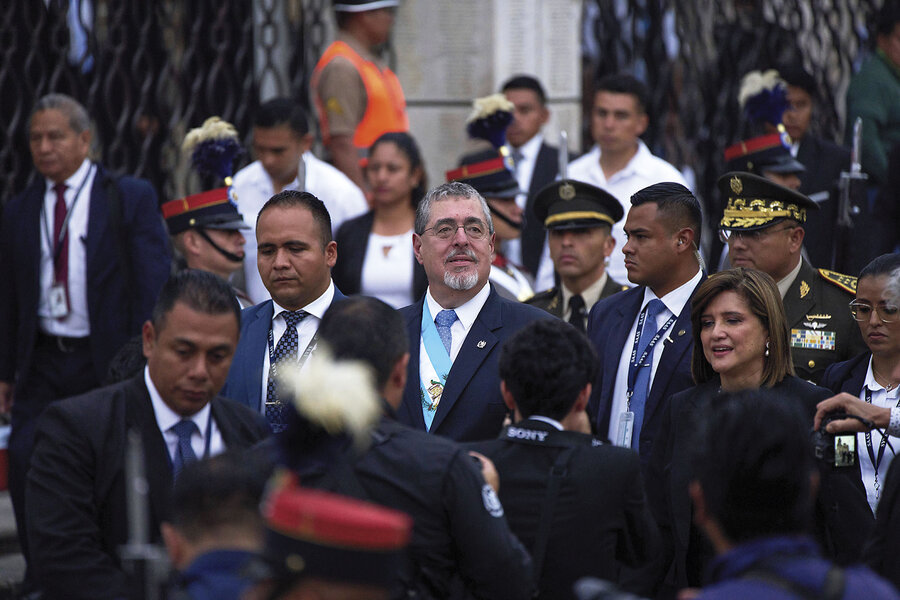
He is the one leader in Central America whom the United States has commended for his “commitment to democracy.” He is also the region’s least popular president.
Guatemalan President Bernardo Arévalo, after two years in office, has earned the nickname “tibio,” or lukewarm. It’s a stark contrast to the mood around him in 2023 when high-energy, pro-democracy protests propelled him to victory, despite an attorney general who tried to block Mr. Arévalo at every turn.
Today, amid insecurity and inflation, he has a 39% approval rating – half of what he enjoyed when he so remarkably took office in January 2024.
Why We Wrote This
Across Central America, voters are losing faith in democratic governments’ ability to curb rising crime rates. That has left the field open for authoritarian, not to say dictatorial, leaders.
Meanwhile, leaders of neighboring countries who have embraced democratic backsliding – or straight-up authoritarianism – are heaped with their citizens’ approval.
In Costa Rica, long a democratic mainstay in Central America, the president there has pledged to consolidate his power in order to fight violence. At the helm in Nicaragua is a totalitarian leader often categorized internationally as a dictator. Both leaders fare better than Mr. Arévalo in public polling.
And the most popular leader governs where democracy has been trampled the most in recent years – in El Salvador, where swashbuckling President Nayib Bukele has cracked down on civil liberties in his drive to slash murder rates.
In fact, it is Mr. Bukele’s mano dura, or ironfisted approach, that has most attracted admirers across Latin America amid rising violence – both real and perceived. The homicide rate is growing in places like Ecuador and Peru, but even where it remains steady, citizens identify crime and violence as top concerns.
Nearly 80% of Latin Americans who express high levels of trust in institutions – from the police to the justice system – also express support for democracy, linking faith in a government’s ability to deliver services like public security to satisfaction with the system of democracy. But public support for democracy is lower in Latin America today than it was two decades ago, according to the 2023 Pulse of Democracy report from Vanderbilt University.

Salvador Melendez/AP/File
The ease with which Mr. Bukele has accomplished goals so central to public wish lists in Latin America, like fighting violent crime, has left many in neighboring countries frustrated by the slow pace of traditional democracy. It could set back democratic gains won over the past several decades, as many nations moved away from military dictatorships and strengthened democratic institutions.
There is a sense that it would be possible to control insecurity, extortion, or gangs if only the national leader were willing to take the necessary steps, whether or not such actions were democratic, says Roberto Wagner, a Guatemalan analyst and expert in international relations.
“That’s why many people say, ‘There are no excuses for democratic governments to put off making changes,’” he says.
Rooting out corruption?
Corruption and impunity are deep-seated challenges across Central America, contributing to high rates of poverty and crime.
Guatemala, for more than a decade, was the envy of the region due to an independent, anti-corruption body investigating everything from drug trafficking to government kickbacks. That all changed after the United Nations-funded commission, which put two former Guatemalan presidents behind bars, was shuttered in 2018. The government controversially chose not to renew its mandate.
In 2023, Mr. Arévalo campaigned on a platform of rooting out corruption. The attorney general, Consuelo Porras, had been sanctioned by the United States for undermining anti-corruption investigations. As president elect, Mr. Arévalo promised to get rid of her.
His success in reaching the runoff election had come as a surprise, with many in Guatemala’s political and economic elite considering Mr. Arévalo a threat to Guatemala’s status quo. But his pledges to bolster democratic institutions and to root out corruption, appealed to a population frustrated by a system of government that didn’t seem to be working for the people. The public prosecutor’s office tried to delegitimize Mr. Arévalo’s party and electoral victories, leading to a months-long national strike seeking to uphold democracy – and the public’s will.
Today, he’s losing his battle against Ms. Porras, despite popular support to remove her. His government says it lacks the legal authority to dismiss her. “Many people interpret my commitment to democracy as weakness,” Mr. Arévalo told the BBC in September. “They say ‘he should do a coup, with the police and the army and put them [enemies] in jail, he’s the commander in chief.’ But you can’t build a democracy with antidemocratic methods,” he argued.

As Mr. Arévalo has dragged his feet, Ms. Porras has criminalized Guatemalans who participated in the 2023 pro-democracy strike. And that inaction gives him the reputation of being unable to get things done.
“As for Arévalo, no comment,” says Marielos, a Guatemalan who didn’t want to be identified by her full name for her safety. “Bukele, on the other hand, is an excellent president because he has improved everything in every sense, especially security. He should unify Central America and lead it.”
In late October, Guatemalan Judge Fredy Orellana issued a ruling that voided all actions by the president’s party, Semilla, alleging it had forged signatures to register the president’s candidacy in 2024. Mr. Arévalo accused the judge and Ms. Porras of leading an attempted coup, labeling them “public enemies” in a nationwide television broadcast on Oct. 26. “Porras, Orellana, and their other pathetic conspirators have created a climate of terror to pave their way and sink our country,” Mr. Arévalo said.
Although his response won approval from Guatemalans seeking more decisive action from the president, the fact that it took Mr. Arévalo almost two years – and a coup attempt – to call for Ms. Porras’s dismissal explains the frustration many here feel with the pace of change.
“Citizens remain deeply dissatisfied with corruption, and not so much with authoritarianism,” says Annelisse Escobar, professor of international relations at the Universidad del Valle de Guatemala. “We are beginning to see an automatic rejection of the idea of democracy if what we understand by democracy is a system that can solve my problems and provide public services,” she says.
“Not everyone is going to defend Arévalo anymore. We see those actors who fervently defended the election results and the people who participated strongly in those demonstrations, very disappointed, saying, ‘We shouldn’t even have supported him because it wasn’t worth it,’” Dr. Escobar says.
Mr. Arévalo’s popularity isn’t helped by Mr. Bukele’s success right next door in El Salvador.
“Everything is tough in Guatemala,” says Margarita, who asked not to be identified by her full name while discussing politics in Guatemala City’s historic center, pointing to issues like crime. “El Salvador is so beautiful, it’s clean, and you can walk around safely,” she says.
El Salvador tallied 2,398 murders in 2019, the year Mr. Bukele took office. Last year, there were only 114 murders nationwide, according to official figures. The increased security has given Salvadorans reprieve from gangs that for decades controlled their communities. And his approach has been heavily publicized abroad, targeting the three million Salvadorans that live in the U.S. and presenting Mr. Bukele as an effective, no-nonsense leader.
What the propaganda doesn’t say is this: El Salvador has became the country with the highest incarceration rate in the world. Constitutional rights, including the right to an attorney, have been suspended since 2022. Many activists and human right defenders have been exiled this year, and 60% of Salvadorans are now afraid to voice political opinions out of fear of government reprisals.
In 2020, President Bukele walked into parliament accompanied by heavily armed soldiers and policemen, to pressure lawmakers to approve a loan to fund his security plan. A year later, he dismissed the attorney general, who was investigating him and members of his Cabinet for corruption.
These were not democratic moves – but they were efficient, says professor Escobar. “The only thing people want is to be safe,” she says.
Costa Rica’s crime problem
In Costa Rica, the administration of President Rodrigo Chaves Robles has seen the most violent years in the country’s recent history, with almost 700 homicides by September 2025, outpacing the average of 500 annual homicides between 2016 and 2022. He applauds El Salvador’s security model, and he has brought the country, which famously doesn’t have an army and has long been considered a haven for democracy in the region, to a crossroads.
In the run-up to Costa Rica’s February presidential election, Mr. Bukele has made guest appearances in videos supporting Mr. Chaves. The association with Mr. Bukele has scored political points for Mr. Chaves, who is not a contender in the elections, but supports the ruling party candidate Laura Fernández, a former official in his administration.
Authoritarianism will be on the ballot in the February vote, says Ilka Treminio, a Costa Rican political scientist. “The ruling party … is considering the construction of a kind of mega prison, inspired by the Salvadoran CECOT,” she says, referring to the prison where the U.S. sent third-country deportees earlier this year. “Laura Fernández, has said she would agree to apply states of exception in certain circumstances,” she adds, referring to the suspension of some civil liberties in the name of improved security.
If Ms. Fernández becomes president, her administration would mean the “continuity of Rodrigo Chaves’ political agenda,” says Dr. Treminio.
Over the past four years, institutions and democracy have been weakened in Costa Rica. “If there is another government with these characteristics, it will be very difficult to return to the democratic state that Costa Rica” has historically been,” Dr. Treminio worries.
Back in Guatemala, in October 2021, a clone of Bukele’s Nuevas Ideas party has started its registration process with the country’s Supreme Electoral Tribunal.
It’s expected to gain support from Guatemalans looking for drastic change, but Mr. Bukele’s reputation as an authoritarian is also raising some concerns. Mr. Bukele “will treat El Salvador like his property,” says Lorenzo Guiérrez, a cab driver in Guatemala City. “And that’s not what Guatemala needs. What it needs is that we stand together, each doing our part.”