This article is taken from the March 2026 issue of The Critic. To get the full magazine why not subscribe? Get five issues for just £25.
The traditional British nurse was as identifiable and familiar a figure as the traditional British policeman. Like the bobby of old she had a uniform, a clear ethos and was a distinctive national invention that would be imitated worldwide. Such images endure in the popular imagination. A child watching cartoons will see Plod still wearing the uniform of 50 years ago, much like Postman Pat, and even the nurse in Peppa Pig dons the old white cap and smock.
Compare past and present and you soon see why. The old uniforms were instantly recognisable, distinct, and communicated not just the status of the profession but a value system. If you attempted to portray the nurse of today, you would have 50 different sub-specialisms and categories to choose from, all clad in featureless polyester pyjamas called “scrubs”. Each are scarcely distinguishable from any other hospital staff member, from consultant to porter. The image of nurses we still communicate to our children as a collective cultural memory — calm, elegant, compassionate and professional — no longer reflects the state of nursing in Britain today. The profession struggles to attract staff and relies heavily on overseas recruitment, with nearly a third of nurses coming from abroad.
Many retire early due to burn-out, with 13 per cent of those leaving the nursing register citing poor physical or mental health as a reason. The quality of nursing has suffered at the same time, as a strained system pushes patient care lower down the priority chain. Work once done by doctors is now done by nurse practitioners, whilst the traditional primary care role of nursing is increasingly devolving to poorly-trained HCAs (Health Care Assistants) or careworkers.
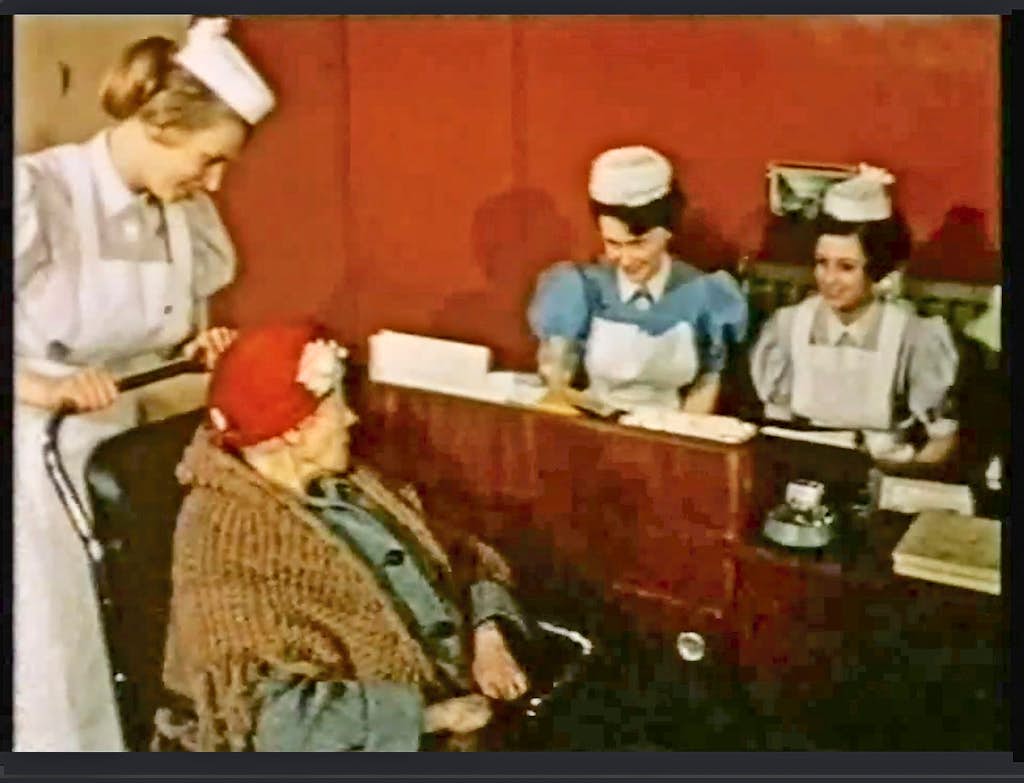
It’s not just about numbers. Modern nurses are visibly different from their classic predecessors. A 1968 London Hospital nursing recruitment film entitled Not So Much a Training, More a Way of Life (you can find it on YouTube) provides an extraordinary time capsule. Wards are bright, clean and calm. Nurses glide along in their aprons and caps, gently leaning over patients. There is an air of both intimacy and formality, with formal titles and surnames used, but also firm eye contact, human touch and laughter. Doctors and nurses are unhurried but efficient, with the watch hanging on the nurses’ uniform as much a symbol as timepiece.
The film is, of course, an advertisement, but it is far from just propaganda. It is 20 minutes long and shows in detail how nurses spend their time. It includes serious discussions about the reality of death and suffering and the question of when to resuscitate patients. The nurses are smartly turned-out young women attending lectures and Oxford-style tutorials. We see them forthrightly debating the place of women in the workplace over dinner.
This model of nursing — hierarchical, uniformed, based on primary care and governed by maternalistic matrons and ward sisters — has long since vanished. The business of cleaning, feeding and caring for the bodies of the sick has often come to be seen as low status by nurses keen to “professionalise” — acquire academic qualifications, become more like doctors and move into managerial or teaching roles. The principles of apprenticeship and internal hierarchy have been lost.
Nurses no longer look the part either, having lost their traditional uniforms along with old expectations about neat appearance, character and manners. Obesity, often caused by bad hospital food, workplace stress and poor mental health, is now rife amongst a profession focused on promoting wellness.

In a context of health scandals, growing waiting lists and a social care crisis, the declining image of nursing has contributed to lowered public trust in healthcare professionals. During the pandemic, viral videos of masked nurses in scrubs doing TikTok dances whilst most of the population was locked away at home did not help. Anecdotes and horror stories about poor care involving nurses and midwives are now common, often involving staff with poor English or unhelpful cultural attitudes towards doctors or patients.
Nursing as a way of life
What has gone wrong? Much was encapsulated in the title of that 1968 recruitment film: Not So Much a Training, More a Way of Life. Nursing was once a vocation, not just a job. Its origins were not in secular medicine, but in 19th century religious orders. The most successful current fictionalisation of nursing is the TV series Call the Midwife, which features the order of Anglican religious women who helped found modern nursing. Groups such as the Community of St John the Divine depicted in the programme, as well as religious Catholic women like the Sisters of Mercy, were the crucial template for developing the profession of nursing, a legacy visible in the nun-like uniform of traditional nurses, and the titles of “matron” and “sister”.
Florence Nightingale was directly inspired by such nursing orders, taking particular inspiration from a visit to a German Lutheran community of deaconesses in Kaiserswerth. Though from a Unitarian background, Nightingale was a devout Anglican who combined a belief in the power of empiricism with a sense of Biblical ethics and the providential role of God in nature.
She understood that nurses were in a unique position, caring for their patients around the clock, to make fine observations about their appetite, pulse, bowel movements and condition. The nurse could both create an ideal environment for recovery and provide much-needed compassion whilst relaying all the observations gleaned from care and conversation back to the doctor.
This made nursing a reforming movement on multiple fronts. It introduced a rigorous empirical basis for diagnosis, care and treatment, and also restored a more holistic model of healthcare that included diet, psychology and environment. It gave women a central role, serving at once as a vehicle for making medicine more compassionate, but also spreading scientific and medical knowledge to women and mothers. Nightingale’s genius was to marry this grounded vision of medicine with a quasi-monastic hierarchy, creating a kind of neo-monastic guild. Directly imitating Roman Catholic monasticism, she points to the model of the mother superior who assesses the character and temperament of her postulants.
This remarkable synthesis proved incredibly effective and underwrote the birth of modern healthcare and the NHS. The ranks of State Registered Nurses, student nurses and SENs (State Enrolled Nurses, essentially junior nurses with a shorter, more practical training to qualify as an SRN) provided the workforce needed for a rapidly growing health service.
The earlier generation of nurses were often younger and retired early, going part time or becoming district nurses as they married and had children. They were energetic, and the role was treated as a vocation, not just a job. Nurses were expected to work long hours and, comparative to today, were paid less.
Despite high turnover, enough experienced nurses stayed in the profession to provide invaluable institutional memory and supervisory authority, mentoring younger nurses. And despite poorer pay and hours, the nurses of the past appear to have had fewer mental health issues. For all the modern push on mental health, hierarchical structures are often far better at pastoral care, because there is a clear figure of authority responsible for the mental wellbeing of those under her. The more orderly environment removes the ambiguities and artificial sense of urgency inherent to many modern workplaces.
The management takeover
It was in the 1970s that the order that had underpinned the success and efficiency of nursing started to wither. The NHS was becoming more bureaucratic, and nurses were being lost to fiercer competition for female labour from the private sector. As society became more secular and consumer-focused, the demands and vocational aspirations of nursing came under pressure.
Similarly to teaching, the profession became politicised, with jargon, social science and progressive theories jostling traditional skills and vocational training. From the liberal vantage point of the university campus, the structured ways of nursing appeared Victorian, hierarchical and ipso facto wrong. In search of higher pay and status, many senior nurses left the wards and went into management.
Whilst ideas of holistic medicine were inherent to nursing from its foundation, just as crucial was the relationship of trust and respect between doctor and nurse, yet many emerging theories of nursing attacked doctors as embodying a purely “medical” approach to illness. According to the historian of the NHS, Geoffrey Rivett, “a partnership of trust, working to a common purpose, began to be replaced by mutual wariness and attempts to define territory”.
Industrial action and discontent over long hours and pay followed. Yet, in the 1980s, there seemed grounds for hope. The Thatcher government promised to return local control and decision-making to hospitals, eliminating the complex administrations undermining the system of matrons. And the moderation of the RCN (Royal College of Nursing) relative to other unions helped win it a preferential pay deal that helped make front-line nursing more attractive.
But a poison pill had been slipped in with the sweeter-tasting medicine. Fortified by their sometimes naive faith in the private sector, the Conservatives brought in a director of the Sainsbury’s supermarket chain, the businessman Roy Griffiths, to reimagine the NHS. Griffiths brought the managerial revolution that was sweeping private companies to the NHS, creating a permanent professional managerial class. This was the effective death knell of the matron, with nurses now under the authority of managers who weren’t actively involved in care. In a familiar story across many fields, ambitious nurses would increasingly leave the front-line of the profession to become administrators, whilst those who remained on the wards lost relative status.
By the 1990s and 2000s, these changes had effectively ended traditional nursing. The uniform was gone, with loose-fitting unisex scrubs or tunics and trousers preferred. Nursing was either “professionalised” in the form of managers and specialists, or casualised in the form of HCAs and careworkers. Foreign healthcare workers, often unfamiliar with British nursing, accelerated the decline. Scandals of filthy hospitals and patients left to suffer in corridors have recurred continuously ever since.
Nursing was taken over by ideologues and distant bureaucrats who lost sight of its core purpose and identity
Not all of the changes in nursing were for the ill, nor could they all have been avoided. Better pay, specialisation and academic training were crucial as medicine became more technical and complex. As hospitals processed patients more quickly, traditional ward-based nursing became less central, and district and community nursing more important. The introduction of nurse practitioners was vital in freeing up time and resources as healthcare expanded, and when done well the hybrid medical/nursing role combined the best of both worlds.
Yet these same developments were poorly handled, fragmenting the profession, and destroying its ethos and morale. Rather than adapting and evolving, nursing was revolutionised by ideologues and distant bureaucrats who lost sight of its core purpose, mission and identity.
Back to the future
If this damage is to be reversed, a guild-like self — regulating and self-managing internal hierarchy needs to be rebuilt, giving nurses a sense of unity and identity even if they end up in specialisms, district nursing, or educational roles. Rather than being held as a higher clerisy, management must go back to the ward and be carried out by those still working in primary care. Senior leadership roles should thus end up being filled by men and women with a lifetime of nursing experience, rather than decades of technocratic management.
Nurses need to go through a more regular form of training in such environments, so that every nurse has the same “core” experience of the Nightingale model of patient care and careful observation over time. Hospitals should keep patients for longer where appropriate and dedicate more resources to outpatient care either in dedicated facilities or through district nursing. Borrowing the Buurtzorg model pioneered in the Netherlands, nurses in the community should act autonomously, as a “self-managing team”, free to spend as much time with patients as they think is needed, but with clear leadership and pastoral support from senior nurses.
Traditional uniforms, or some elegant modern variation of them, should return to bolster this sense of identity, unity and purpose. Likewise, HCAs and careworkers should be replaced or retrained with a revived form of SEN (State Enrolled Nurse), so that the benefits of the nursing ethos are spread across the care sector, and with a higher level of training and pay.
As we struggle with an ageing population and social care crisis, reviving nursing is about much more than pay and policy. It requires a spiritual and institutional regeneration in which the role of vocation — the ideal of dedicating your life to a higher purpose — is recovered and promoted anew.