On Marco Rubio, Carl Schmitt and the potential for a new direction for American influence
While the world was captivated by the destruction in the Gulf and soaring oil prices, the war claimed another casualty. JD Vance, the heir apparent and 2028 presidential hopeful, who had built his political brand on opposing forever wars and criticising American military commitments abroad, now had to justify the intervention in Iran. He seemed to realize the trap he had stepped into and disappeared from social media after bidding farewell to the first American soldiers killed in the faraway Gulf. The signal of loyalty to Trump had proven more important than the principles he had once professed.
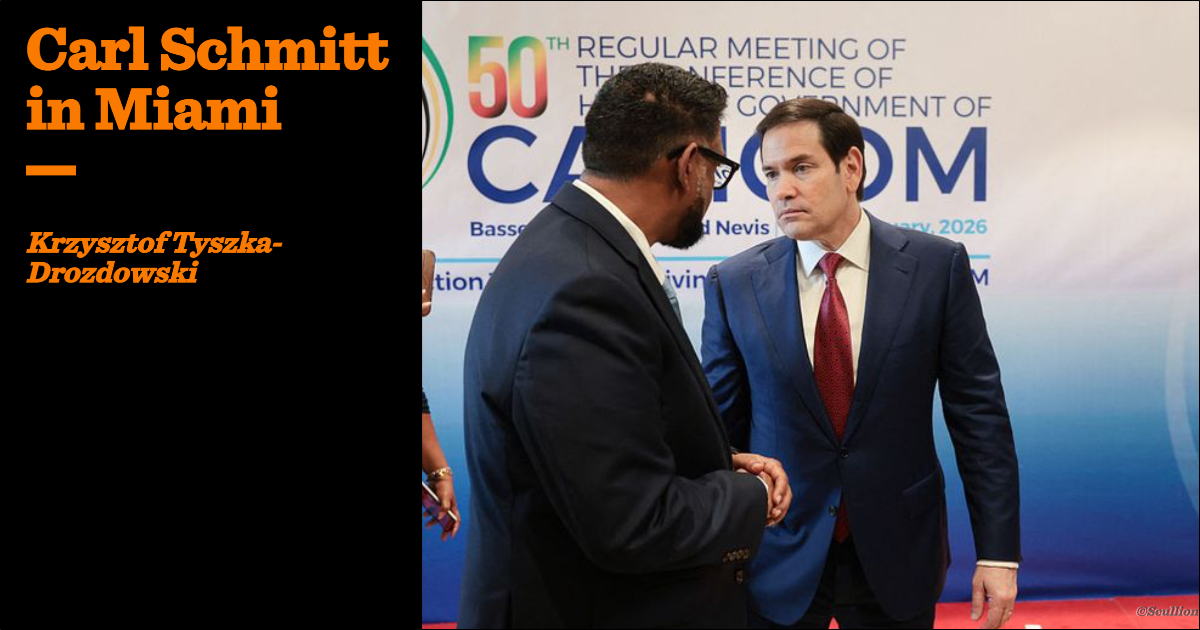
While Vance was defending airstrikes he would have condemned if the office were occupied by a Democrat, a different, more constructive foreign policy effort was underway. The Miami Declaration, a promise to fight cartels and criminal organizations in America’s backyard, was another overlooked accomplishment added to Marco Rubio’s 2028 portfolio.
While Vance chose to be Trump’s pitbull, Rubio balanced loyalism with the role of architect of a new American system in Latin America. His first trip as Secretary of State was not to the remote margins of the empire, but to the backyard of the republic: to Central America.
One of the most important stops was Panama. The country, a trade link between two hemispheres built by the U.S., was falling under Chinese influence. Now, it’s being rolled back. Rubio spearheaded the toppling of Maduro in the most successful US intervention since the ousting of Noriega in 1990 — a smart, surgical operation the world had convinced itself the US was no longer capable of. He worked with Scott Bessent, who engineered dollar swaps to keep Javier Milei in power, giving Argentina more time to reform. Mexico has been pressured not only to hit cartels flooding the United States with drugs and violence, but to slap China with steep tariffs (including 50 per cent on cars). Like-minded allies, ready to deepen their ties with America, are winning elections across the continent.
The decision to intervene in Venezuela is a testament not only to Rubio’s political vision. He demonstrated acumen in building coalitions and outmaneuvered his rivals. Richard Grenell, Trump’s envoy for special missions, wanted to push for more talks with Maduro, continuing the Biden line toward Caracas. Rubio was able to impose his hardline solution to the problem by winning Stephen Miller and Peter Hegseth over. The rest is history.
Careful readers of the National Security Strategy will be struck by the seriousness of the section covering the Western Hemisphere. While in Trump’s 2017 National Security Strategy the Western Hemisphere received a brief treatment, in 2025 it became the longest one. Its importance was consecrated by the “Trump Corollary to the Monroe Doctrine”. In sharp contrast, the part concerning Europe reads likesomething written by Gen Z fans of Julius Evola, with vacuous slogans about defending Western civilisation and identity. Paragraphs devoted to Asia betray wishful thinking about restoring trade balances with China and maintaining “cutting-edge military advantage” (if there is one, then why in war simulations, as admitted by Pete Hegseth, does the US lose every time?).
When the NSS lays out that America’s aim is “denying non-hemispheric competitors,” what it declares is a reordering of the world. The U.S. has for too long expanded its geopolitical liabilities, while assets required to cover them were shrinking. It has reached a point where its traditional sphere of influence has shifted under the economic sway of its Chinese rival.
“The old world is gone … We live in a new era in geopolitics, and it’s going to require all of us to sort of re-examine what that looks like and what our role is going to be,” proclaimed Rubio. His strategy toward the Western Hemisphere traces neatly back to the vision of a multipolar world articulated by Carl Schmitt: a globe divided into “great spaces”, or Großräume.
A geopolitical space, Carl Schmitt explains, is, first and foremost, “a space of achievement.” Cuius economia, eius regio is the principle that decides who rules over those spheres. China building factories, nuclear plants, ports and railways across the continent, buying up rare earths and other resources, means pulling Latin America out of the US “space of achievement”. China has 24 signatories of the Belt and Road Initiative in the Western Hemisphere. Military cooperation should also raise eyebrows. Consider: China has five times more Latin American students in its military academies than the US. There is still plenty of work to be done, even if Washington is gaining political allies in Latin American capitals and cutting off the flow of Venezuelan oil to China.
The neo-Monroeian project was articulated in its most ambitious form by Republican Senator Benito Moreno: “from the tip of Argentina to the tip of Canada, a Western Hemispheric alliance that the world has never seen… We really have everything we need here. And we have these two great oceans in between [us and the world]. And we can be basically a completely self-sufficient western hemisphere… with America as a leader.” Instead of escalating commitments in places where none of the US’s vital interests are at stake, it would focus attention and resources on rebuilding, in the parlance of Carl Schmitt, the American Großraum.
There is a disquieting element in all of this. Reestablishing American dominance in the Western Hemisphere will mean accepting that the other superpower, China, has the right to claim its own geopolitical space. For generations raised under American empire, this sudden leap into a multipolar world will be frightening and fraught with danger.
Marco Rubio’s vision seems to point to a different America. Not a replay of the aughts — a Republic, not an empire; one disillusioned with wars in faraway places; led not by hubris, but by a desire for self-renewal. The neo-Monroeian project could be the only constructive legacy of Trump’s foreign policy and the vision of the future that current American policy so painfully lacks.
The crisis of American empire may well serve as a focusing mechanism
The 2028 election remains a riddle. What we can say is that the Secretary of State represents a vision behind which Americans from both left and right could unite. Vance, by trading his ideas for culture war gimmicks and losing his credibility in the Iran conflagration, made it much easier for Marco Rubio.
The crisis of American empire may well serve as a focusing mechanism. The Ukrainian quagmire, the failure to neutralize the Houthis, the retreat from the trade showdown with China, now the war with Iran. Let’s not forget the looming threat of Chinese invasion of Taiwan. American power is spread increasingly thin, no longer adequate to cover its liabilities around the world. Washington will have to choose what counts. Marco Rubio could be the president who makes that choice.