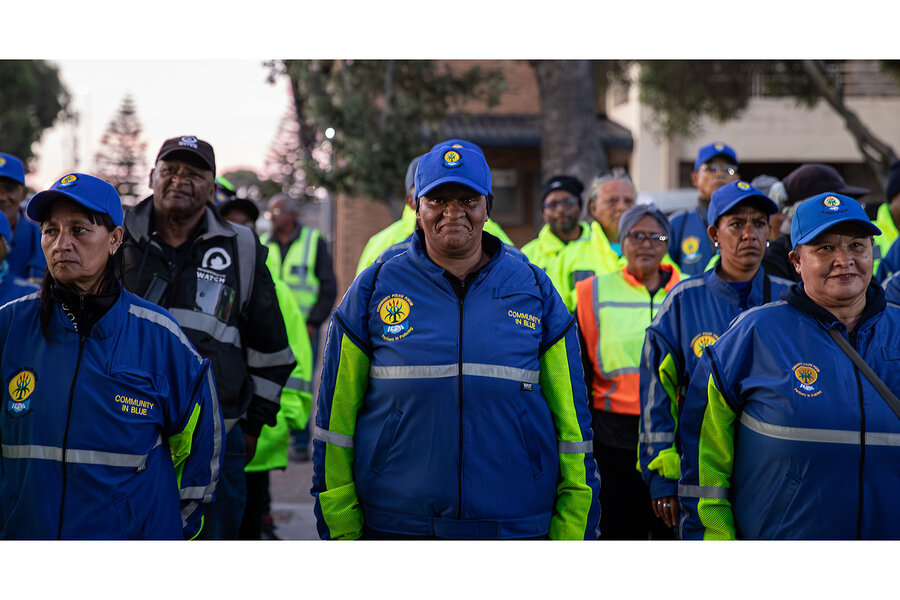
On a recent morning in Cape Town, as tourists bronze themselves on the city’s white-sand beaches, a small volunteer army of mothers and grandmothers patrols streets that visitors rarely see. The group moves briskly on foot across Rocklands, a working-class neighborhood on the city’s edge.
The goal is simple: to protect residents and disrupt the activities of local gangs, which were responsible for nearly 500 homicides in Cape Town between April and September of last year alone. In theory, this should be the work of the police. But many here view officers with suspicion.
In any case, these matriarch patrollers have a weapon the police don’t.
Why We Wrote This
Cape Town’s gangs are notorious. But in at least one part of the city, they face a formidable foe: the neighborhood “aunties.”
Call it the power of the neighborhood “auntie,” who like any loving older woman in one’s life, is there to protect, nurture, and, when the situation calls for it, make one wither under her disappointed gaze.
“We speak to [gang members]. We respect them, treat them as human beings,” explains one of those aunties, Cheryl Driver, her high-pitched voice full of enthusiasm. In return, gang members usually speak to the aunties in the hushed, deferential tones reserved for elders. “We are all families; they are our children,” Ms. Driver says.
Fractured communities
Rocklands sits in the Cape Flats, a stretch of sandy and windswept working-class neighborhoods on the edge of Cape Town, where many people of color were forcibly moved decades ago by the apartheid regime. Today’s gang violence has its roots in that era, when relocations tore apart families and old social structures, leaving many young people poor, hopeless, and looking for somewhere they belonged.
Gangs offered a sense of community and a means of income where formal jobs were scarce. And with scant police presence in the Cape Flats, they flourished.
Today, groups with names such as The Americans, The Fancy Boys, and The Hard Living clash for control of territory and the Cape Flats’ lucrative drug trade. In neighborhoods like Rocklands, it is not uncommon to find bodies lying on the pavement after gang shoot-outs. Residents say they have learned to look away, cross the street, and pretend they saw nothing. Parents warn their children not to play outside, and families lock themselves indoors before nightfall.
Confronted with this violence, community watch groups – including several led by older women – are taking matters into their own hands. Wielding flashlights and wearing yellow jackets, they patrol relentlessly. “When [gang members] see us coming, they leave,” explains Amanda February, who is in her mid-50s and one of the founders of the Rocklands community neighborhood watch, on a recent morning patrol. “Being out on the streets every day is disrupting their business.”
As she walks, she points to two silhouettes retreating from the patrollers into the dark. “They were up to no good,” she says.

“Eyes and ears” on the ground
Ms. February, like many mothers here, knows the pain of gang violence intimately. Her daughter was addicted to “tik” – a local word for methamphetamines, which have flooded the Cape Flats. For months, Ms. February and her husband searched local drug dens to find her. That’s when it occurred to her: “We had to act as a community,” Ms. February says.
Today, her daughter is in recovery, and Ms. February is on the streets to protect other people’s children.
Gangs frequently offer children and teenagers “a bit of money to hide drugs or stand guard, and then it becomes a vicious cycle,” explains Carol October, another member of the patrol group. Gangs target kids from homes where “there’s no money, no fancy clothes, sometimes no food. The parents, especially the fathers, are often absent,” she says. “Then the gangsters come and tell them they’re going to buy them stuff. They become role models.”
And sometimes, she says, there’s nothing the aunties can do to stop that. On a recent morning patrol, she and the rest of the group stand on the top of a hill, looking down at a house connected to the drug trade. “They’ve seen us; they’re hesitating,” says Ms. October, referring to two young men approaching the house. They look up several times, eyeing the patrollers. Eventually, a girl comes out of the house holding something in her hand and gives it to the men.
The women can only observe. Once a week, the group patrols alongside the police and other neighborhood watch members. During those patrols, they can intervene when they see a crime being committed. But most days, their role is simply to watch. “We’re not armed; we are just the eyes and ears of the neighborhood,” Ms. October says.
Still, every morning, they are up at 5 a.m., escorting children to school, and adults to the taxi ranks and bus stops from which they will travel to the city for work.
By 8 a.m., Ms. October must be at her job as a nanny in one of the city’s more affluent neighborhoods. She usually returns home after dark, sometimes joining the night patrols.
“My husband thinks I should give myself a break,” she says. But she remains determined: “We are all mothers and grandmothers. If we don’t try to keep our children safe, nobody will do it for us.”