At this time of year we’re all trying to avoid falling sick – but are you able to detect the subtle signs that someone is ill?
While coughing, sneezing and nose-blowing are obvious clues, there are faint signals that can also indicate a person is worth avoiding.
Researchers carried out a study asking participants to analyse pictures to see how well they could detect lassitude – the facial signs someone is unwell.
They were shown different images of 12 individuals, who had a photo taken when they were healthy and another taken when they had Covid, a cold or the flu.
Overall, they found that women were more accurate than men at distinguishing between a person who was sick or unwell.
This could be because women, who have historically been the primary caregiver for infants, have undergone evolutionary pressure to recognise sickness early.
‘When feeling sick, people reliably exhibit observable signs in their faces. People are, overall, sensitive to the lassitude expression in naturally sick faces,’ the team, from the University of Miami, said.
So, can you tell which of these images were taken when the individual was ill?


At this time of year we’re all trying to avoid falling sick – but can you tell which image shows an ill person? Left is picture A, right is picture B

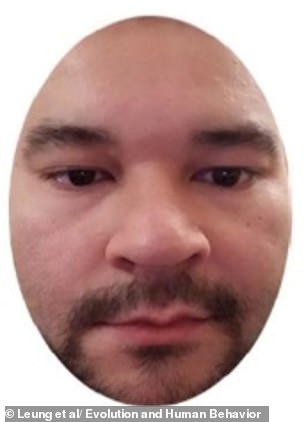
Of these two images, which do you think shows the person when they are sick? Experts say women are better at detecting small clues. Left is picture C, right is picture D
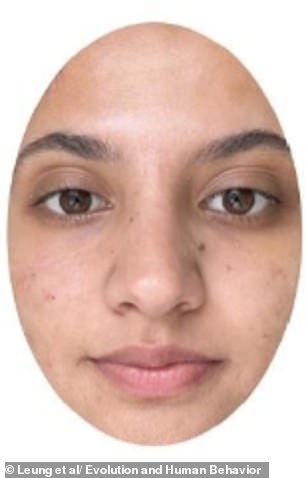
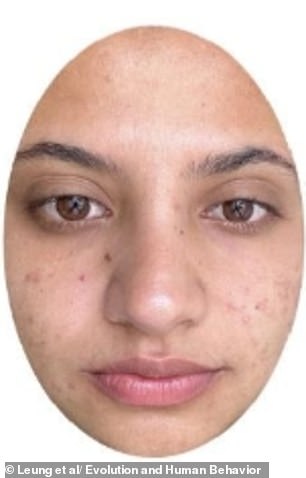
Participants were also shown images of this individual – which do you think she looks the most ill in? Left is picture E, right is picture F
The researchers revealed some telltale clues that indicate someone is unwell.
These include red or sleepy/relaxed eyes, drooping eyelids, pale and slightly parted lips and drooping corners of the mouth.
Other indications can be clammy or puffy skin, or a red face.
From the images above, pictures A, D and F are of individuals who are sick.
Upon closer inspection, picture A shows the person appearing slightly more shiny – or clammy – than picture B, when they are healthy.
In picture D, taken when the person was unwell, the eyelids droop more and the lips appear paler than in picture C.
They also seem to have more of a reddish glow – another signal that can indicate illness.
While pictures E and F are a bit trickier, you would be correct if you said the individual is sick in picture F.

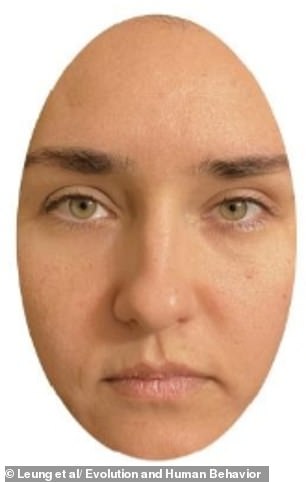
Now you know what to look for, can you tell which of these pictures shows the woman when she is sick?
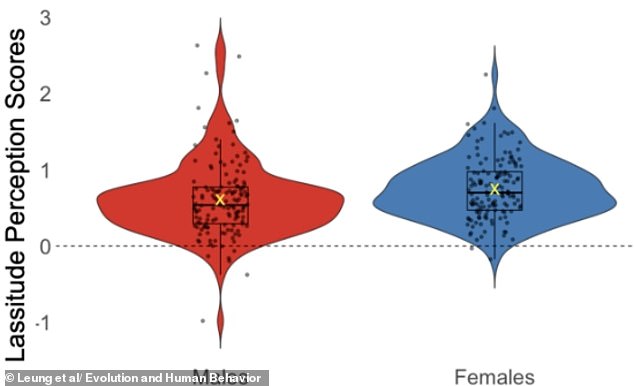
The researchers found that women were able to perceive subtle signs of illness better than the men involved in the study
In these two pictures, it is slightly easier to work out which one was taken when this woman was ill.
In the second image, she has a turned-down mouth and obviously drooping eyelids, indicating she is unwell.
She also appears paler and slightly clammy.
Writing in the journal Evolution and Human Behavior, the team said: ‘Overall, the current study found that females are better than males at recognizing facial sickness based on ratings of people’s faces.
‘This finding indicates that females may be more attuned to natural facial cues of sickness.’
The researchers said future studies will be necessary to disentangle what mechanisms may have shaped these sex differences.
‘Nonetheless, our findings suggest individual differences in the ability to perceive facial signs of lassitude, with some individuals—particularly males—potentially benefiting from support in developing this skill,’ they concluded.
This could help contribute to reducing the transmission of disease.
The UKHSA has recently shared advice on symptoms to help people determine whether they have cold, the flu or Covid.
A cold is usually characterised by a blocked or runny nose, sneezing and a sore throat, and symptoms occur gradually.
Flu signs and symptoms, meanwhile, develop very rapidly and extreme tiredness is common. Other symptoms include a fever and body aches.
While Covid symptoms have changed over time, some of the most prevalent include a change in sense of taste or smell and a particularly painful sore throat.