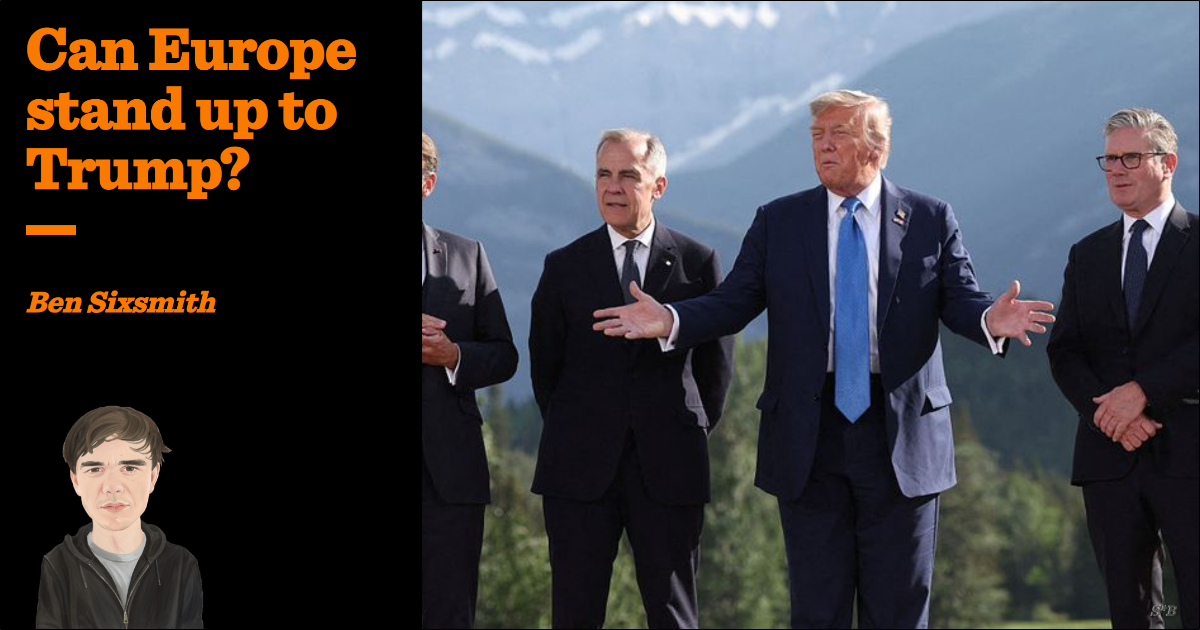

It feels bittersweet to see European leaders standing up to Donald Trump’s arrogant demands for Greenland.
Yes, I am glad to see them standing up to him. They should. I’ve said it before and I’ll say it again: American bullying of its allies over Greenland is tactically short-sighted and morally abominable. That Trump’s petty bitterness over not receiving a Nobel Prize, and hubris after his brief intervention in Venezuela, appear to have been significant only make this campaign look more stupid and obnoxious. Trump’s apologists will continue to reel off pained references to Arctic security, and self-defeating third worldist allusions to the plight of the Greenlanders, but this is clearly a giant ego trip before it is anything.
So, why is it bittersweet? Well, firstly it’s tough to see how European leaders are going to maintain their confrontational posture. The fact is that Europe needs the US a lot more than the US needs Europe. The US does benefit from its links to Europe, and it is possible that Trump will back down — or at least get distracted — but we should not have such a weak hand of cards to begin with.
Trump is behaving disgracefully, yes, but he is behaving like this because he can
This leads us on to the broader source of bitterness. Trump is behaving disgracefully, yes, but he is behaving like this because he can. David Polansky was not wrong to argue in The Critic last week that European states have acted like protectorates without wanting to be called protectorates.
Military spending has declined despite repeated American complaints. Perhaps Europeans could have been forgiven for taking the objections of George W. Bush lightly (his administration, after all, was hardly a glowing advert for the importance of military spending). But how about Barack Obama’s administration? It was Obama’s Secretary of Defense, Robert Gates, who said that NATO was “turning into a two-tiered alliance”:
Between those willing and able to pay the price and bear the burdens of alliance commitments, and those who enjoy the benefits of NATO membership – be they security guarantees or headquarters billets – but don’t want to share the risks and the costs.
This, said Gates, was “unacceptable”. What was the excuse for not listening then? In fairness, European nations have sharply increased their military spending, like Poland and Denmark (the latter of which makes Trump’s bullying even more disgraceful). But European armies — including Britain’s, as Ben Barry so disturbingly wrote in the December-January issue of The Critic — remain in a sorry state. It was just too easy to rely on American power.
European states have also been far too complacent about energy. Last week, German Chancellor Friedrich Merz acknowledged that abolishing nuclear energy in Germany was “a serious strategic mistake”. Granted, it was not his decision. But it still feels a bit like hearing someone who lives in the middle of a Southern Californian forest saying that getting rid of fire extinguishers might have been short-sighted. Ya think?
President Trump is not a good man, or a wise man, but he is not always wrong. Back in 2018, he warned German officials against relying on Russian gas. Just a few years before the invasion of Ukraine, the German diplomats giggled at him. Are they still laughing? (Of course, Britons have their own reasons for concern on this score.)
Finally, European leaders have undermined any sort of national or civilisational identity that might have bolstered a stand against this sort of imperialism. Mass migration has taken place on a scale that — as Paul Heron writes for The Critic today — makes any kind of collective identity a chimera. Moreover, European leaders have consistently talked as if Europe is defined solely by universal values, making it almost impossible to rally around its distinctness. Far fewer Europeans than Americans would be willing to fight for their country in any circumstances.
It is — thank God — extremely impossible that we are going to go to war with the US. Still, the fact that Trump thinks he can push us around has everything to do with European leaders making us so pusharoundable. Perhaps it’s not too late. Perhaps, as Sebastian Milbank writes in these pages, Trump will force our leaders to be more realistic. Alas, I suspect that the opposite could be the case. I suspect that Europeans will treat this as a chance to bask in a sense of cultural superiority. No, we might not have the military power, or the economic power, or the cultural power, but at least we’re not so vulgar.
Well, there’s something to it. I wouldn’t want Europeans to be infected with Trumpian jingoism. But could we not have effective institutions as well?