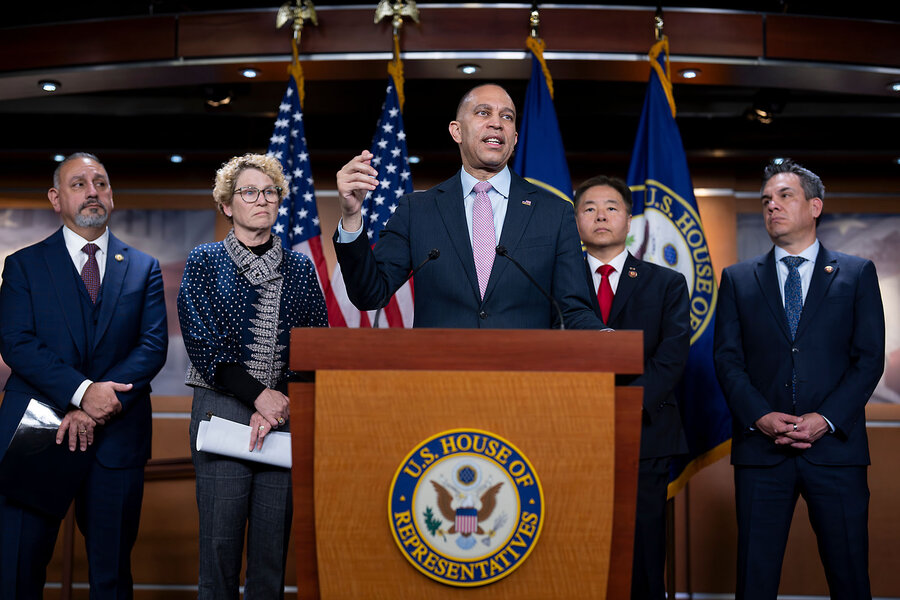
The Senate’s failure on Wednesday to pass a war powers resolution curbing the president’s ability to keep attacking Iran – with a similar outcome expected in the House – represents the latest example of how Congress in recent decades has become more of a bystander than a decider on U.S. military operations.
The House plans to vote Thursday on whether to constrain President Donald Trump. Lawmakers, though, could get another chance to weigh in on the war: The Trump administration is reportedly preparing to ask Congress to approve up to $50 billion in supplemental funding for the effort. But the debates over war powers, experts and lawmakers say, reflect an argument that started with the country’s founding: Which branch of government has more authority over military conflict?
The Constitution designates the president as commander in chief of the armed forces. But it gives Congress the power to “declare war.”
Why We Wrote This
Some members of Congress want to constrain President Donald Trump’s attacks on Iran, with votes occurring this week. But lawmakers have been diluting their oversight role for decades, and that history plays a role in the possible failure to get a war powers resolution through both the Senate and the House.
Congress has not done so since 1942. Experts agree that, in recent decades, the institution has ceded much of the decision-making about war to the president. Many see that as a sidelining of the Founding Fathers’ system of checks and balances, though some think it’s more in line with what the Founders envisioned.
Clark Neily, the senior vice president for legal studies at the libertarian-leaning Cato Institute, says Congress does have mechanisms it can use to exert its power. Among them are withholding funds the president needs to take certain actions, or, as a last measure, voting to impeach a president who is overstepping their boundaries.
But, he says, the institution has to be willing to act.

“When Congress is either unwilling or unable to exercise those powers – as ours clearly is – then regardless of what the Constitution says, there’s no real practical limit on the president’s ability to unilaterally involve us in foreign military conflicts,” Mr. Neily says.
Congress’ war power over time
Michael J. Glennon, a professor of constitutional law at Tufts University, traces the decline in Congress’ war power partly to things he says the Founding Fathers didn’t predict: strong political parties, and the way members feel pressured to fall in line behind their party’s president.
“[The Founders] believed that members of Congress would have an ambition to resist encroachments by the executive, because they’d have a kind of institutional pride that essentially prevails against all else,” he says. “And they don’t.”
Lawmakers’ support for the war currently appears to be breaking down along party lines. With a few exceptions, Democrats oppose it while Republicans are supporting Mr. Trump.
In the past, Congress has at times tried to reassert its authority in military conflicts.
“In the wake of the Vietnam War, there was a realization,” Mr. Neily says, that ambiguity over how war powers should be divided was leading the president to assert more control.
To try to claw back some of that authority, Congress in 1973 passed the War Powers Resolution, a law requiring the president to notify Congress within 48 hours of military action and barring the deployment of armed forces for more than 60 to 90 days without congressional permission.

The law also directs a president to “consult” with Congress “in every possible instance” before initiating hostilities.
Though Secretary of State Marco Rubio called some members of Congress to alert them immediately before the strikes on Saturday, many members of Congress – mainly Democrats – say the institution was bypassed.
Mr. Glennon, who in 1973 provided legal advice to Senate conferees drafting the War Powers Resolution, says Mr. Trump violated it when he directed strikes against Iran. “Consultation implies going to Congress for its advice and counsel,” the professor adds.
Mr. Trump and some other Republicans have said the 1973 law is unconstitutional.
In recent conflicts, including the global war on terrorism, Congress has passed what’s called an authorization for use of military force, or AUMF. It’s a way to allow a president to take targeted military action without formally declaring war. In 2002, Congress approved an AUMF which allowed President George W. Bush to send armed forces into Iraq the following year.
In 2011, many Republican lawmakers criticized President Barack Obama’s decision to conduct strikes in Libya without obtaining a similar authorization from Congress. The Obama administration argued those military operations were limited enough that they did not constitute traditional “hostilities.”

Francis Chung/POLITICO/AP
War powers resolutions
President Trump did not request an AUMF from Congress when the U.S. carried out strikes against Iranian nuclear sites last June, or when it captured Venezuelan President Nicolás Maduro in January. In both cases, lawmakers introduced resolutions demanding the president halt military action and await congressional sign-off. Without enough Republican support, they all failed.
Some say these types of resolutions don’t go far enough. Democratic Sen. Chris Murphy of Connecticut has called for Congress to block all other legislation until members debate and vote on an AUMF for the war in Iran. He argues lawmakers shouldn’t only vote to stop a conflict, but on whether to start it in the first place.
“If a War Powers Resolution becomes the way we debate war, then the burden is forever shifted,” he wrote on social media Monday.
Republican Sen. John Curtis of Utah, who acknowledges Congress has ceded some of its power to the president, on Tuesday called the current situation “a train that’s left the station.” He said forcing the president to stop the war at this point would be “devastating” and unfair to U.S. troops, including those who have already lost their lives.
John Yoo, an expert in constitutional law at the University of California at Berkeley, doesn’t think wars must be authorized by Congress before they happen. Instead, he says Congress’ power to “declare war” has more to do with its ability to control military spending, although he recognizes many of his peers disagree.
“Congress is, of course, free to try to stop any military intervention, but I think the Constitution and historical practice require Congress to do this primarily through its power of the purse,” he says.
If Mr. Trump asks Congress to approve additional military spending, it could put that “power of the purse” to the test. His request could face significant hurdles – though Republicans hold the majority in both chambers, they will still need a handful of Democratic votes in the Senate to pass new funding.