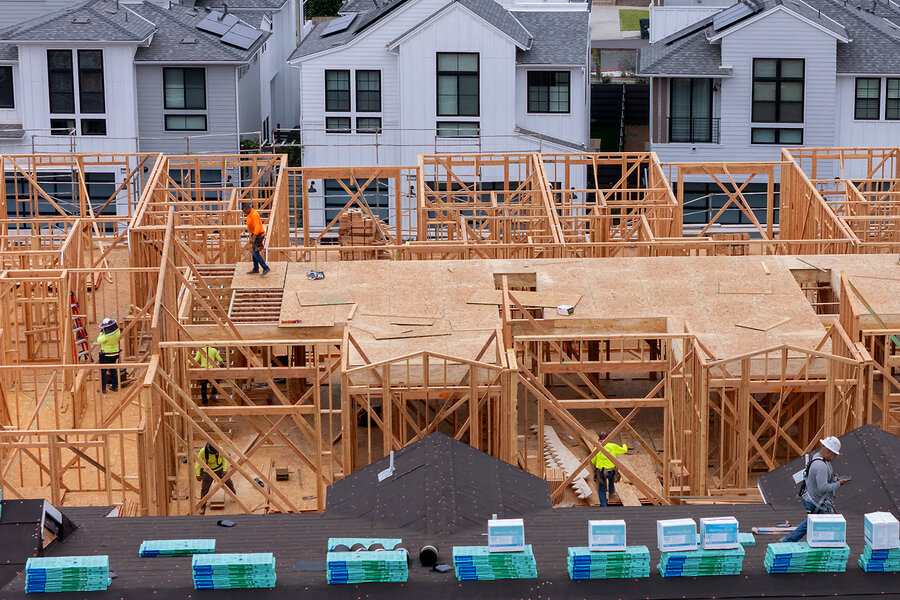
Tricia Crane stands at the corner of Wilshire Boulevard and 26th Street in Santa Monica, a few blocks from her home, pointing out a stretch of businesses that will be replaced with a 170-unit apartment building.
A Starbucks has already closed; a store selling chairs and mattresses is still open, but not for much longer. This block just 2 miles from the beach is scheduled to be redeveloped in January.
Facing a budget crisis and a state mandate to create more housing, members of the City Council, she says, are “just doing whatever they can” to get more units built.
Why We Wrote This
One answer to an affordability gap in housing, experts say, is building more units to try to ease the pressure on prices. That can mean changing laws that regulate where and what kinds of housing can be built.
The eight-story building will stand out among its mostly one-to-three-story neighbors. It’s one of a half dozen developments that will add over 1,000 units to this coastal city of 91,000 people next to Los Angeles.
Average monthly rent is about $3,500 here, among the highest in the United States. Ms. Crane is concerned that the addition of these market-rate units in the highly desirable beach community won’t do anything to bring prices down. “We are losing our middle class,” she says.
But these are the type of projects that pro-housing advocates hope to see more of, and California is making them easier to build. Over the past few months, Gov. Gavin Newsom signed a slate of laws aimed at eliminating a deficit of 2.5 million housing units. In support of more and denser housing, lawmakers relaxed the state’s landmark environmental rules, cleared the way for multiunit housing near transit hubs, streamlined building permits, created new funding programs for developers, and increased tax credits for renters.
The laws are, in part, designed to promote units that are affordable – generally defined as costing no more than 30% of a family’s income. They move California in the right direction, says Sherri Lawson Clark, a cultural anthropologist at Wake Forest University who studies housing and poverty. If California – where midtier homes cost more than twice the nationwide average – can narrow the affordability gap with an influx of new housing, then it could “perhaps be a blueprint for other states and localities,” she says.

Ali Martin/The Christian Science Monitor
The Golden State’s effort faces significant obstacles. Factors like the high cost of construction, concentration of relatively high earners, and high interest rates affect how much it costs to build, buy, and rent units – which directly impacts their accessibility. In fact, California has enacted a series of reforms over the last decade, only for the crisis to persist.
A recent study by the McKinsey Institute for Economic Mobility estimates the U.S. is short 8.2 million housing units – 32% more than 10 years ago, despite decades in which laws have often moved toward more streamlined permitting and denser housing. The limited supply, says the report, has kept rents and home prices high.
California’s need for more housing units, plus a growing disparity between income and housing costs, calls for a “both/and” solution, says William Fulton, professor of practice at the University of California, San Diego’s department of urban studies and planning. “You have to build way more housing” in general, he says. “But you also need to build as much affordable housing as you can.”
New laws could change California landscape
A long-standing state law requires cities to have plans for meeting projected housing needs, and to update those plans every few years. About two-thirds of Santa Monica’s existing housing stock is in buildings with five or more units, according to a 2023 analysis by the Santa Monica Daily Press. The city’s building target is nearly 9,000 new units by 2030. Just over a third of that – 3,400 – has been completed. Nearly all of it is in multifamily or mixed-use buildings.
The new law that allows for more housing near transit hubs clears the way for high-rises of up to nine stories, and overrides any local ordinances.
The wide-ranging reforms reflect the complexities of housing affordability.
“There isn’t a silver bullet here,” says Mr. Fulton. Homes get built at the market’s highest end, where profits are higher, and at the very low end, because that construction is subsidized. But “very little new housing is being built” for people making $100,000 a year, he says. “That’s a very complex spot to be in. … Rents are going up, and they’re the ones who are really getting squeezed.”
Only 15% of Californians can afford to buy a median-priced single-family home in their state, according to the California Association of Realtors. In 2012, it was 56%.
Adding market-rate units, even at the high end, helps ease the shortage and expand affordable options, says Mr. Fulton. As people move into more expensive homes, their less expensive units free up for others to move into.

This push to expand the kinds of housing available in California communities could reframe the California dream, as condominium and apartment buildings gain legislative support to outpace single-family homes like the ranch, Craftsman, and Spanish bungalows found throughout the LA area.
And one significant obstacle to building condos and apartments no longer exists. Faced with the loss of thousands of homes in the LA wildfires, plus the increasing crisis of affordability, lawmakers agreed on limited reforms that ease restrictions on denser building where infrastructure already exists, generally in urban areas.
The new law rolls back the landmark California Environmental Quality Act, waiving its regulations for “infill” projects and clearing the path for a wide range of development, including single-family homes as well as multiunit and mixed-use projects.
Housing effort has community impact
The new laws will affect residents in different ways. In some areas, developments have the potential to usher in big changes to traffic patterns and demographics.
Ms. Crane moved to Santa Monica with her husband in 1982. They bought a 1920s Spanish bungalow on a leafy street not far from the planned 170-unit building.
If that building goes up, she says, not only will traffic increase on the smaller side streets, but it will make parking more difficult as well. She also laments the loss of businesses along the commercial stretch, which has a mix of restaurants, boutiques, grocery stores, and shuttered storefronts.
“We’re losing community,” she says.
But the YIMBY movement has had strong backing in the State Legislature. Standing for “Yes in My Backyard,” YIMBY counters the idea of supporting solutions as long as they’re implemented somewhere other than near where one lives.
That “yes” movement, which advocates for more and denser housing, is championed by state Sen. Scott Wiener, who was elected on a pro-housing platform. Governor Newsom campaigned on a promise to lead the state in building millions of new units by 2025. Both say increasing the housing supply will ease the state’s affordability crisis.
California YIMBY declared the state’s reform package a “landmark victory” earlier this month in a newsletter. “2025 was by far the biggest year for pro-housing reforms in our history,” the group wrote.
But driving around Santa Monica on a tour of the new housing complexes, Ms. Crane calls them “a gift to the developers.” (The Monitor reached out to builders and had no response.)

Ali Martin/The Christian Science Monitor
“This is not going to generate affordable units,” she says. “This is driving the middle class out.”
The National Association of Home Builders published a recent study that determined about 75% of U.S. families could not afford to purchase a median-priced home. For most of the last 20 years, median home prices in the U.S. have exceeded the affordability benchmark of 30% of a family’s income. This year, the median cost of housing in the U.S. shot up to nearly half (47%) of a family’s median income.
Miracle McKinney aspires to purchase a home, but for now, “it’s just really survival,” she says.
Ms. McKinney estimates she spends close to 70% of her monthly income on housing, even though she lives in a subsidized apartment. As a volunteer with the nonprofit Alliance of Californians for Community Empowerment, she advocates for policies that keep people housed. “Building isn’t the only solution,” says an ACCE spokesperson.
ACCE wants to see more cities pass laws that allow tenants an opportunity to purchase their building if it goes on the market. Tenant-opportunity-to-purchase acts are in at least 11 cities, including San Francisco, Chicago, and Washington, plus Maryland.
Ms. McKinney says she and her neighbors can’t compete with the corporate developers buying up properties.
Everyone deserves housing, says Dr. Lawson Clark from Wake Forest, and the U.S. has the capacity.
If there are too few housing units, “then, yes, I think we need to sort of make a way for that to happen.”