A pair of brothers worked tirelessly for over a year to save a crumbling mansion in Michigan that they bought for just one dollar.
Christopher and Steve White’s efforts have now left the historic Gilbert Mansion in Ypsilanti on sale to prospective apartment building owners for $1.13 million.
The brothers told Realtor how they first came across the 19th century building in 1986, when its windows were broken and boarded, eaves sagged and rotted, ornate brackets were falling off, bricks were crumbling, paint was peeling, window frames had deteriorated and the original front door was completely gone.
At that point, city officials had already spent seven years trying to find a buyer for the decrepit property, which was built in 1861 – the same year then-President Abraham Lincoln called for 75,000 volunteer troops as hostilities ignited with states that had seceded from the union.
‘The city was taking proposals to find the best fit for the community,’ said Christopher, who has owned the property for 40 years.
‘Someone proposed a bed-and-breakfast. Someone else proposed office space,’ he said, while he and his brother submitted their proposal to turn the Second Empire Mansard jewel into an apartment building.
To their advantage, the Whites had already made a name for themselves in the city for renovating other historic properties, including two nearby homes that they had just finished converting into five-unit and seven-unit apartment buildings.
City officials ultimately approved their proposal, and the brothers bought the property for just one dollar.
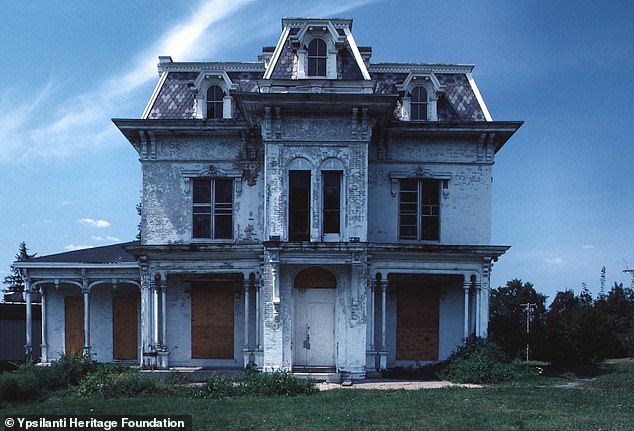
Christopher and Steve White purchased the historic Gilbert Mansion in Ypsilanti for just one dollar from city officials
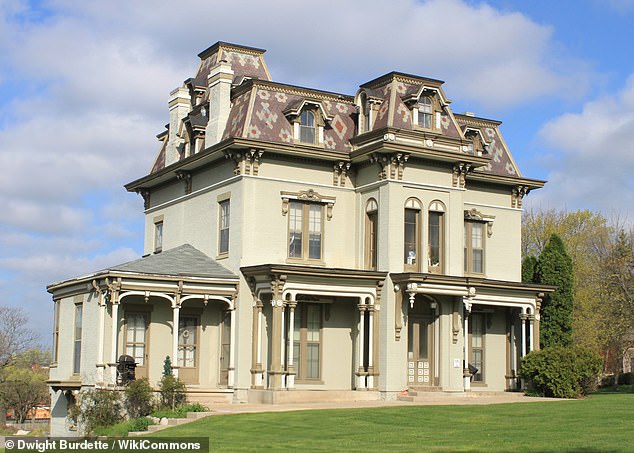
It is now on sale to prospective apartment building owners for $1.13 million
But in order to preserve the beauty of the historic home, the siblings conducted exhaustive research on the Second Empire Mansard style, which dates back to when Napoleon III transformed Paris beginning in 1852.
The style reached its peak popularity between 1855 and 1885, particularly in the Northeast and Midwest United States.
The Gilbert Mansion had been built right in the middle of the craze by John Gilbert Jr, after his father, John Gilbert Sr, left him a large swath of land on North Grove Street, according to the Ann Arbor News.
The senior Gilbert had invested in mills and properties, making his fortune in real estate before losing control of the mills during an economic downturn in 1837.
The lot that the mansion now stands was one of the few pieces of property he had left by 1840, as his son worked to restore the family’s wealth through a series of business and municipal projects – including investing in some of the buildings that still stand today in Ypsilanti’s Depot Town.
With the family’s wealth secured in 1860, Gilbert Jr built the house, which the Ypsilanti Daily Press said ‘had some claim to magnificence, due partly to Mrs Gilbert’s lovely roses and lilies in a bed just south of the lawn.’
‘There was also an artificial lake, which came into being as a result of handy springs and a scooped out section of land, which resulted when the railroad was built,’ the newspaper reported in 1962.
‘A smaller pool was located nearer the house, which had a fine, cool spring at its back door.’
Join the debate
Should cities do more to save historic homes, or leave them to private investors like the White brothers?
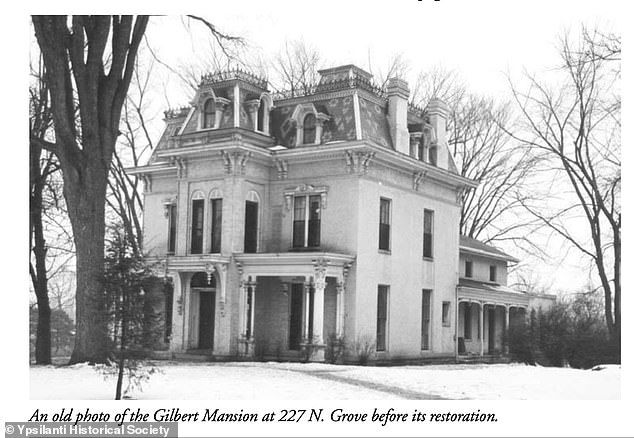
The house on North Grove Street was built in 1861 by John Gilbert Jr
Gilbert Jr died in 1864, and his wife Harriett died in 1910.
The couple had six children, of whom only two outlived their mother: a son, William, who lived in Grand Rapids, where he died in 1933, and a daughter, Alice, who lived in the family home until 1920 before moving to another house nearby.
She was the last of the Gilberts, and after she moved out of the house, it became the property of Daniel Smith, who made his fortune installing heaters in Detroit’s streetcars.
But the city acquired the mansion during the Great Depression, when Smith failed to pay taxes on the property.
The home was then used as a social center during World War II and a teen canteen in the early 1950s.
The Ypsilanti Boys’ Club moved into the house in 1961 for use as an activity center, but moved out in 1974, at which point the Girls’ Club moved in.
By then, the house had already fallen into disrepair, and the Girls’ Club moved out in 1981.
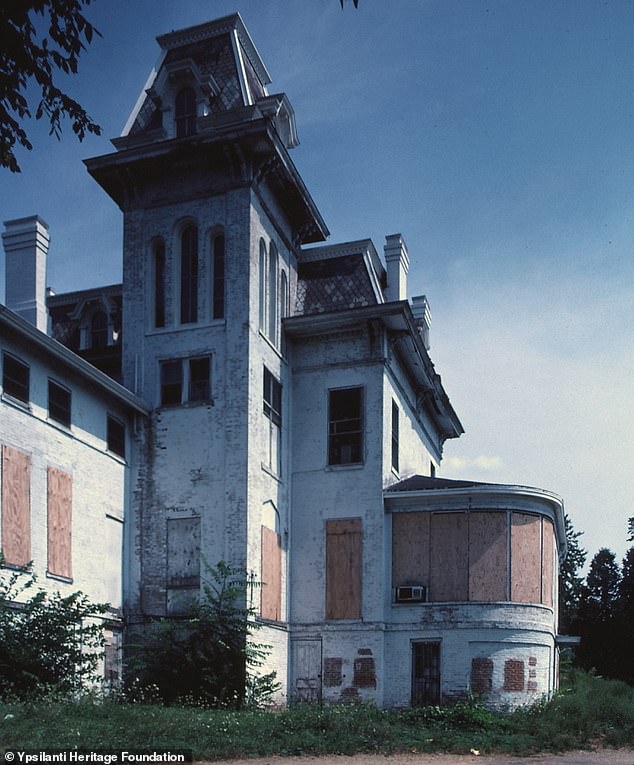
It had fallen into disrepair by the 1970s, after being used as a social center during World War II, a teen canteen and the activity center for both the Boys’ and Girls’ clubs
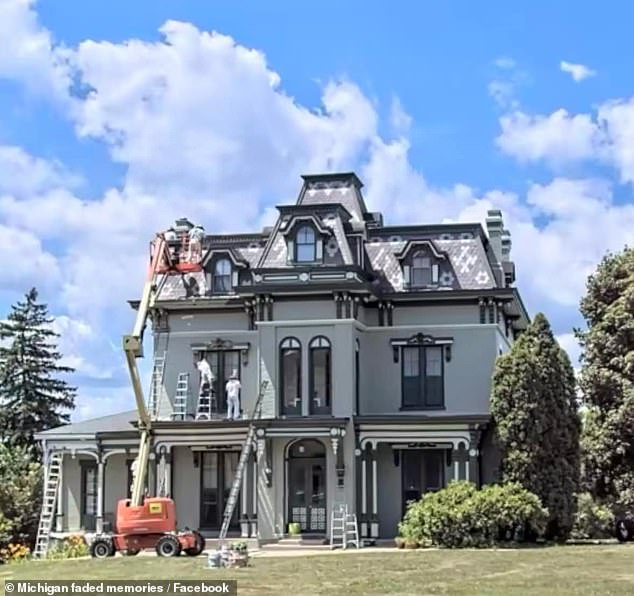
Once the White brothers took over years later, they spent 14 months renovating and turning the home into seven luxury residential units
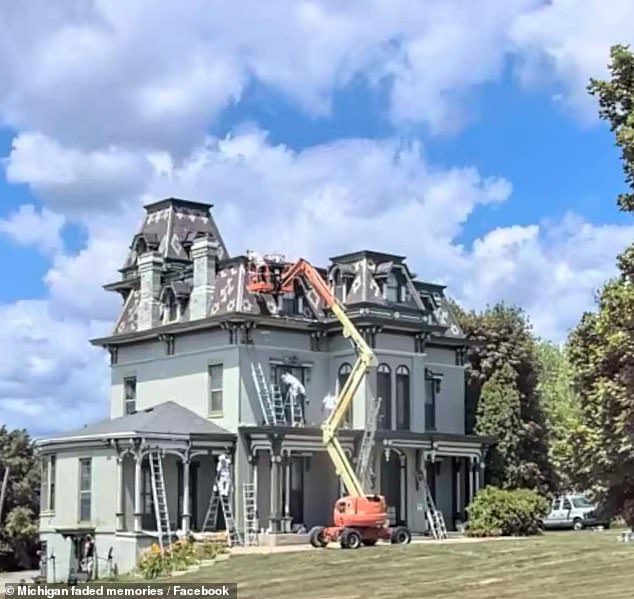
They completely gutted the interior of the house, with the exception of the original hardwood floors and a rare Pewabic tile fireplace
Once the White brothers took over years later, they spent 14 months renovating and turning the home into seven luxury residential units, ranging from 800 to 1,200 square feet each.
To make way for the apartments, the interior of the home was completely gutted, with the exception of the original hardwood floors and a rare Pewabic tile fireplace – an artifact from the renowned Detroit-based company.
The brothers also kept the common halls in its historic configuration, as they added new mechanics, drywalls and finishes throughout the 8,000-square-foot home.
The only element that did not require in-depth restoration was the patterned slate roof, which was still in nearly-perfect condition despite weathering more than a century of Michigan winters.
‘As far as the slate roof goes, it stood the test of time and is in great shape to this day,’ Christopher said.
The apartment building now features high ceilings with large ‘daylit windows,’ according to its listing on LoopNet.
There is also a four-story tower on the backside of the building that overlooks the city, and each apartment comes with a breakfast nook and built-in bookshelves. Some even have porches or private patios.
But the building is currently fully occupied with tenants, with zero vacancy.