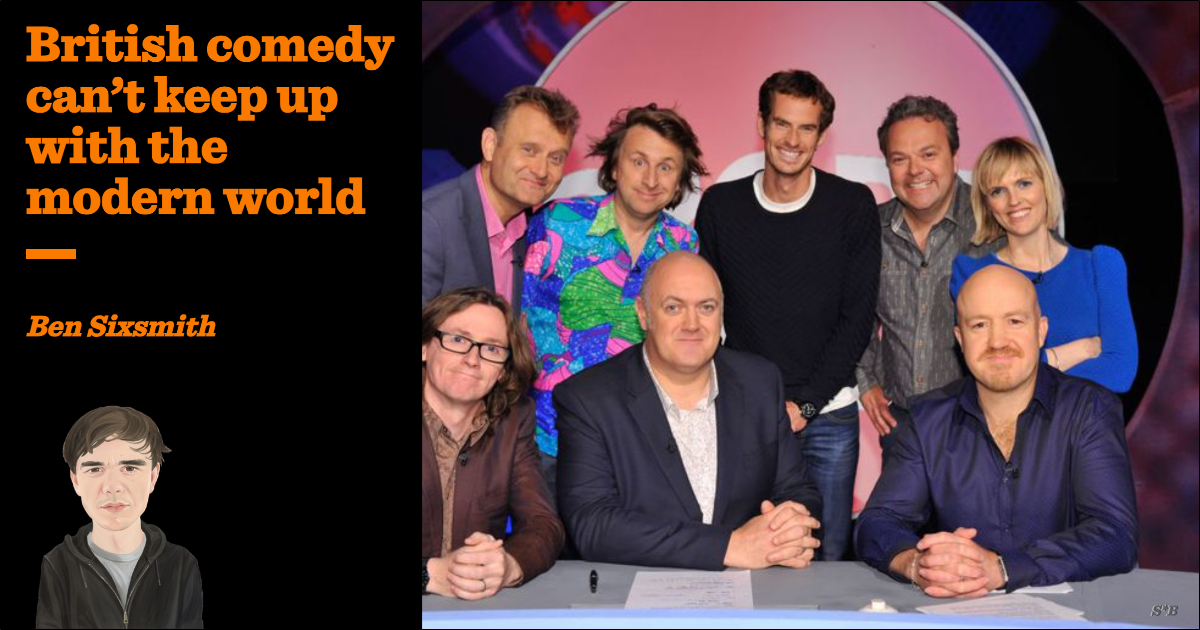

Economic times are grim, so I hate to complain about anyone getting work, but the return of Mock the Week to British screens is rather poignant.
The satirical panel show appeared on the BBC between 2005 and 2022, and will now be hosted by TLC. The same host, Dara Ó Briain, will be joined by many of the same panelists, like Hugh Dennis, Ed Byrne and Russell Howard.
Again, I know the life of a comedian is tough. I can’t blame anyone for wanting, and getting, a job — and a job that I am sure can be a lot of fun. But are we really so short on ideas?
Yes, my ill-feeling is partly political. The likes of Ó Briain and Howard tend to be singing from the same hymn sheet — and that hymn sheet is called The Guardian. The left-wing clubbishness of this kind of show was excellently satirised by Harry Enfield and Paul Whitehouse in the 2000s, who showed a series of high-strung comedians (all named Russell) saying, “Oh, my God! The Daily Mail!”
That said, I swear on a stack of copies of The Daily Mail that a panel show featuring a handful of ageing right-wing comedians snickering about pronouns and Greta Thunberg would not receive a much warmer reception from me. It’s not the politics of Mock the Week that is the real problem — it’s the format.
“Panel shows have always been a limp form of comedy,” I wrote in a piece about Ian Hislop and Have I Got News For You (which, in fairness to the people behind Mock the Week, started a lot earlier and has never gone away). It allows producers to “churn out content without a lot of overheads, reducing their cultural and political subject matter to the same level of bland ridiculousness”.
In the early days of Mock the Week, Frankie Boyle’s acidic jokes made an impact. (And he really could be funny. Even as an admirer of Margaret Thatcher I can appreciate the wit behind his joke that her funeral would be important “because a lot of people will want to pay their respects and a lot more people will want proof that she’s really dead”.) He was on the series, though, for less than four years — and as comedic shock and awe has diminishing returns, in the sense that it becomes predictable, that was probably too long.
Mock the Week trundled on without him for another twelve summers. I know people have routines, and there is nothing wrong with comedy programmes being among someone’s familiar favourites, but it’s morbid to think that someone might have been pining for it. “The revived show will also see many features from the original format being brought back,” we are promised:
For instance, this includes returning rounds such as ‘If this is the answer, what is the question?, ‘Wheel of News’, ‘Picture of the Week’ and ‘Scenes We’d Like to See’.
Was anyone desperate for the return of “Scenes We’d Like to See”? If so, can we stage an intervention?
This is yet another dismal manifestation of Britain’s comedic necrocracy. Have I Got News For You will be on British screens till Paul Merton and Ian Hislop are dead in their seats. Spitting Image returned to abysmal reviews and has been inexplicably commissioned for a YouTube series. (This has at least inspired some diverting content as the production company behind Spitting Image has been sued by the estate of Michael Bond, creator of Paddington Bear.)
Of course, no one can be lazier than a critic — and I’m also sensitive to the risk of being professionally unimpressed. No, it’s not as if there is a great deal of creative ingenuity behind a mildly disdainful comment piece about a television show.
But that doesn’t mean I’m wrong. The cultural mainstream, by and large, is dealing with the modern world by effectively ignoring it — becoming as relevant as an old man in a nursing home who has not had an original thought since the 1980s.
We live in an age of constant news, warped epistemologies, stark polarisation and dizzying technological change. When Mock the Week left British screens, Dara Ó Briain said that the show “couldn’t be more silly than the news”, and there was something to it. Seven comedians sitting in a room once a week and cracking jokes about Donald Trump’s latest antics was entirely too staid and stilted a format. It has only become more so with time.
Again, this is a series that was launched in 2005. In 2005, I was 14. The hideous war of the age was very far away. Myspace was as sophisticated as social media got. The Republican president of the period was more derided than he was feared. If there is an audience for Mock the Week in 2025, one imagines that it is people who want to sink into a warm bath of noughties nostalgia.