“In Britain, as in the wider west, collectivisms of all kinds are in decline,” Economist golden boy Jeremy Cliffe wrote back in 2015. “These trends are more pronounced in Britain than elsewhere and show little sign of abating.”
Cliffe’s words, in a report for the Blairite think tank Policy Network, supported his thesis that large-scale immigration and ethnic diversity were transforming the country forever — and conclusively for the better. As he put it, “cosmopolitanism is Britain’s future” and political parties needed to embrace this reality. “The graveyard of political careers is, after all, littered with the tombstones of individuals and parties who attached themselves to declining segments of the electorate at the exclusion of other, growing segments.”
Everyone must jump onto the train of the future or be left behind with these “declining segments”.
These words are from just a decade ago, but seem to be coming from another world, a time when centrist liberalism was the default of British politics. It was a time when David Cameron’s Conservatives had just won a second term in government, without Liberal Democrats to hold their hand this time. They had promised a referendum on EU membership and would now have to deliver it. But Cliffe was confident his side would win. In his paper, he pointed to how support for the EU “is now clearly on the rise; in February, YouGov posted the largest support for staying in the union since its records began (45 per cent to 35 per cent).” The trends were obviously heading in the right direction, notwithstanding the odd bump in the road.
A year later and this high-progressive optimism had been thrown to the four winds. The EU referendum had been lost to Farage, Johnson and Gove. “Brexit” was due to happen, despite no one in power wanting it to happen. Donald Trump shockingly won his first US Presidential Election later in the year.
Having moved on from the prestigious “Bagehot” column to become “Berlin Bureau Chief” for the Economist, Cliffe notoriously founded a new anti-Brexit political party on Twitter only to leave it 12 hours later after his employer told him this is not the way things work in current affairs journalism. After stints with the New Statesman and George Soros’ Open Society Foundations, he is now Editorial Director & Senior Policy Fellow for the European Council on Foreign Relations (ECFR).
Notwithstanding the knocks its promoters have experienced in the past decade, the argument that Cliffe makes in his paper remains the default of the British overclass on immigration and diversity: an Alamo to retreat to when under fire. In the progressive style, it unites the utopian yearning of the activist or preacher with the rationalist mien of the technocrat. This is an account not just of what Cliffe wants, but of what the future will be. It is an expression of knowledge. As he says, “some might consider [it] a hyper-liberal vision of Britain,” but “that vision resembles the future”.
While the vision may be hyper-liberal, the means to get there are neo-Marxist. Just as Marx and Engels assigned revolutionary agency to the working class, Cliffe looks towards immigrants and their children. He takes London as an exemplar of what the rest of the country is becoming, for the better: “urban, even metropolitan, where non-white faces are common, where same-sex couples can walk down the street hand-in-hand without raising eyebrows, where many residents have been to university and are internationally minded.”
In some ways it’s a lovely vision. But it didn’t completely match the reality then and it certainly doesn’t match the Britain of ten years later. Migration has undoubtedly made us more internationally-minded, but not always in the ways intended. In recent years, industrial-scale illegal migration via the English Channel, the Boriswave of Third World legal migration and Islamist mobilisation over the Israel-Palestine conflict have all served to make tribal, sectarian sentiments more pronounced. Collective, opposing identities are now front and centre of politics, especially at the street level, where English, British and Palestine flags now serve to mark territory in uncomfortable parallels to Northern Ireland.
Labour’s new Home Secretary Shabana Mahmood has made much of the need to reduce tensions, recently announcing a range of Danish-style reforms to the notoriously loose British asylum and immigration system. However Nigel Farage’s party Reform continues to lead the opinion polls, with Labour way below what pollsters thought was its floor not so long ago. All in all, it is not quite what Cliffe had in mind.
His paper, entitled Britain’s cosmopolitan future, testifies to how badly even the so-called “moderate” or “centrist” left lost its way on issues of identity and immigration. By consciously sacrificing the working class in favour of a range of others (the old “Rainbow Alliance” conservative-minded Labourites had long disparaged), you could argue that they ended up in an even more radical, utopian place than the far left — and with a similar revolutionary grounding.
Giving immigrants and non-white people a blessed, chosen people’s role as Cliffe does was always naive and utopian, imposing a burden too heavy for any group to bear, let alone one so many and varied. The size and significance of migration in Britain in recent years is almost beyond comprehension, with upwards of a million people entering annually in recent years. That has created a million new individual stories of migration each year — and many millions more stories within and around them.
Any conclusion of whether the sum total of this is good or bad is hobbled from the start by the sheer scale. But we can safely say that the liberal-left narrative of immigrants who have come in, worked hard and made valuable contributions to local communities and the wider society is a real but limited part of the story. A thorough and honest narrative must also account for disproportionate crime rates among many immigrant populations, as well as the sensational nature of crimes from terrorist attacks to the large-scale atrocities of grooming gangs.
Britain has become hyper-liberal in some respects: not least the freedom some people feel to do what they like in public places without regard for others, part of a more general breakdown in common culture. But in other ways, freedom is eroding: from clampdowns on online speech to the proliferation of women’s modesty codes (both formal and informal) and ramped-up security measures everywhere from Parliament to Blackpool beach.
Cliffe’s argument unfortunately chose “vision” over such observation and recognition. It particularly failed to recognise the significance of systemic diversity as an extension of multiculturalism. This version of “diversity”, as a way of organising society, is primarily political, offering favour and disfavour based on group membership and ideological conformity. In many ways it is hostile to cosmopolitan ideals around freedom of choice, prosperity and elevated culture.
The centre-left’s inability to process this represents an historic failure.
But it didn’t have to be this way. Following the Labour Party’s defeat in 2010, there was a brief window in which serious reflection and even self-criticism occurred. In 2011, four years before it released Britain’s cosmopolitan future, Cliffe’s publisher Policy Network co-published a much more comprehensive, analytical report with the Dutch Labour Party think tank Wiardi Beckman Stichting, exploring the challenges posed to social democratic politics by the politics of identity, diversity and immigration. Contributors on the British side included David Goodhart, Trevor Phillips and Maurice Glasman.
So much has changed since 2011. But the issues analysed in this report are those which still torment Britain and other Western European countries, in more elevated form, fourteen years later. The Dutch thinker René Cuperus’s contribution is particularly pertinent. He wrote: “Intellectual discourse has for too long been characterised by a species of political correctness that praises multiculturalism and ‘The Foreigner’ as enriching for society while turning a blind eye to the de facto segregation and marginalisation of many new immigrants and the stress they place on the welfare system in many nations.”
It is perhaps worth emphasising that this critique emerged from the left. It also recognised a potential cultural conflict between what Cuperus called “Europe’s liberal-permissive societies and orthodox Islam”; one which, he said, was broadly denied in mainstream politics. “The established democratic parties reacted to the rise of extreme right, racist parties with a cordon sanitaire, but made the mistake of also applying it to the issues these parties campaign on, i.e. the shadow sides of mass migration: problems of integration and segregation; high unemployment and crime rates; ‘multicultural discontent’, especially within the constituencies of the people’s parties: ‘feeling a stranger in one’s own country’.”
Progressive left politics now has little to offer except its status as elite ideology
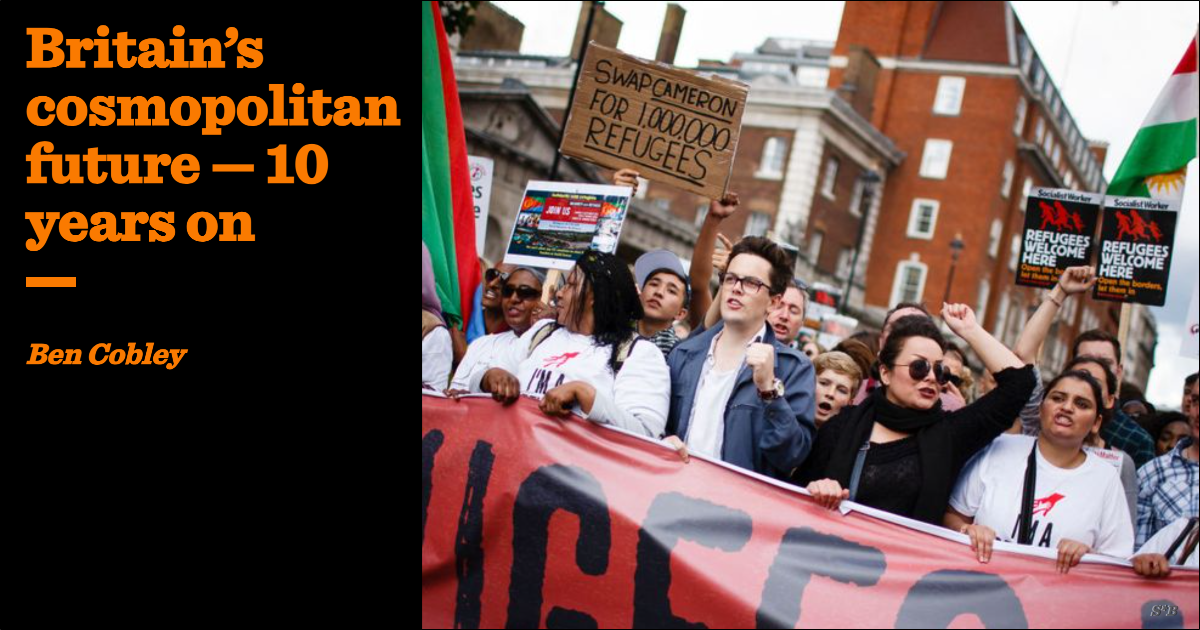
Alas, the centre-left, with all its institutional power, turned away from such confrontations with reality, choosing fantasy and boosterism instead. As a leading intellectual told me recently, the scene remains “intellectually dead”. Progressive optimism endures, but it comes at us via the same old tired and defensive sloganising: “Diversity is our strength”, “Refugees are Welcome”, “Labour won’t win by trying to out-Reform Reform”. Progressive left politics now has little to offer except its status as elite ideology.
Ironically, given its grounding in an imagined future, this perspective clings to the past: a time when it seemed that Britain’s multicultural (as opposed to multiculturalist) society might just pull through via natural integration and assimilation.
But that world has now gone. The hyper-diverse, hyper-mass immigration Britain that has replaced it is a strained and unhappy place, unproductive and untrusting, the opposite of what we were promised. Bloviating bishops, politicians, campaigners and media organisations must all take a share of the blame for that — as should the think tanks and writers for presenting utopian dreams as inevitable realities. If the policies they promoted had not been followed, a great deal of suffering would have been avoided. And Britain’s future would have looked somewhat brighter — even more cosmopolitan — than it does today.