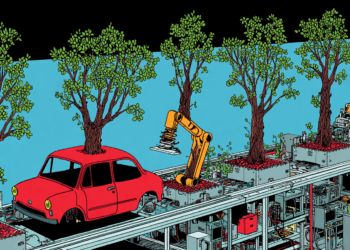
Britain, as has been observed at length in these pages, is not living its best life. Divorced from its European bride, estranged from its post-colonial children, and scratching its unshaven face wondering how to pay the bills. Like many a sad bloke at the end of his tether, Britain is about to throw away the last of its meager savings at the casino.
His Majesty’s Government, or as it now prefers to be known, the “UK Government”, is betting everything on AI. Between worsening global conditions, a high cost of borrowing and tight fiscal rules, the British government has left itself precious few levers to stimulate growth. AI seems to present an easy way out. With trillions of dollars of investment flooding into the new industry, the government is desperate to have a share of the digital gold rush.
On paper, this seems like a winning prospect. Britain has some of the top research and teaching centres for computer science, and a modest tech industry of its own. The promises being made about the power of AI range from fully automating white collar work to so-called “superintelligences” that could leap human technology ahead by decades or centuries. Even the lower bound of AI hype — of meaningful productivity gains and a return to early 2000s growth rates — must seem like the gates of paradise opening to weary British policymakers.
Faced with these kinds of potential winnings, Keir Starmer has gone all in. Middle-aged machismo radiated from last year’s government press release on AI. Britain was going to “turbocharge AI” and “mainline AI into the veins of this enterprising nation”. Our flagging fiscal libido was about to be saved by an infusion of artificial virility.
The boy’s own catalogue of centrist dad whizz-bangs was gloriously unfurled to a grateful nation. There would be “AI growth zones” presumably full of beep-booping robot butlers, a “£14 billion pound investment” from major tech firms, and a 50 point plan that “will make the UK irresistible” to youthful AI start-ups.
But much like other thrilling products in boys’ magazines, what arrived in the post has fallen far short of what was advertised. A year on from these grand promises, the Guardian reported that the scheme is “riddled with ‘phantom investments’ and shaky accounting”. According to the investigation, “the money isn’t necessarily real, the datacentres may not be new, the jobs are unaccounted for — and the supercomputer site 12 miles north of London is still a scaffolding yard.” Britain’s AI future folks — some assembly required.
Of course very real money is being spent on AI, in the form of over £3.35 billion in government contracts for AI services, a total that is only set to grow thanks to a strategy of “transforming” the public sector through AI.
Whatever the technology’s potential, it is very far from reaching it
Yet polling suggests that less than half the British public trust this policy, and at a time when public trust in the state is at record lows, this is a very risky gamble indeed. Whatever the technology’s potential, it is very far from reaching it, and as I have written previously, the limitations and risks of the technology are largely ignored or concealed by those touting it. That leaves Britain as an “early adopter”, forking out billions for AI systems that will be far worse and less specialised to the needs of the public sector than what we might see emerge in 5-10 years time.
Nor is this primarily benefiting a domestic British industry — the AI industry is concentrated in America, and Britain’s most successful AI firm, DeepMind, was acquired by Google 12 years ago. Somehow, I don’t expect government plans to extend to renationalising it.
And over in Silicon Valley, tech industry leaders openly acknowledge that the pace of investment in AI vastly outstrips its present potential for profitability. Figures like Jeff Bezos and Sam Altman have cheerfully admitted AI is a bubble. The calculation there is that it is a “good bubble” and that, as one investor puts it, “the benefits of innovation outweigh the costs of volatility”.
Yet the sheer scale of investment, which has seen firms like NVIDIA hit valuations putting it on a par with the entire British economy, reflects an unprecedented level of hype. Many of those same figures who see this as a “good bubble” are also claiming that we are on the brink of something called “the singularity”. According to Sam Altman we are “close to building digital superintelligence”.
How plausible do we find this claim? Part of this goes to how you perceive what AI is currently doing. Despite the fact that LLMs (large language models) are categorically incapable of possessing memory, learning, or having any sense of self, leading industry figures like Altman continue to suggest, amongst other things, that “we have recently built systems that are smarter than people in many ways” and that “2025 has seen the arrival of agents that can do real cognitive work”.
We don’t have to deny that AI is an impressive technical achievement to see that this is nonsense on stilts. A computer can perform mathematical calculations faster and to a higher level of complexity than the most brilliant mathematician, but this does not mean that a pocket calculator is smarter than a professor, or that when you multiply a number on it that the calculator is doing “cognitive work”. The same principle applies to a machine that can be prompted to paint a picture, produce an eerily camp paragraph of bland prose, or remix a Hollywood movie.
Even if you earnestly believe that we will some day create a true intelligence, the fact that major figures in the AI world already believe that they have done so should be the loudest of warning bells.
Yet the more plausible claims for AI may be just as worrying in another sense. If outcompeting the human brain is one goal, another is replacing the human worker. One reason trillions are flooding into this industry is the hope that hundreds of millions of jobs can be automated out of existence.
Even if this is possible, it is far from clear that it is desirable, or that it will benefit Britain. Areas once governed by human intelligence and sensitivity will instead be the domain of mindless chatbots. The quality of customer service and public sector provision could nosedive. All this before we account for a vast spike in unemployment. And what of those fabled new AI jobs? Feeding prompts into the machine? Constantly grappling with juddering automated simulacra in place of a workforce? Not as well that this is all based on an energy intensive industry in the middle of an energy crisis.
When it comes to AI even “success” looks like gigantic, unprecedented economic disruption
Blithe confidence in the wisdom and inevitability of this technology is endemic in Silicon Valley, as well it might be. But consider this. The previous digital revolution saw the tech giants in America cash in, but 20 years on, it has left only America rich, with Europe poor and dependent, and Western industry — those “old economy” jobs — shipped to Asia.
When it comes to AI even “success” looks like gigantic, unprecedented economic disruption. When or if this arrives, it will be years later than promised by the hype merchants. In the meantime, the AI bubble is certain to burst, and it is only a question of when. In either instance, Britain will not be the long term beneficiary of an AI industry, like the digital giants of the previous revolution, primarily based overseas.
Somewhere in the geopolitical last chance saloon, a clapped out country is nursing its final drink, and watching a spinning roulette wheel, never realising that the game is rigged.