Britain has always prided itself on being a tolerant country. A nation that learned, the hard way, where hatred leads – and resolved never to let it take root again.
Yet today, antisemitism is no longer lurking on the fringes of our society. It is increasingly visible, increasingly organised, and increasingly dangerous.
This is not merely a matter of prejudice or social cohesion. It is a national security issue – and one that we are still failing to treat with the seriousness it demands.
Since the atrocities of October 7, antisemitic incidents in the UK have surged to levels not seen in living memory. Jewish schools require armed guards.
Synagogues are targeted with threats. Jewish students are harassed on campuses. British Jews are being told, implicitly and explicitly, that their loyalty is suspect and their presence conditional.
And all across the West, we are seeing Jews being murdered for who they are.
The massacre of Jewish people gathering to celebrate Hanukkah by an Islamist gunman on Bondi Beach was fuelled by the same ancient hatred as the murder of Jews marking Yom Kippur at Heaton Park synagogue in Manchester.
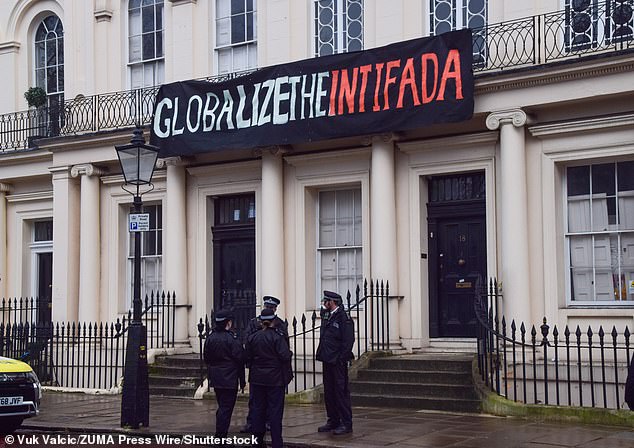
A banner carrying the slogan ‘globalise the intifada’ in Regent’s Park, central London
The same hatred on display when Yaron Lischinsky and Sarah Milgrim were gunned down on the steps of a Jewish museum in Washington DC. And in Colorado when Mohamed Sabry Soliman shouted ‘Free Palestine’ and tossed Molotov cocktails at a crowd gathered in support of Israeli hostages.
That is why the Metropolitan Police’s announcement that it will now arrest people chanting ‘Globalise the intifada’ is welcome – but it is also long overdue.
Let us be clear about context. Calls to ‘globalise the intifada’ have carried an unmistakably violent meaning for decades. They reference campaigns of suicide bombings, stabbings and shootings targeting civilians, including children. This was true long before Bondi. Long before October 7. Long before the current wave of protests.
The idea that such chants only became problematic recently is simply not credible.
What the Met’s announcement really exposes is a deeper problem: inconsistent enforcement and legal uncertainty. For months, officers on the ground have faced chants and banners that many reasonable people would recognise as incitement – yet action has been sporadic, hesitant or absent altogether.
Britain has rightly proscribed terrorist organisations including Hamas and Hezbollah. Supporting them is illegal. Praising them is illegal. Displaying their symbols is illegal.
Yet the gap between the law as written and the law as enforced has become dangerously wide.
Part of the problem is operational. Officers policing large, volatile marches understandably worry that arrests may escalate disorder. Others lack the specialist knowledge needed to recognise coded slogans, symbols or Arabic-language chants that cross the legal threshold. That points to a clear need for better education, briefing and intelligence-sharing for officers tasked with policing contentious protests.
But there is also a more serious issue: a disconnect between arrest and prosecution.

Mourners gather near floral tributes left to the victims of the Bondi Beach massacre
Even where arrests are made, successful prosecutions are far from guaranteed. Thresholds for incitement, intent and public order offences are complex and unevenly applied.
Cases fall away. Charges are downgraded. Outcomes are unclear. The result is a perception — widely shared by both Jewish communities and extremist organisers — that enforcement is uncertain and consequences are limited.
That perception is itself a security vulnerability.
Extremist movements thrive not only on ideology, but on testing the state. They probe boundaries. They look for hesitation. They exploit ambiguity. When the response to antisemitic intimidation appears tentative or reversible, it sends a signal that pressure works.
This matters because antisemitism is rarely an end point. It is a gateway grievance. It creates an atmosphere in which conspiracy thinking flourishes, violence is rationalised, and minorities are portrayed as legitimate targets.
History shows that when antisemitism spreads unchecked, it is usually a prelude – not a conclusion.
Our security agencies have long warned that radicalisation is cumulative. It feeds on permissive environments and repeated exposure to grievance narratives. Normalising violent rhetoric – even when framed as protest – lowers the barrier to action.
It also creates opportunities for hostile states and transnational movements to exploit division within democracies. Societies that appear unwilling or unable to enforce their own laws are easier to destabilise. Trust in institutions erodes. Authority weakens.
This is why antisemitism must be treated not only as hate crime, but as part of Britain’s national resilience and security framework.
None of this requires abandoning free speech. Britain’s commitment to open debate is one of its strengths. But free expression does not include the freedom to intimidate, to glorify violence, or to make minority communities fear for their safety.

Lord Walney is the government’s former independent adviser on political violence and disruption
Peaceful protest does not extend to deliberate law-breaking designed to test how far the state can be pushed.
The Met’s new stance is a step in the right direction. But it must be backed by clearer legal thresholds, consistent prosecution, and political resolve. Otherwise, arrests without outcomes will only deepen cynicism – and embolden those who believe they can operate with impunity.
British Jews are not asking for special treatment. They are asking for equal protection, applied consistently and without fear.
They are right to expect that antisemitism is confronted with the same seriousness as any other force that corrodes trust, fuels extremism and endangers lives.
Antisemitism has always been a warning light. When it flashes, something deeper is wrong. Ignore it, and the damage spreads far beyond one community.
Britain must act – firmly, fairly and decisively – not only because antisemitism is wrong, but because national security depends on it.