I was making my way to the Thameslink service. I like to be efficient with my time — it leaves me with more time in which to be lazy — so I left the house without having gone to the loo.
“I can just go to one on the train,” I thought, loos being one of the great boons of rail travel. Having just about caught the train, I immediately set about finding a place where I could spend a penny. I looked up at a screen which helpfully informed me that the train has five loos, all of which are available. Alas, the first one I found had no toilet paper, lights or working lock, and was covered in grimy graffiti. It was the same story with the next one, and the next one, and the next one — including the only accessible one. By the time I found the sole functioning loo, a queue had formed and I realised there is no way I will have the time to get in before I have to get off. “There must be some profound lesson about the state of modern Britain to be learnt from this,” I thought.
Maybe there is. Social cohesion is notoriously difficult to measure. The popular mood, for a while, would have led one to believe that bad things have been happening to it. But if you go around and survey people about it, the answers you get will not suggest anything like a collapse in social cohesion. On the contrary, on some measures, it is in fact improving.
The Community Life Survey — an official government survey commissioned on a regular basis by DCMS and MHCLG — tells us that 62 per cent of adults feel they belong strongly to the neighbourhood, a dramatic collapse from the high of… Sixty-five percent, achieved in the golden years of 2020/21. The proportion of people who regularly chat to their neighbour (69 per cent) likewise, has not changed much in the last decade, and the same is true for just about every measure in the Community Life Survey that could plausibly be used as a sort of shorthand for social cohesion.
Perhaps the problem is with the survey and Verian, which runs it, just needs to get its act together. But the same data pops up in other surveys, too. According to the World Values Survey — an exceptionally rigorous research programme and the brainchild of the great Ronald Inglehart — social trust in the UK has markedly increased in recent years. Whereas just 30 per cent of respondents reported that most people can be trusted in 2005, some 47 per cent did so in the Survey’s latest wave. Before it stopped tracking it, the British Social Attitudes survey also reported social trust increasing by 10 percentage points between 2007 and 2017. Admittedly, a lot has changed in the last nine years, but most people, when asked, would place the origins of Britain’s social malaise well before 2017.
Are we then to surrender to the data? As an undergraduate studying philosophy, I read a paper in which the author tried to argue that moral accountability does not, in fact, exist. He acknowledged that we may still feel as though some people are morally praise- or blameworthy, but hoped that, upon reading his persuasive argument, those feelings would gradually dissipate as the light of truth trickles through to our sensibilities. Of course, no such thing happened to me. If the conclusion of an argument is too implausible, there must be something wrong with the argument. Or, as the Jeff Bezos saying goes, when the data and the anecdotes disagree, the anecdotes are usually right. If everybody knows that social cohesion is struggling, but the data disagrees, there must be something up with the data.
Too often, however, my loo presence is treated with suspicion
Now, it has occurred to me that there is one thing that tracks anecdotal evidence regarding social cohesion almost perfectly — the state of the local loo. There is a lot of trust involved in letting somebody use your loo. The privacy of that space is so sacrosanct that third-party interference in loo-based activities is out of the question, and so rule enforcement is scarce. Consequently, I feel flattered when, going into a loo, I am offered a free-running tap, a normal soap dispenser, lotion, and sometimes even a towel — even if only a paper one. It implies that whoever is in charge of the loo trusts me not to abuse the gifts they have bestowed upon me — the true mark of trust in your fellow man.
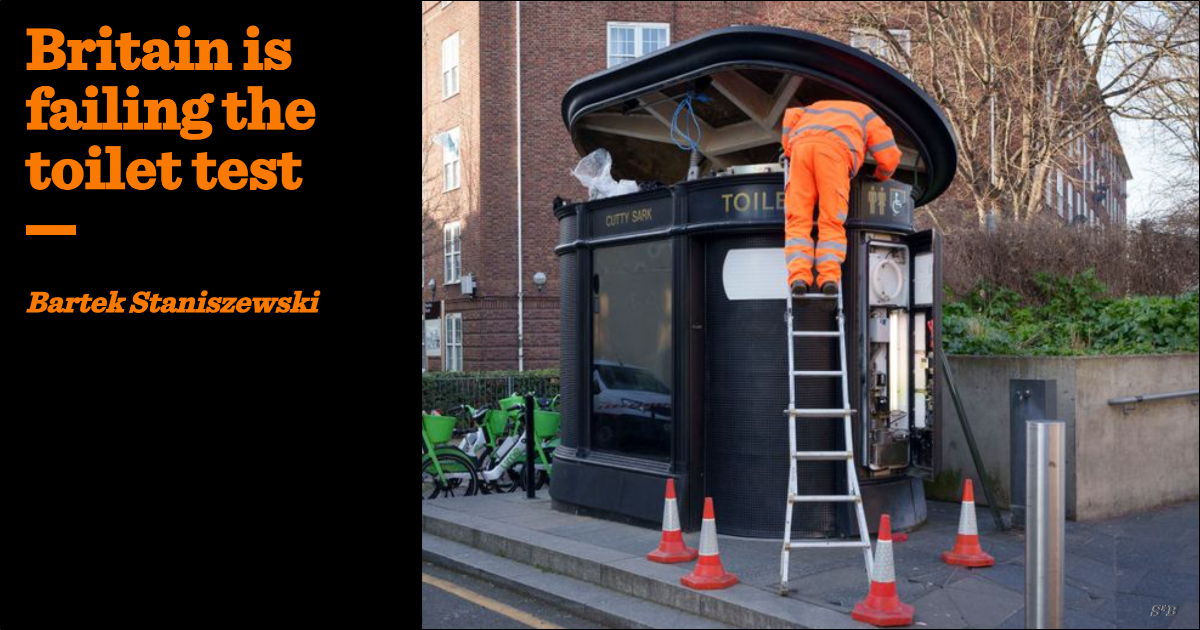
Too often, however, my loo presence is treated with suspicion. The tap operates on the basis of a magical proximity-detection mechanism which, when it works, releases a pitiful trickle of water scarcely capable of washing off the tiny droplet of anti-bacterial soap that a dispenser equipped with a similarly esoteric sensor bequeathed to me. When it comes to drying my hands, my choice is normally limited to another sensor-based device which turns off well before my hands are actually dry — not that it was doing anything in the first place. Cleaning my face is also out of the question. If it feels particularly grubby, I might endeavour to wipe it with toilet tissue, but said tissue is often provided to me only in flimsy single sheets that are so difficult to remove from the dispenser without ripping them against the metal edges that it is normally more efficient to yank the thing and remove a few dozen at once, making me feel like a vandal.
But I can hardly blame the loo administrator. Often, the loos with the most draconian mechanisms are also the most vandalised ones. Indeed, train loos are often both the most vandalised and the most difficult to use. On the other hand, I have never been to a loo which offered me a soft towel that was anything less than immaculate. The fact is that, if the loos with the motion sensors did not have them, somebody would indeed leave the tap running or run away with the soap.
Perhaps public loos were always this bad, and so the data does not lie. But this does not mean that there is not a problem. One of the chief pleasures of going abroad, for me, is the joy of free-running toilet taps and hand towels in restaurants, bars, and, yes, even trains. Sometimes I even get to choose the temperature of the water coming out of the tap — a luxury normally afforded only to the attendees of London’s most prestigious bathrooms. On the loo social cohesion scale, those places are doing alright. And Britain? Shit.