The visitor numbers and heritage status of the Southbank tell us nothing about what people actually want to look at.
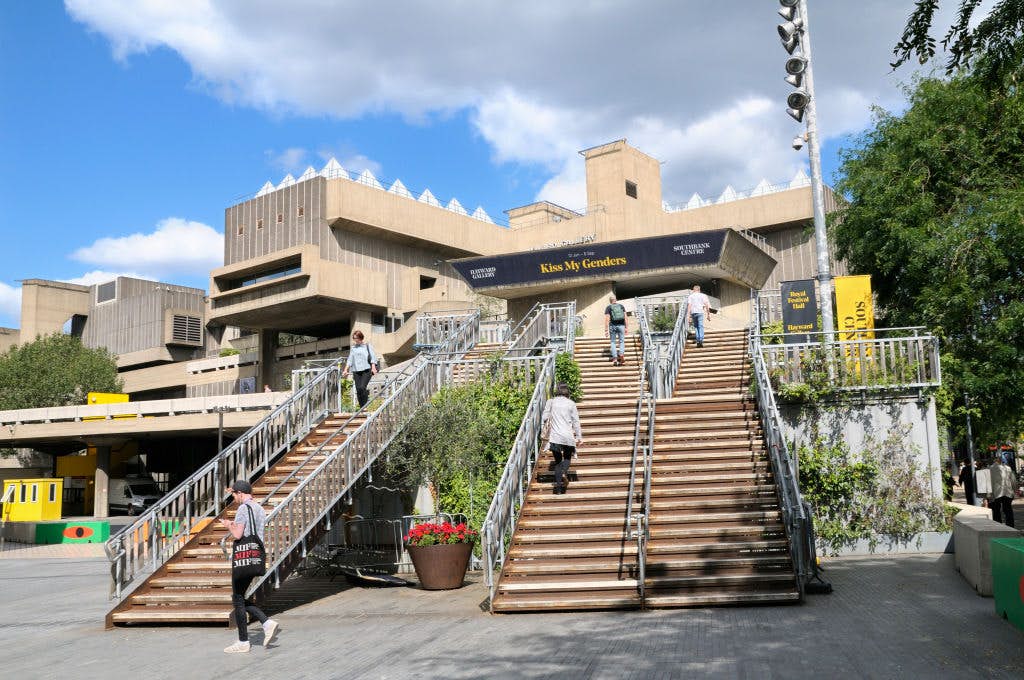
London’s brutalist Southbank Centre has been listed at Grade-II by Historic England. The centre itself is visited by around 3.4 million visitors a year. Modernist aficionados are cock-a-hoop. This, they claim, is evidence that Britain now loves brutalism. The long years of the British public’s hatred for post-war architecture are over. Even brutalism, the most unforgiving style, laden with the Atlantic Wall bunker aesthetic of pillboxes and reinforced concrete, has now been taken to the British collective bosom. A breathless Bloomberg journalist cooed that the “wider public are ready to embrace these buildings.”
This is not a serious argument. Firstly, the reason the Southbank Centre has been listed is for its architectural and historic significance, not any measure of popularity. British buildings are listed either for their architectural or historic interest. Whilst the “appearance of a building … is often a key consideration in listing” it is not necessarily so. Public popularity (sadly) is irrelevant. Nor is the South Bank Centre’s listing such big news. The modernist Festival Hall beside it was Grade-I listed nearly 40 years ago in 1988. The brutalist National Theatre on the other side was Grade-II* listed in 1994.
The Southbank Centre deserves visitors. It is well located on the River Thames in one of the few stretches which properly faces the river. It sits between Waterloo Station and Westminster. The excellent two Golden Jubilee Footbridges completed in 2002 place the South Bank directly in the path that commuters can take on a summer evening if they are heading to Waterloo Station and want to take in a show or exhibition before the journey home. The wider South Bank is home to a bevy of world-class arts institutions and now to commercial attractions round the corner, such as the London Eye and the London Aquarium.
Despite these advantages, the rise of visitors is nothing to write home about in the wider context. The Southbank Centre has always been popular. By the early 1990s it was attracting around 2.5 to 3 million visitors a year. Today it attracts 3.4 million. This represents only modest growth over three decades, especially by London standards. Over the same period, the British Museum has increased its visitors from just over 5 million in 1990 to around 6.5 million today. The Natural History Museum, however, has seen far more dramatic expansion, rising from around 1.5 million visitors in 1990 to over 6 million today, an increase of more than 300 per cent. Since 1990, visitor numbers to London have risen from roughly 12 million overseas visitors to over 21 million at their peak, an increase of around 75 to 85 per cent. By contrast, the Southbank Centre’s growth has been closer to 10 to 30 per cent at most. In other words, its visitor numbers have largely tracked, and arguably lagged, the wider rise in London tourism rather than exceeding it. If visitor numbers prove anything, they prove the success of London, not of brutalism. The Southbank Centre has not outperformed London. It has simply benefited from it.
I am not sure that visitor numbers are a very wise proxy for architectural preferences but if we are going to use them then a brief review of London’s top tourist attractions based on 2025 data from the Association of Leading Visitor Attractions would indicate that public preferences run to colonnaded Greek revival and the high Victorian Gothic rather than brutalist bunkers upon the Thames. To be precise, based on visitor numbers, 38 per cent of visitors prefer classical buildings (The British Museum, the National Gallery, Somerset House, the Science Museum), 25 per cent prefer Victorian buildings (the Natural History Museum, the V&A), 19 per cent prefer castles (Windsor Great Park, the Tower of London), 11 per cent prefer stripped classical buildings (Tate Modern) and only 8 per cent prefer brutalism (the Southbank Centre).
This is silly stuff of course but then so is the argument that the heritage status of the Southbank Centre or the visitor numbers signal public preference for Brutalism. That said the strong preference for Classical and Victorian designs revealed by the ‘museum visitor metric’ is not that far off the real data based on visual preference surveys and pricing research.
A wiser way of measuring public architectural preferences in Britain and abroad is to ask people and to examine what people pay to buy or rent properties. There the data is wide ranging and consistent. Not surprisingly, given the emerging evidence on neuroscience preferences, the Atlantic Wall brutalist aesthetic remains deeply unpopular with a strong majority of people in Britain and internationally. In every visual preference survey ever conducted, large majorities prefer more traditional places with texture, patterns, a sense of place, embedded symmetries and coherently complex buildings. New buildings need not necessarily replicate precisely the past. However, they should rhyme with it and echo the same humane qualities that sheer concrete walls struggle to find. Between 70 and 90 per cent of people across all social-economic segments are very consistent on this in every robust survey conducted in Britain, America or Holland. Rich or poor, young or old, male or female, left wing or right wing, all strongly prefer more vernacular and traditional buildings. Slightly less wide-ranging studies in South America and Norway agree. So consistent is public preference that large language AI models can predict it with ease.
If you do not believe the surveys, believe the money. Pricing studies in America, Holland and Britain demonstrate that, other things being equal, people pay more for more traditional looking buildings and places. For example, in a robust Dutch study of 60,000 housing transactions new homes with a traditional design aesthetic sold for 15 per cent more than modern ones, other factors held equal.
I have human sympathy for the fans of aggressive modernism and Cold War bunker Brutalism. Theirs is a lonely path. Their appreciation for the unloved is itself admirable. It is always impressive to stick up for what you believe in the face of public indifference or dislike. One has to salute the relentless energy which they have secured the listing of the South Bank Centre. It has taken 35 years of more sensible governments saying “no” until a foolish one said “yes”. But the modernist mafia seized their moment with judicious aplomb. Well done them in persuading the Government to list a loveless lump that the modernists genuinely adore but which most of us dislike or to which we are at best indifferent. Good luck to them I say. Just please don’t impose any more of your inhumane preferences upon the rest of us.