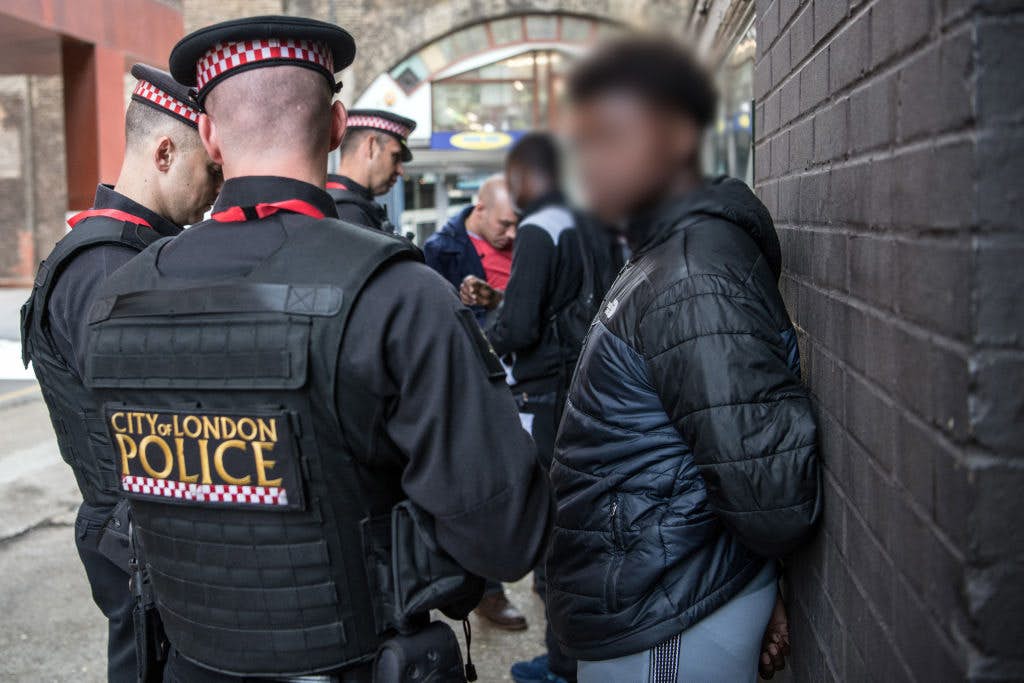
It was like Peter Hitchens’s worst nightmares. Chaos on Clapham Common — hundreds of teenagers swarming the high street, shops locking customers inside. Across separate days, the Met had to deploy a hundred officers and imposed a dispersal order, and only managed to arrest six teenage girls. The Snapchat posts and TikTok videos organising the next “linkup” were circulating before the smoke had cleared.
Nobody was protesting anything. This wasn’t the result of socioeconomic necessity or political principle. They were just being horrible for the sake of being horrible — shoving each other down the frozen food aisle in M&S while filming on their phones, or sending families with prams scrambling for safety behind locked doors. They were having fun at other people’s expense because they have never been shown the discipline necessary to pass a civilised society from one generation to the next.
They knew from experience that the consequences would be negligible. In August 2023, a TikTok campaign to “rob JD Sports” brought hundreds of teenagers to Oxford Street. Nine arrests, dispersal orders stretching to Leicester Square, and then nothing. In January 2025, eight hooded youths cleared the Apple Store at Brent Cross of fifty iPhones in twenty-four seconds. Six were arrested. One fourteen-year-old received a nine-month referral order and was instructed to pay £100 in compensation to each security guard. Yes, that’s right — one hundred pounds. That certainly showed him!
Just this past weekend, the same Saturday as the first Clapham incident, teenagers swarmed Birmingham city centre. There will be more over Easter. There will be more all summer.
There are no serious plans for what to do with our large and growing population of young people who act with total indifference to the law or any settled cultural norms. So, here is my unfashionable proposal: bring back borstal.
The borstal system was designed by Sir Alexander Paterson, who became Prison Commissioner in 1922 and spent the next quarter-century modelling his institutions on the English public school. Boys lived in houses of no more than fifty, each with a dedicated housemaster. The regime was built around a full day of hard, purposeful work: vocational training, education, physical exercise. Progress was measured through a grade system, with privileges and release dates earned through behaviour and achievement. On release, every boy came under the supervision of the Borstal Association, which provided aftercare and retained the power of recall.
Paterson’s famous dictum was that “men are sent to prison as a punishment, not for punishment”. He even recruited from the same pool as the public schools themselves: young graduates who could command respect and teach something worth learning.
The interwar borstal system was regarded internationally as a model. It declined after the war for the usual reasons: overcrowding, underfunding, institutional entropy. By the time it was formally abolished, reoffending rates had climbed to 60 or even 70 per cent. But what replaced it has been worse by every measure.
Their replacements, Young Offender Institutions, have enabled reoffending rates approaching that 70 per cent within twelve months. The assault rate is fourteen times higher than in adult prisons. A joint Ofsted and Prisons Inspectorate review, published last year, documented a decade of declining educational provision, and no YOI in England was judged to be providing adequate education.
The only attempt at structural change has been the “secure school” model recommended by a 2016 review. One has been built. Oasis Restore, in Rochester, opened in mid-2024 on the very site of the original 1902 borstal. It arrived four years late and tens of millions of pounds over budget. Within twelve months it had to close temporarily after safety failures. It holds forty-nine children at maximum capacity. There are roughly five hundred in the youth custody estate. This model is clearly far from scalable, or even workable, on current evidence.
The old system failed because of a lack of political appetite to fund the scheme as numbers of offenders grew. The political genius of bringing the Paterson model is that it gives the political right the consequences it demands and the political left the rehabilitation it insists upon. Both sides should be able to support mandatory residential detention that actually teaches young people to read, to work, and to live within the law. The alternative is the scenes we see increasingly on our high streets.
The costs should be compared against the lifetime of not rehabilitating these kids before it is too late
What would a modern borstal look like? Mandatory residential detention for persistent young offenders. A full day of structured activity: English, maths, digital skills, a proper trade. Small houses within larger establishments, each with staff who know every young person by name. A clear progression system with release earned, not given. Compulsory aftercare with the power of recall. It would be expensive, but the costs should be compared against the lifetime of not rehabilitating these kids before it is too late.
Imagine a Teach First style scheme for borstal teachers. It could tug on the heartstrings of all well-meaning people who care about helping those from the wrong side of the tracks, but with the structure and safety that might actually enable them to get through to their wards. Advances in AI-driven learning are already showing that intensive, personalised academic instruction can be delivered in a fraction of the time traditional schooling requires, freeing the rest of the day for vocational training, sport, and practical skills.
The only alternative to riots or this caring, structured system is a more brutal crackdown. The 1994 Juvenile Offender Law in El Salvador, which granted effective impunity to minors, created the conditions for MS-13 and Barrio 18 to recruit exclusively children as foot soldiers because of their legal protections. The gangs turned El Salvador into the murder capital of the world. Nayib Bukele’s response to such lawlessness has been brutal, if wildly effective. The case for the Paterson borstal model is that it offers the structured, purposeful alternative before things deteriorate to the point where the iron fist becomes the only option voters will accept.