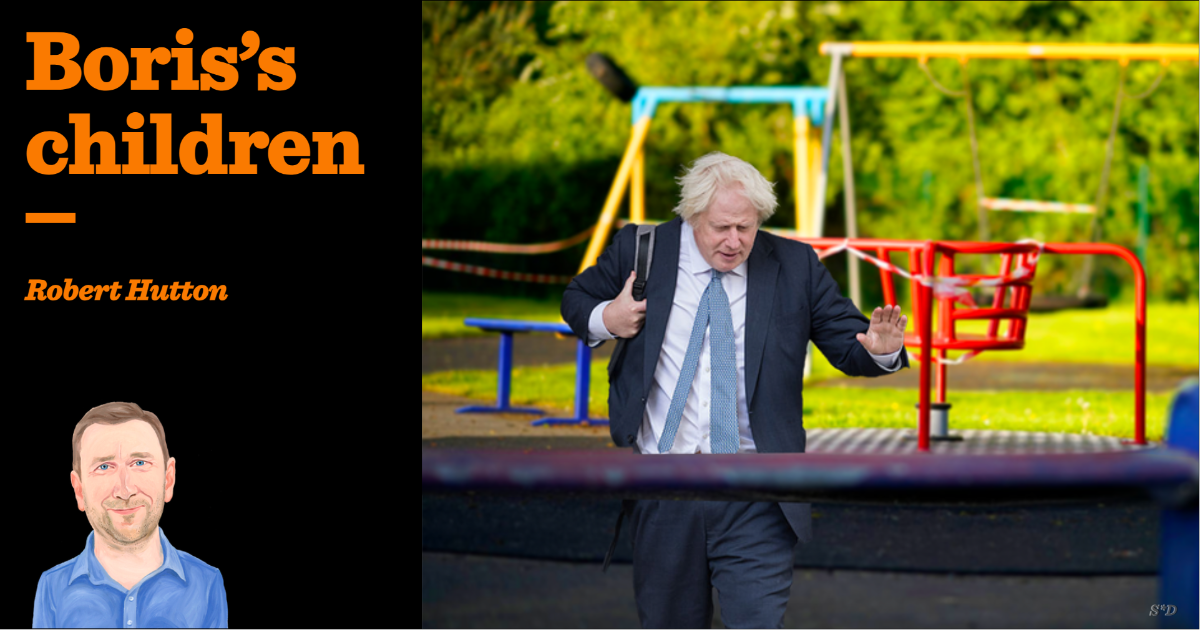

“My memory is now contaminated.” It was one of the more accurate statements we heard from Boris Johnson on Tuesday morning, though this is never a high bar. He was speaking, again, to the Covid Inquiry, which is taking evidence on children. Very much the former prime minister’s specialist subject.
He was thanked for coming — “Absolute pleasure,” he replied — and then asked to state his full name. “Boris Johnson,” he replied, taking us to two lies in under a minute (three if you count swearing the oath). Will we ever find out how one pronounces “de Pfeffel”?
His hair was flat, which is his usual way to tell us that he’s taking things Very Seriously, but his chin was unshaved on the right-hand side, adding to his general shambolic air. Perhaps he had got dressed on a hotel fire escape, staying silent as a furious husband searched the room within.
All our memories of Covid are contaminated, by the instinct to put the whole awful business behind us, and by what we have learned since. This was Johnson’s point, that judgements are easier to make with hindsight. Though as ever when it comes to his time in office, it’s possible to think that some questions might have been just about answerable in advance. Like, for instance, “if we’re planning to close all the schools, should we mention that to the Department for Education?”
It turns out that the answer that Number 10 reached in February 2020 was “No”. Both the men running the DfE had already testified that no one had mentioned this possibility to them, and that they had therefore done no planning for this eventuality. “The government was determined to keep schools open,” Johnson explained. As the military say, if you hope for the best, you don’t need to plan for anything else.
His sigh gave a clear indication of precisely how much regret and contrition that was, to the nearest thimbleful
Despite the denials of the people running the DfE, the former prime minister was sure that they had in fact made plans. Marvellously, he was arguing that the people running the department had done a much better job than they claimed. A “heroic” job, in fact, which will certainly come as a surprise to anyone who had school-age kids in 2020.
As the morning wore on, we went through a series of retreats: it was “obvious” that the DfE should have planned for it, then “I assumed that they were planning for it”, and then, finally, he definitely hadn’t told them NOT to do it. It was clear that the Shouty Men Club that ran Downing Street in those days had little time for little people. Johnson, one senses, has never been very interested in children, certainly once the moment of conception is passed.
“I understand the criticism that we should have planned better for school closures,” he eventually conceded, in the same bored tone one imagines he uses when mistresses ask him why he said he’d had a vasectomy.
It was the same tale on other aspects of the education chaos, whether the reopening of schools or exam grades. In a rare moment of fairness to Johnson, a lot of this lies at the door of the Education Secretary at the time, Gavin Williamson, who clearly had absolutely no interest in doing his job. You can complain that Williamson wasn’t invited to key meetings, or you can note that slightly more engaged secretaries of state might have complained about this themselves, at the time.
“Can I just interrupt?” said the inquiry chair, Baroness Hallett. “Running the United Kingdom as prime minister … ” The rest of her sentence was lost in a sudden rush of shocking memory of a time when the idea of putting Johnson in charge of anything more complicated than a night smashing up a restaurant didn’t provoke instant laughter.
To understand the flaws of the Keir Starmer administration, you have to understand that it’s a reaction to the Johnson government. Is our current prime minister possessed by process and fixated on following official advice? That’s not such an unreasonable reaction to watching Johnson do things his way.
Clair Dobbin, the inquiry lawyer, put it to Johnson that, when he announced schools would reopen in summer 2020, “you were promising something you knew couldn’t be delivered.” Johnson looked at her, his eyes narrowed. It must seem so very unfair to him when people make this complaint, as they so often do. After all, they like the promises when he’s making them, whether the promise is “no border in the Irish Sea” or “I’m leaving my wife”. It’s only afterwards that they get all difficult about the fact the promise hasn’t come true. Is it his fault that people react this way?
As the morning went on, he moved from boredom to irritation. What would he have said if he’d spoken to any children about the chaos of their being given imaginary exam grades? “I’m sure I would have expressed the regret and contrition I feel now,” he said with a weary sigh that gave a clear indication of precisely how much regret and contrition that was, to the nearest thimbleful. And then he snapped. “You try coming up with a system to give a fair exam result for people when they can’t sit exams!” He rolled his eyes, somewhere between Jack Nicholson in A Few Good Men and a teenager explaining why the car in the ditch isn’t their fault: “It’s not easy, OK!”
We moved to the chaos of New Year 2021. “Of all the really, really low moments, that was terrible.” Probably not helped by the massive hangovers his team were nursing from all the work-related piss-ups they’d had. We learned that the Covid Operations Committee had been told that January that the public was engaging in “mass flagrant abuse of the rules”, though they could have worked that out from a glance at the Number 10 recycling bins.
“Was the loss of education a disaster?” he snapped, “Yes! Was the loss of exams a disaster? Yes! It has to be seen in the context of us trying to deal with a much, much bigger disaster.” Which was probably a reference to Covid, rather than his time in office. Probably.