“I am primarily a words person,” Lucy Mangan writes. “If a picture is worth a thousand of them, I always thought, I’ll happily do the reading.” The British journalist and author of “Bookish: How Reading Shapes Our Lives” has been happily reading since she was a child. She admits to practicing tsundoku, a Japanese term for the act of buying books and letting them pile up. She owns 10,000 – and counting. All have been acquired for one purpose only: pure, personal pleasure.
Mangan’s 2018 “Bookworm” was an affectionate account of her early years and her childhood reading, which included visits to the likes of Narnia, Wonderland, and Willy Wonka’s chocolate factory. “Bookish” picks up where that volume left off and follows a similar structure. Here she charts her journey from her teens into adulthood, and reveals which books guided and shaped her along the way. It’s an insightful and witty journey, and a paean to the enduring rewards we glean from good books.
Mangan begins with her awkward adolescence in the 1980s. Aware of her misfit status in and out of school, she carries on as normal by losing herself in formative and immersive books. She marvels at Maeve Binchy’s novels about friends and family that put women center stage. She is captivated by Josephine Tey’s detective novels, which blend mystery with psychological shrewdness. But then her teacher introduces her to “Pride and Prejudice” and from that moment she wholeheartedly embraces Jane Austen, “an introvert’s writer.”
Why We Wrote This
In “Bookish: How Reading Shapes Our Lives,” British author Lucy Mangan delivers her maxims: buying books is preferable to borrowing them, adults should read children’s books, and no reader should ever be ashamed of what they read. “Book snobbery is amongst the most dismal of all the snobberies,” she writes.
Gradually, Mangan turns to books that take her out of her comfort zone. She finds Alice Walker’s “The Color Purple” “unflinching and gruelling in a way I didn’t know it was possible to be.” She devours Margaret Atwood’s “The Handmaid’s Tale” in one night and greets the new dawn “feeling harrowed, exhilarated and altogether as if my mind had been sandblasted by every one of its 300-odd pages.”

As a student of English literature at Cambridge University, Mangan flounders. However, she encounters like-minded souls who help her realize she is not alone, nor is she an oddball, for loving books. After her studies, she makes a wrong turn into a law career before breaking into journalism. Books accompany her during this phase and at other milestones in her adult life. She relishes the escapist thrills of Lee Child’s Jack Reacher adventures while recovering from childbirth. She derives solace from romantic novels in the aftermath of her father’s death. Only her wedding day sees her behaving differently from the norm, the occasion making “stupidly, unexpectedly and unavoidably large inroads into good reading time,” she writes dryly.
“Bookish” is a moreish box of delights. Mangan is out to show, not show off – to share her favorite books, sing their praises, and explain what they mean to her. She expounds on the merits of rereading over the “once-and-done” approach (she found George Orwell’s “Nineteen Eighty-Four” “terrifying in entirely new ways” when revisiting it recently) or simply experiencing “the absolute joy and security” of returning to a faithful old friend.
Mangan argues persuasively that the printed page trumps audiobooks, that buying books is preferable to borrowing them, and that adults should read children’s books. And most crucial of all, she declares that no reader should ever be ashamed of what they read.
“Book snobbery is amongst the most dismal of all the snobberies,” she writes.
Mangan is an omnivorous reader, and we gladly follow her as she highlights books of all genres, from historical sagas to dystopian fiction to young adult literature. Some of her opinions are refreshing (she champions “underdog” Brontë sister Anne over the more acclaimed Charlotte and Emily), just as some of her revelations are surprising. Mangan admits that while Agatha Christie may well be the world’s bestselling novelist, she has never read her.
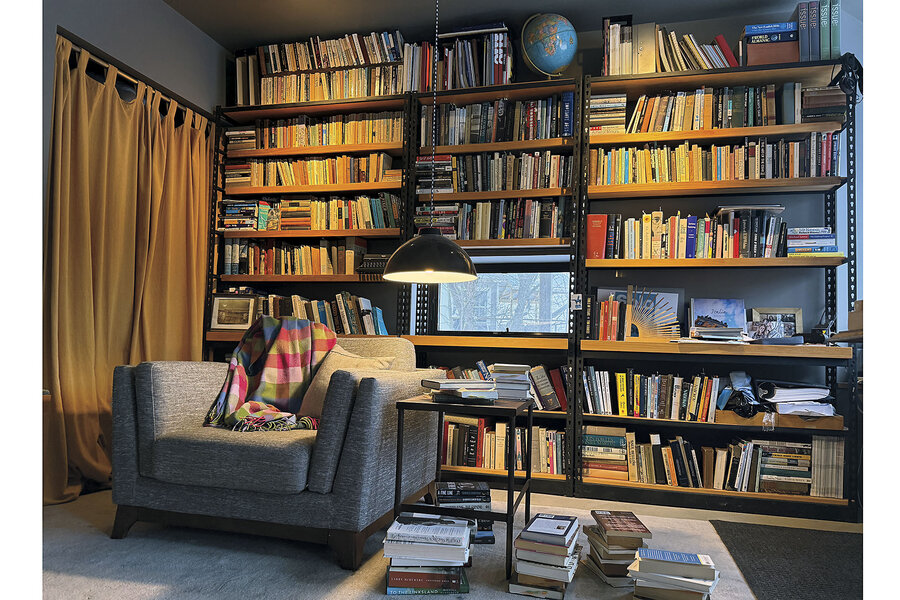
Two aspects in particular keep us turning the pages. One is the enthusiasm Mangan exhibits at regular junctures for all things book-related: browsing in bookstores (including a hidden gem in Cambridge, England, called the Haunted Bookshop); preparing for an imagined future “bookpocalypse”; and securing a room of her own and turning it into her personal library-
sanctuary. She thrills to discover new authors who have produced umpteen books.
The second is Mangan’s steady supply of humor, some of it self-deprecating, all of it sharp. There is one deftly depicted comic moment when her new husband suggests they combine their libraries. “It wouldn’t be merging our collections,” Mangan points out. “It would be breaking mine up. I just don’t think we’re that close,” Mangan tells him, before informing us: “I agreed to have a baby instead.”
Part memoir, part good-book guide, “Bookish” is also a rallying cry. “If we stop reading, if we stop putting ourselves in other people’s shoes,” Mangan writes, “then we cut ourselves off from inward avenues of growth, exploration, adventure.”
This charming and entertaining book shows how reading has broadened a mind and enriched a life.