- Do you have a story? Email lettice.bromovsky@dailymail.co.uk
Booker Prize-winning novelist Ian McEwan has hit out at one of modern life’s most common habits – carrying a water bottle everywhere – calling it ‘a derangement’.
Speaking at the Cheltenham Literature Festival, the Atonement author said society’s obsession with constantly sipping from bottles has spiralled out of control.
‘Thirty years ago, nobody had bottles of water. You had a drink from the tap when you got home,’ McEwan told the audience.
‘And suddenly we were persuaded that you can’t go 10 minutes without being thirsty. This is a derangement.’
Reusable bottles have become a must-have accessory among younger generations, while shelves in supermarkets and coffee shops are stacked high with branded mineral water.
But McEwan, who has explored environmental themes in his writing, questioned how the trend became so entrenched.
‘Millions of plastic bottles everywhere, as if being thirsty was a terrible affliction. It only is in extremes. Just wait 10 minutes and go home and have a cup of tea,’ he said.
‘How did it come about that we accepted this? You see people walking down the street with a bottle. If this was 1950, someone would think “what is that person doing with a bottle of water?”
‘It’s a very small thing, in a sense, but it’s a symbol of how life can change without us really noticing.’
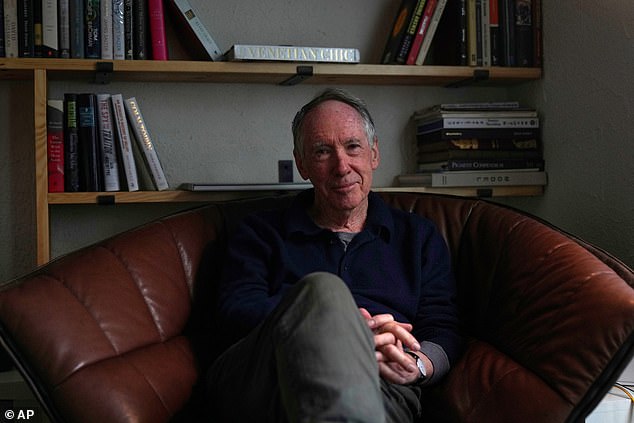
Booker Prize-winning novelist Ian McEwan has hit out at one of modern life’s most common habits – carrying a water bottle everywhere – calling it ‘a derangement’
McEwan’s latest novel, What We Can Know, imagines a near-future world where climate change and nuclear conflict have submerged entire cities and left Britain as a chain of islands.
He recalled a moment with his late friend Martin Amis, who once joked about humanity’s dependence on disposable plastics.
‘I remember walking down the street with Martin and he was having a disgusting hamburger in a polystyrene shell,’ McEwan said.
‘I said something about the hideousness not of the burger but of the thing it was sitting in. And he said “well, future generations will look back on us and be very grateful that this piece of plastic kept my hamburger warm for an extra 30 seconds”.
‘And I feel, whenever I’m chucking out another plastic bottle, that we are all in this madness.’
The 76-year-old author, whose career spans nearly five decades with bestsellers including Amsterdam, Enduring Love and On Chesil Beach, also addressed growing concerns that social media is destroying young people’s ability to concentrate on long-form writing.
‘Attention span is a biological matter and I don’t think they have really shortened,’ he said.
‘People spend hours on TikTok sitting upstairs at the end of their beds not talking to anyone, but in previous generations they would sit at the end of their beds reading a book. So I’m a little sceptical at the idea we don’t have attention spans.
‘I think it’s more just practice. People have lost the practice and they can regain it. I think there are far more important things to worry about than attention spans.’
McEwan has in recent years also urged younger writers not to fear offending readers in an age of ‘sensitivity readers’ and censorship.
He said writers should be able to express themselves freely without fear of reprisal – after classics by the likes of Roald Dahl and Ian Fleming were given the ‘sensitivity’ treatment in 2023.
He said that he heard a young author talk about his fear of writing about male desire, adding: ‘I thought, “poor guy!” because you’ve lost the desire of half the world.’
In a message to those who might be offended by freely expressed views in writing, he said: ‘Screw the lot of them.’