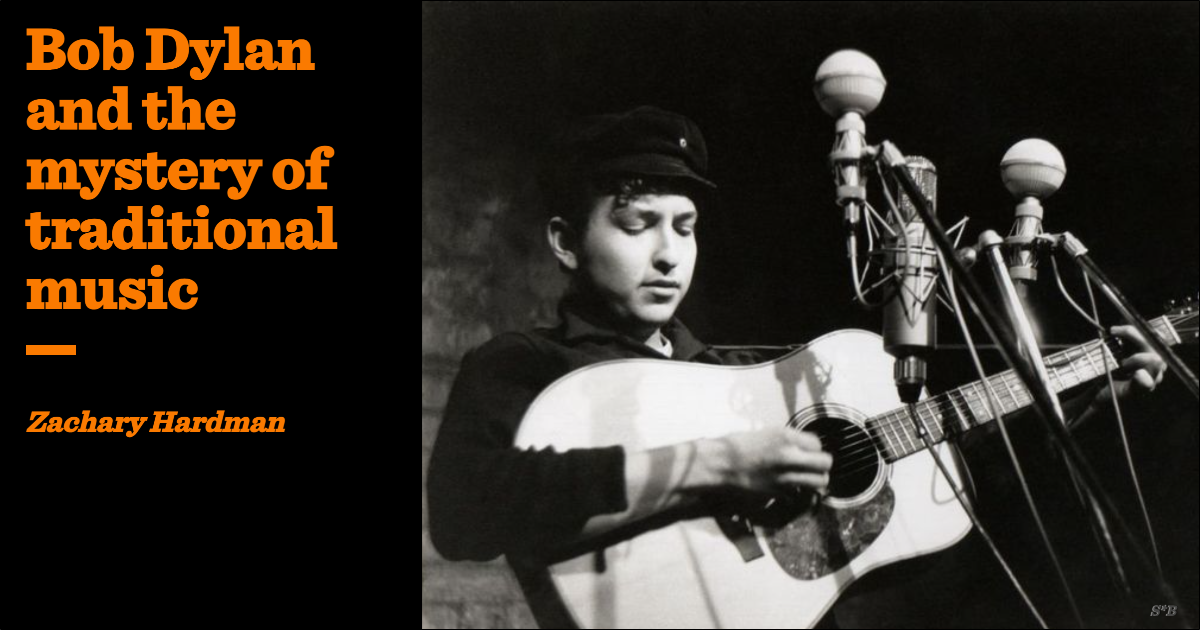
In a 1966 interview, Bob Dylan said that “mystery — just plain simply mystery — is a fact, a traditional fact”. A “tradition” is the transmission of customs or beliefs from one generation to the next for safekeeping. The word “mystery”, etymologically speaking, is an initiation into an otherwise secret truth. When he arrived in New York in the freezing winter of 1961, Dylan — who was nineteen-years-old — had already undergone his initiation. In discovering the music of his idol, Woody Guthrie, he experienced what he describes in his memoir Chronicles, as an “epiphany”, as though “I had been in the dark and someone had turned on the main switch of a lightning conductor”.
Guthrie was a folk troubadour, a freight car-riding wanderer from Oklahoma who might have stepped out of the pages of Steinbeck’s Grapes of Wrath. Dylan — born Robert Zimmerman — was a college drop-out from Duluth, Minnesota, the son of respectable Jewish parents, his father the owner of an appliance shop. But shortly after this encounter, Dylan would don similar weather-beaten work clothes to Guthrie, affect his hero’s manner of speech, memorise his songs, even introduce himself to strangers as a wandering drifter, determined to become Guthrie’s “greatest disciple”. Though he had never as much as seen Guthrie, he felt himself “related with him”. He “looks not unlike my father in my father’s early days”, writes Dylan, in the grip of spiritual rebirth.
In search of New York’s folk scene and Guthrie himself, who was confined to a hospital bed, Dylan was “at the initiation point of zero, but in no sense a neophyte”, with folk music “embedded in my mind like a religion”. Rock n’ roll music — an early influence — had youthful dynamism, but ultimately lacked what Dylan calls “power of spirit”. Country musicians, such as Hank Williams — the lonesome, heartsick cowboy — were also an early love, but the smooth, soporific Nashville sound had taken “all the wilderness and weirdness” out of country music, according to Dylan. Traditional music, on the other hand — composed of the blues, work songs, and ballads — was both strange and profound.
“Barbara Allen”, for instance, a song Dylan played in his early days — the story of a young woman who dies of grief after refusing a dying man’s love — can be traced back to the 17th century. “Two Sisters”, moreover — the story of a young woman, pushed into a river by her jealous sister, before an instrument is fashioned from her bones by a miller — may have been extant since the middle ages. Arriving with the first American settlers, these songs were sequestered in rural communities largely insulated from modernity, until folklorists and musicologists began making field recordings in the early 20th century. Obscure professional recordings also fell into the hands of private collectors, such as New York bohemian and mystic Harry Smith, whose Anthology of American Folk Music was, for the musician John Fahey, a richer trove than the Dead Sea Scrolls. Dave Van Ronk — Dylan’s contemporary in New York — called it a “bible”.
Having gained access to this mysterious, invisible world, Dylan now began to inhabit it
According to music historian Greil Marcus, such resources gave these musicians access to what he called the “old, weird America” or an “invisible republic”, an otherworldly landscape populated by ghosts and fugitive gods, drawn, in Dylan’s own phrasing “from legends, Bibles, plagues”, and based on “vegetables and death”. The songs were a “preceptor and guide … into a parallel universe with more archaic principles and values”, Dylan writes. When he and his contemporaries sang ancient ballads, they guided their audience into this poetic, enchanted realm, obscured by technological progress and scientific rationalism, as though they had the power to fling open the gates of the past and raise the spirits of the dead. And having gained access to this mysterious, invisible world, Dylan now began to inhabit it.
“Through the Open Window” is the eighteenth in a long-running series of Dylan “bootlegs” composed of unreleased material. We meet Dylan as a fifteen-year-old schoolboy and follow him to New York, through his rise to fame, ending with recordings from a 1963 concert at Carnegie Hall. African-American work songs (“Po’ Lazarus”) mingle on the album with country blues (“Corrina, Corrina”), Appalachian folk songs (“Man of Constant Sorrow”), and old English ballads (“The Cuckoo”). We hear Dylan’s imitation of Woody Guthrie’s okie twang on “Jesus Christ” and some of his earliest forays into songwriting, including the spirited “Let Me Die In My Footsteps” and the reflective break-up song “Don’t Think Twice It’s Alright”. What strikes us is the rapidity of Dylan’s ascent. Within a couple of years of arriving in New York, he had gone from Guthrie impersonator to writer of civil rights anthems, such as “Blowin’ In The Wind” and the “Times They Are a-Changin’”. Three years on, he was recording the epoch-defining Blonde on Blonde, his seventh album, which owes itself not only to his extraordinary talent, but his willingness to inhabit that strange other world.
But this also apparently came at a price. In his memoir, he tells the bizarre story of how one Bobby Zimmerman, an early president of the San Bernardino Hells Angels, was killed in a motorcycle accident in 1964. “That person is gone”, writes Dylan, “that was the end of him”. Somewhere between the realms of life and death, he had become, mystically, the spirit of traditional music itself. Highway 61, the “main thoroughfare of the blues” begins in Duluth, his hometown, he writes, while the source of the Mississippi River — the “bloodstream of the blues” — can also be found in his “neck of the woods”. Sober-minded readers will give this little credence. But it is Dylan’s capacity to inhabit mystery itself that still initiates his listeners into stranger truths.