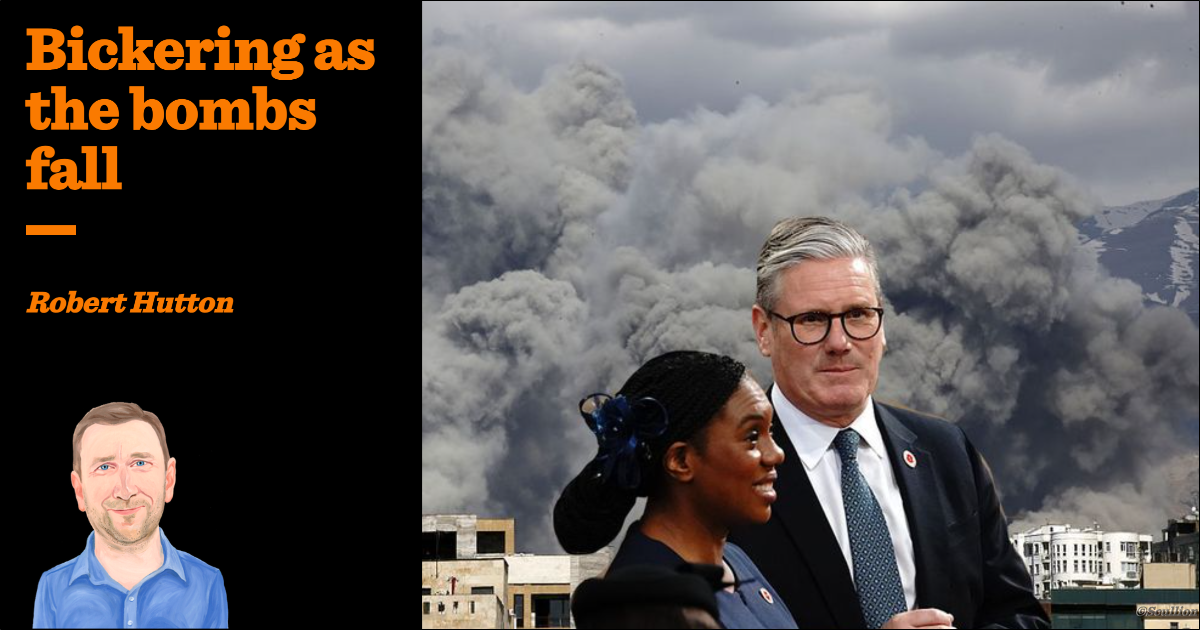

There was an air of seriousness in the House of Commons. Over the weekend, great events had taken place: the sweeping away of the hated Ali Khamenei from Iran, and of the scarcely less-hated Labour Party from Gorton and Denton.
Earlier in the day, Kemi Badenoch had made a heroic attempt to link the two issues, claiming that Keir Starmer’s reluctance to get involved in Donald Trump’s attack on Iran was because he feared upsetting Muslims. As though there aren’t any British Muslims who are glad to see the back of Khamenei, or indeed any other reason why a Labour prime minister would be nervous about a Middle Eastern regime-change operation run by a US president without a plan. However bad a job you might feel Starmer is doing, Badenoch speeches are a reminder that things could be worse.
Or Nigel Farage speeches, come to that. Monday began with a press conference in which the Reform leader explained that he wasn’t bitter about his party’s defeat in Gorton and Denton, that the other sides had cheated, and that he doubted that anyone who had voted Green had a job. It was a reminder that the rules about not sneering at the electorate only apply in one direction.
Farage has a plan to avoid Reform election defeats in the future, which is to remove people who might vote for other parties from the franchise. Specifically, he is now campaigning to stop non-British citizens from voting in British elections. “People are voting more about Gaza than they are about Gorton,” complained a man who regularly skips Parliament so that he can go to America.
It was put to Farage that this all felt a tiny bit racist, and he offered an innocent face. The voters he wanted to remove “could be from Australia,” he said. “They could be from Canada.” I’ll go out on a limb and say that if Manchester’s suburbs had a large Canadian-born population, we’d be hearing less about it.
Badenoch too feels that Muslims can’t be trusted to vote the right way, but her solution is to tell them to behave better. Her speech was about people who indulge in “separatism”, which turns out not to mean nationalists in Scotland, but people from Pakistani backgrounds in Manchester. “Separatism,” Badenoch explained, “is a way of living that keeps a group apart from wider society.” Like being in the Shadow Cabinet.
“There are groups whose political loyalties, when it comes to conflicts in the Middle East, do not align with the British national interest,” the Tory leader explained. It really is a mystery why Muslims aren’t voting in droves for a party that accuses them of being against Britain.
They’re not the only people who are destroying the country, of course. There’s also history teachers. “Our curriculum should tell a coherent national story,” Badenoch said. What is the coherent link between the Wars of the Roses and the Industrial Revolution and the Suez Crisis? Whatever it is, under a Conservative government it will be taught “without the grievance or the guilt.”
“We will protect free speech,” the Tory leader said. Though not for Muslims, presumably. Or history teachers. In charge of sorting out these contradictions is “Lord Toby Young”.
Someone laughed at that point, though a better joke was to come: the Conservatives will introduce a “meritocracy test” to ensure that people don’t get jobs that they’re unqualified for. Say what you like about Badenoch’s time as Tory leader, you can’t question her commitment to supplying her own punchlines.
Speaking of the overpromoted, let’s turn briefly back to Starmer, who later on set out why he had refused Trump permission to use British bases as staging posts for attacks on Iran, but was allowing them to be used for “defensive operations”.
There was a logic to the position, but he did his best to sound uninspiring about it. Many prime ministers attempt Churchillian rhetoric at such moments. Starmer models himself on a headmaster explaining that the rules for trainers in the sports hall are really very simple.
Labour MPs found themselves in the unusual position of broadly supporting him, as indeed did at least one Tory, Sir Edward Leigh.
But Badenoch had already explained why she thought Britain should have joined the initial strikes. “I’m not a lawyer,” she said, which feels a little bit harsh on Birkbeck, University of London, where she got a law degree in 2009. The only question that mattered in international law, she said, was “is it common sense?” This is tremendous news for everyone in Beijing with common sense views about how their part of the world should be run and who by.
What about previous adventures in the region that went wrong? “The lesson of Iraq is: make sure you have the evidence first.” Is that the only lesson? Were there any others, learned during the subsequent occupation for which there had been no plan? Apparently not. Anyway, she said, Iran are real bad guys, in implied contrast with the unfairly maligned Saddam Hussein.
And should MPs have a vote on military action? This was a bad idea, the Tory leader said, because Parliament was full of “extremely silly people”. Well, she said it.