With defections looming and insiders hedging their bets, Reform faces an awkward question: who actually fills its benches?
In this month’s issue of The Critic, our new contributing editor Chris Bayliss writes on Farage’s candidate problems.
The recent spate of Conservative defections have only hardened the narrative that Reform are the Tories 2.0 — and given that increasing numbers of Tories are likely to be turned turquoise by his impending May 7th defection deadline and the fightback of centrist conservatives, it is not a story likely to go away soon. But then, at least no one is calling them a one-man-band anymore.
Chris points out Reform’s rising status as the default party amongst non-left wing provincial voters has opened up to them millions of normal people, who may better suited to fill Reform’s benches than former Tories or their most vociferous — and online — supporters. This tracks the strategy of France’s National Rally, which in recent elections has put forward candidates with ordinary backgrounds — including caregivers, nurses and other frontline workers — rather than just political insiders.
Current political insiders are hedging their bets as to where the future of the right lies. At a recent informal gathering of Conservative candidates many were reportedly open to the idea of standing for Reform instead, and quietly asking if the May 7th deadline applied to them.
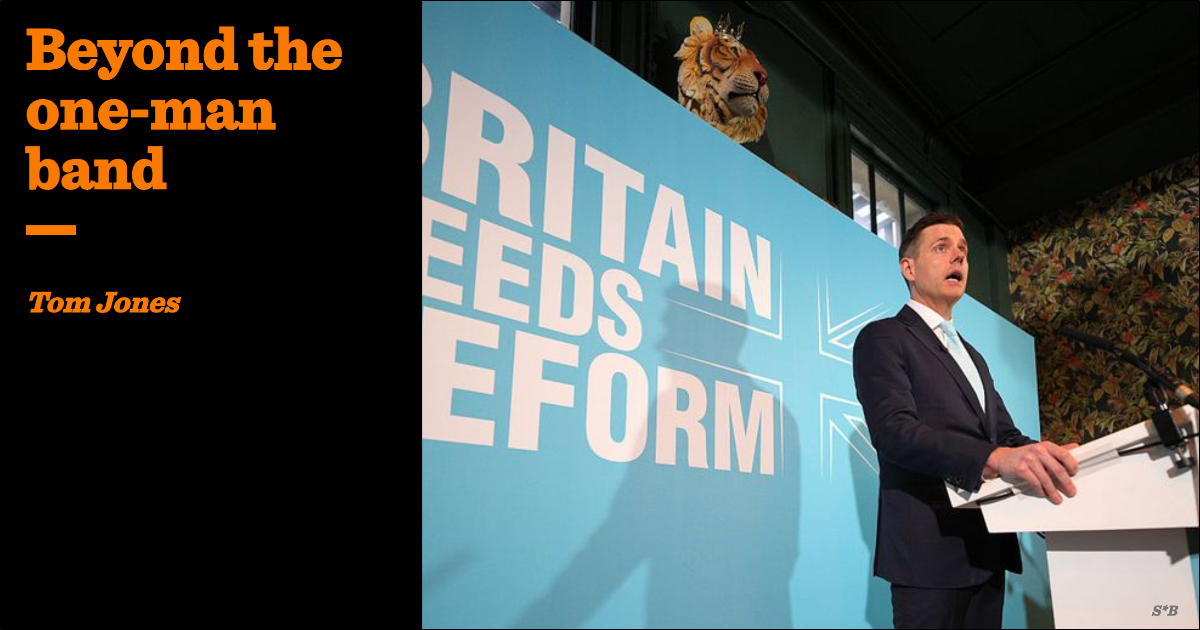
But in Denton and Gorton Reform cannot wait for them to make up their minds, and have announced Matt Goodwin as their candidate. It’s been a curious road into politics for the now-candidate; he first came to prominence as an academic, studying both the rise of UKIP and the far right in general — in particular the English Defence League. He is the co-author of two major works on the right: National Populism (with Roger Eatwell), a Sunday Times bestseller in 2018, and Revolt on the Right (with Robert Ford), long-listed for the 2015 Orwell Prize.
Goodwin enjoyed an impressive rise as a young academic, earning a reputation as an energetic hard worker, and his insights earned him attention from both media and government. Goodwin was appointed to Conservative Minister Sayeeda Warsi to an advisory body on tackling anti-Muslim hatred — a position he eventually resigned from in 2015 on the grounds the government was not doing enough to tackle Islamophobia.
Since then Goodwin has gradually undergone a process of de-voyeurisation, going from observer of nascaent right-wing movements to active participant. He is, perhaps, the most successful political entrepreneur in Britain; his Substack is one of the biggest in Britain, and he is a regular host on GB News.
But how did he get on the road to Damascus? In a post handily titled “What happened to me?”, he explains that he held views which at the time put him in “majority territory”: that “the economy, which had been battered by the global financial crisis, was in desperate need of reform”, that “mass immigration erodes social trust, social cohesion, public support for welfare, and fuels populism”, and that implementing Brexit “was essential to maintain public support for, and trust in, our democracy.”
The radicalisation, he explains, was not one of the electorate, but of an increasingly detached political elite, which he describes in his second book Values, Voice and Virtue (another Sunday Times bestseller). They have adopted a new set of luxury beliefs, and a developed a deep intolerance of any questioning of them, along the way taking the institutions they dominate with them— the BBC, the civil service, universities, advertising agencies, museums, galleries, and public bodies — and using their social and cultural power to impose a narrow package of socially liberal views on the rest of society, which by and large it does not share.
According to my podcast co-host, the only way for Reform to avoid becoming the Tories 2.0 is to repeat their failure in government; they need “people who are willing to be unpopular”. Reform need a hard nose, he suggests, and will need to select for a measure of disagreeability amongst their candidates that was largely lacking amongst Tory Ministers of the last 14 years. Goodwin certainly fits this mould; given his shift from the liberal world of academia, he is clearly not afraid of losing friends over politics. Likewise his style — even as an academic, as this interaction with Tommy Robinson on the BBC’s Big Questions in 2012 shows — has always been punchy and forthright.
Disagreeability in politics is an effective weapon, if applied carefully and correctly. Reform’s anti-establishment poise has generated a more boisterous, robust political style that seems to draw in people who are pretty disagreeable already; one might name Zia Yusuf, Lee Anderson, and Goodwin-like outriders like Isabel Oakeshott. But there is a balance to be struck here. The problem with the Tories was that they were selecting for agreeability; Reform’s problem could become the opposite. To keep expanding their appeal, Reform will need candidates who can charm potential friends yet be stubborn in the face of implacable opponents.
But most voters will see Goodwin as a TV presenter and political commentator. Until those future candidates decide to jump ship, it’s most apparent source of talent is still a tiny orbit of media figures and commentariat; that Reform are even drawing their “clean skins” from this relatively small pool should be a concern.