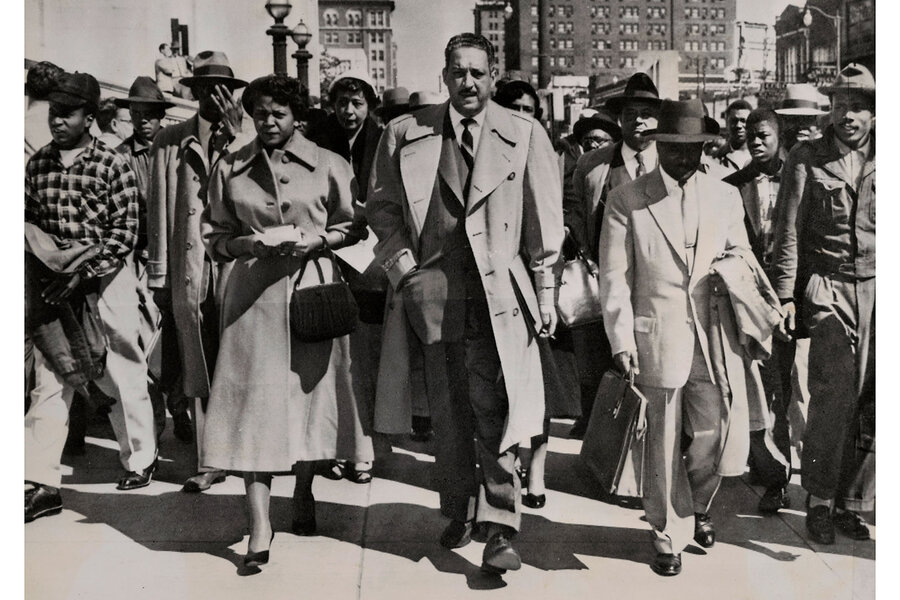
Thurgood Marshall’s place in history and policy-shaping decisions are legendary. The country’s first African American Supreme Court justice, who was known as “Mr. Civil Rights,” argued on behalf of the NAACP in the landmark Brown v. Board of Education case in front of the Supreme Court. Years later, he would be appointed to that same iconic bench.
A documentary, “Becoming Thurgood: America’s Social Architect,” which is now streaming on PBS, looks at more than the case and the court that defines him. It studies his roots, which include his Baltimore birthplace and the roles of historically Black colleges in shaping his politics and worldview. His mentor, Charles Hamilton Houston, offered a sharp quote on the career path of an attorney: “A lawyer is either a social engineer or a parasite on society.”
Like Justice Marshall, Bobby Donaldson, an associate professor of history at the University of South Carolina, chose the former. Dr. Donaldson leads the institution’s Center for Civil Rights History and Research and serves as the lead scholar for “Columbia SC 63: Our Story Matters,” a documentary history initiative on the struggle for civil rights in Columbia, the state capital. He was once a Thurgood Marshall Fellow at Dartmouth College in New Hampshire.
Why We Wrote This
Legends get frozen in time in collective memory. But they were people first, scholar Bobby Donaldson points out. He tells Ken Makin: “There was very little in 1908 in Baltimore that would’ve predicted that Thurgood Marshall would be the first African American member of the Supreme Court.”
The Monitor spoke with Dr. Donaldson by phone after a Columbia-based screening of the documentary. The interview has been edited for length and clarity.
How has Thurgood Marshall shaped your life and career?
Growing up, I always aspired to be a lawyer, and Thurgood Marshall was the epitome of the Black Civil Rights lawyer of the 20th century. I held him up as a role model, and now that I’m teaching and have held a fellowship named after him, it’s a lesson learned about all the preparation, struggle, and networking he did before he was ever a member of the United States Supreme Court. Here’s someone who was the grandchild of slaves. He knew enslaved people growing up in Baltimore and understood the trek of the Great Migration. He becomes a window by which we can see Black history in the 20th century.
This documentary was a reminder that, though Thurgood Marshall is an iconic figure, we know little about his background and beginning. For me, it was instructive to get more detail about his upbringing before he became a phenomenal civil rights lawyer. Audiences knew him as the older man in the black robe in the Supreme Court, and did not know that his path to the Supreme Court was one marked by achievement and struggle.
As landmark Civil Rights decisions come under siege, what does it mean to revisit the justice’s contributions?
Thurgood Marshall makes it clear: No one ever said the role would be easy, and no one ever said that even these achievements would mean the dramatic transformation of our nation to [one] where all people are treated and regarded as equal. I think he would look around today and acknowledge the serious challenges, but also remind us there are lessons to be gleaned from the past. Remember, the 1964 Civil Rights Act, the 1965 Voting Rights Act, were not even seen as doable in 1950. But what took place was strategy, coalition building, vigilance, and people awakening and demanding and fighting for change. We are often reminded that Thurgood Marshall was the attorney of a number of major civil rights victories in this country, but those victories came through the sacrifice and the struggle of ordinary people. I think one of the lessons learned [from] the film is that even as we battle challenges today, we cannot battle them successfully without being well versed in our history.
How does Justice Marshall’s work translate to everyday people?
Part of what happens with history is that people are sort of frozen in a given moment. When we’re talking about figures – whether it’s Jackie Robinson, Mary McLeod [Bethune], or Thurgood Marshall – understand these are human beings, with aspirations and achievements, and human beings with struggles and disappointment. I think it’s important for students in particular to understand the human nature of these iconic figures, that they’re not monumental from birth. That’s something that emerges over time. There are Thurgood Marshalls all around us, and I think that was part of the film’s goal, was to remind individuals that, with preparation and aspiration, you can be successful as a Thurgood Marshall. The reality was there was very little in 1908 in Baltimore that would’ve predicted that Thurgood Marshall would be the first African American member of the Supreme Court. There is little that predicted that Thurgood Marshall would help to design and lead a civil rights litigation battle.
What does it mean to be a “social architect”?
That is what the Civil Rights Movement was about. One of the things that I appreciate in the film was Thurgood Marshall was the legal brain of the NAACP, and he wanted to push for an agenda that would redefine the meaning of democracy and equality in this country. He very much believed that the blueprint for advanced democracy rested in the 14th and 15th Amendments. Very methodically, at the ground level, he began an effort to challenge longstanding racial injustice by using those tools. Thurgood Marshall was a strategist and an architect of the future for civil rights. A lot of the legal framework and the legal foundation that he and the NAACP envisioned later became the framework by which the Civil Rights movement could claim success.
Part of the goal of the sit-ins and the demonstrations of the March on Washington, some of those goals were to say, Now let’s make real the Constitution. In order for the activists to be successful, they needed the legal apparatus to do so. Charles Hamilton Houston, the dean of the Howard University Law School, made the decision that he was not just producing ordinary lawyers, but what he described as social engineers, people who would use their talent and education to transform the world around them. Thurgood Marshall became arguably the best student of Charles Hamilton Houston in doing that work.