Families living near one of London‘s most hated LTNs which banned cars from the local councillor’s own road are battling to have the scheme scrapped.
Being stuck in traffic has become part of the daily routine for residents of leafy Queen’s Park in the northwest of the capital after their council became the latest to introduce road closures – all in the name of ‘healthy neighbourhoods’.
Videos even show ambulances getting held up in tailbacks stretching hundreds of yards, which campaigners say are triggered by the baffling measures.
Since it was first proposed in 2020, more than 2,000 people – one in six who live in the ward – have signed petitions against the hated project.
Furious residents say it has simply pushed traffic into other roads, increasing pollution and noise, the same concerns raised in West Dulwich, south London, which in June became the first LTN in the UK to be axed.
But it’s not bad for everyone. Labour councillor Stephen Crabb lives on one of the roads now closed off to traffic and, according to emails discovered via Freedom of Information requests, pushed for the scheme.
And despite a report showing more than 80 per cent opposed it, an 18-month Extended Trial Order (ETO) went ahead in November 2023, closing off Summerfield Avenue, Montrose Avenue, Hopefield Avenue and Dudley Road from 7am to 10am on weekdays.
By April this year, motorists were looking forward to hitting the – relatively – open road again but the closures were bafflingly renewed, ignoring fresh surveys showing discontent had not faded.
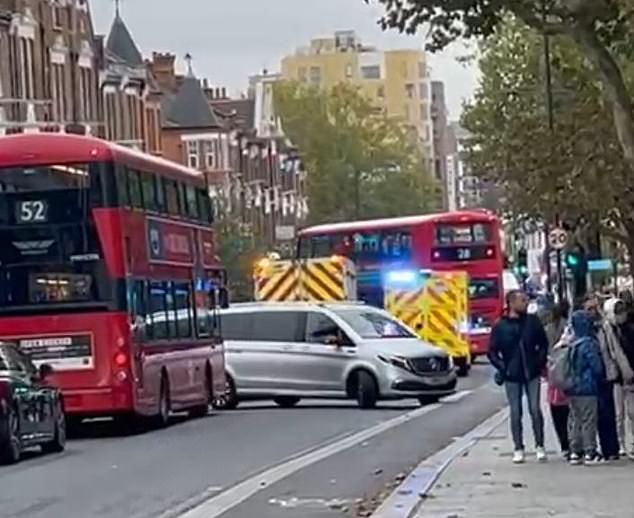
Videos show ambulances getting held up in tailbacks in Queen’s Park, London – which campaigners say are triggered by baffling LTN measures
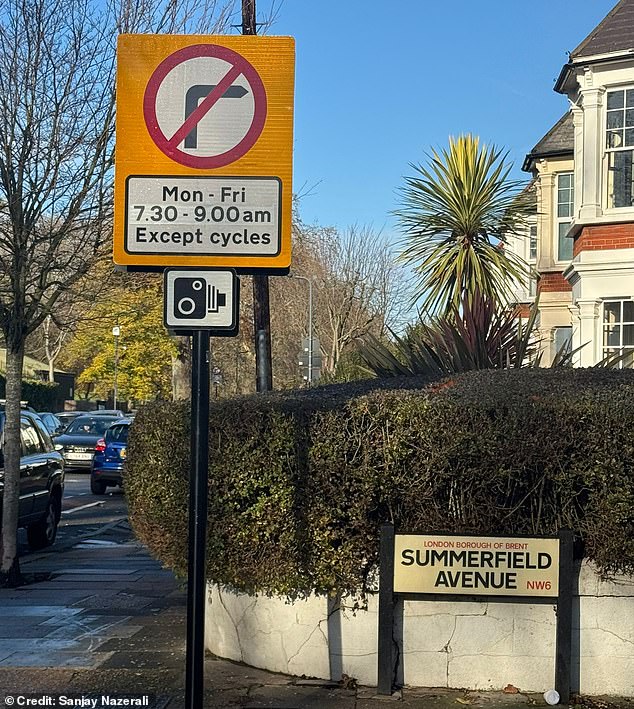
Furious residents say the LTN, pictured, has brought pollution and noise and wastes council resources
Unable to implement the scheme permanently due to its unpopularity, Brent Council ordered another trial, using the loophole of changing the window to 7.30am to 9am.
This latest development has turned Queen’s Park into a ‘toxic battleground’ pitting council officials and residents of the closed roads against those forced to navigate the busier surrounding streets.
Peter Phillips-Minet, 52, has been fighting the idea since it was birthed five years ago and said it ‘has created a tremendous amount of entirely unnecessary division and negativity in the community’.
He added: ‘It’s become a big political issue and they’ve obviously handled it really badly.
‘We are now two years into what was billed as a “6-month experiment”. It has generated an awful lot of misery and division for the area.’
Sanjay Nazerali, 60, has been one of the scheme’s most outspoken critics and told a council Cabinet meeting this year: ‘These ETOs have caused deep and lasting division in our community.
‘They have created a two-tier ward in which the relief enjoyed by few has created an exactly commensurate level of pain for everybody else.’
Branding the project ‘horrific’, Mr Nazerali told the Daily Mail he doubted whether the renewal was legal.
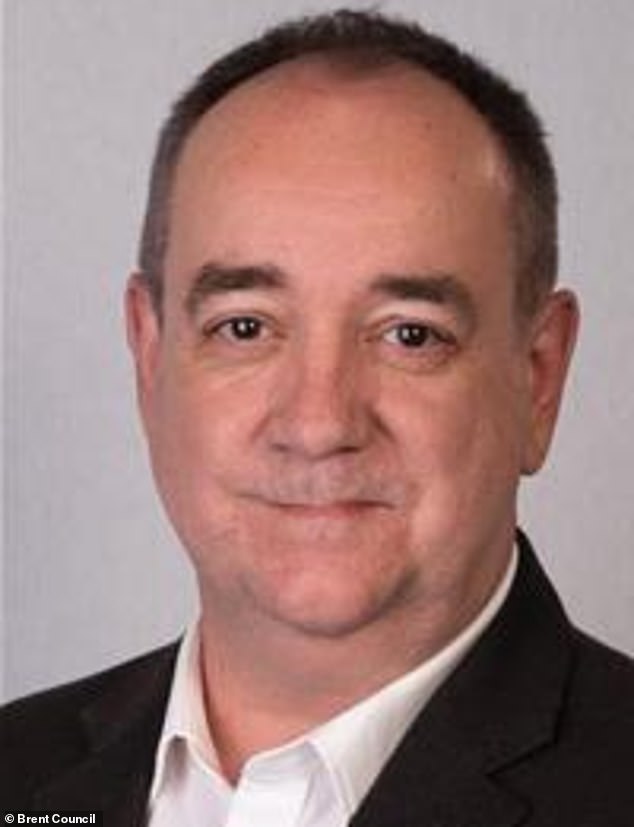
Labour councillor Stephen Crabb, pictured, lives on one of the roads which no longer has traffic and, according to emails, pushed for the scheme
‘You’re not allowed to just change the times,’ he said. ‘We could have complained but you have to go to the Supreme Court within eight days.
‘It’s clearly a positive thing for people who live on those streets because it has removed a lot of traffic but something like 40 per cent who live [on the closed streets themselves] think it’s a bad idea.
‘They basically just created the most socially regressive policy that’s torn a community apart.’
He added the scheme’s unpopularity could erode Labour’s solid majority at next year’s local elections.
‘If I had the slightest political aspiration, I would just go out there and say, “can we just fix all this stuff? Can we just fix the unfairness here?”‘ Mr Nazerali said.
‘It’s all about fairness. We all know London traffic is horrible and we all have to put up with it.
‘It’s stretching what democracy should mean. When you have this level of complaint against something, do you or don’t you accept it?’
Barbara Want said: ‘It has turned into a toxic battleground between people in this ward and the councillors and the council.
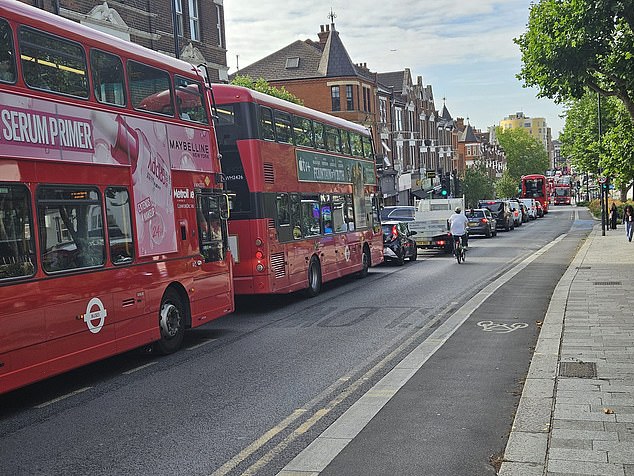
Traffic piles up in Queen’s Park. Families living near the LTN are pushing to have the scheme scrapped
‘They cost a fortune; they have done nothing to sort travel stress, they have just displaced traffic elsewhere; and they found out two councillors, one who lives on one of the roads, pushed for the plans.
‘People were absolutely furious. These five roads would love to have no traffic – who wouldn’t?
‘Campaigners for walking and cycling would love the fact that sometimes I can’t drive where I want to go but many people need to drive.’
And what about the fact a councillor lives on one of the roads which benefits?
‘It has tipped people over the edge,’ she said. ‘It is as patronising and self-serving as you can get. It is beyond unfair, it is grubby.’
Even some of those who live within the LTN – and therefore enjoy reduced traffic – recognise the wedge it has driven between different groups.
Nick Burstin said: ‘It is performative. It is basically “Daddy knows best”.
‘Traffic has become such a divisive and unpleasant topic. It pits one street against another.‘
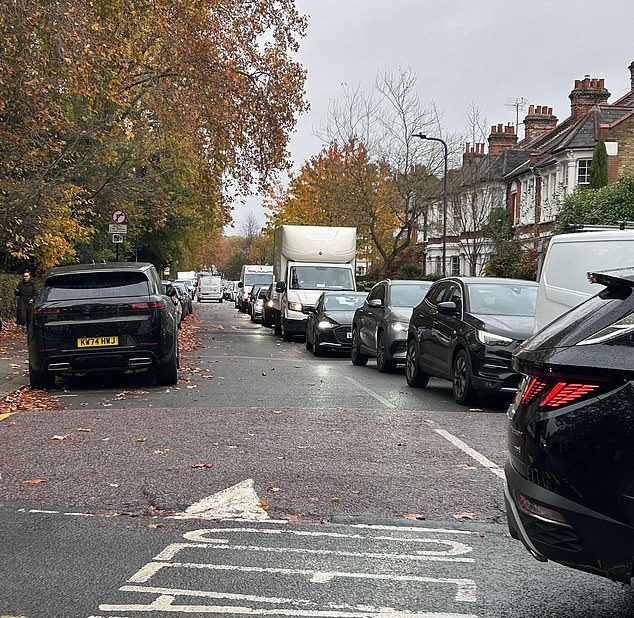
Being stuck in hefty jams has become part of the daily routine for locals after their borough became the latest to be hit with road closures – all in the name of ‘healthy neighbourhoods’
Mr Burstin added that resources could have been used to solve an existing traffic issue on the junction between Harvist Road and Salusbury Road.
He said locals had been asking for two lanes and a filter light at that spot for years, and this would cause less congestion.
‘Nothing has happened with this issue, because it would improve traffic flow [which is not one of the council’s stated aims],’ he added.
‘Instead of treating residents as pawns in a game of political ambition, why not use resources to achieve an agreed goal?
‘When you’re being taken for a sap you’re not very happy about it.’
Olga Brookes, who lives on one of the roads benefitting, is against the scheme and insists there are better ways to solve the area’s traffic problems.
She said: ‘There cannot be a blanket solution for all urban areas. We cannot stop the traffic as these routes are essential for supplying goods and services to Central London.
‘There are at least 10 schools within the immediate area. This generates a lot of traffic during school drop-off times.

Sanjay Nazerali, pictured, has been one of the scheme’s most outspoken critics and told a council Cabinet meeting this year that the project has ’caused deep and lasting division’
‘Many people bring their children by car because it’s the only option. We can’t force families with several children to get on a bike.’
Ms Brookes added that heavy traffic only blights Brent between 8am and 9am and for the rest of the day the area is quieter than most of London.
She said: ‘There are seven streets benefitting from this arrangement. It’s lovely and quiet on our street in the mornings.
‘Yet all around us is sheer hell – completely blocked main roads, chaos, pollution and misery. The traffic doesn’t move. Children walking to school inhale toxic fumes. Emergency services cannot pass.
‘Considering the streets who started this campaign have a local councillor living on them hasn’t helped the matter.’
Local anger built steadily from the moment leaked LTN plans blew up on local WhatsApp groups in 2020.
The scheme was a product of the scramble for Transport for London funds during Covid, with senior Labour councillor Neil Nerva pushing for its adoption, according to Mr Phillips-Minet.
After early backlash, things went quiet for about a year.

Peter Phillips-Minet, pictured, has been fighting the idea for five years and said it ‘has created tremendous amount of entirely unnecessary division and negativity in the community’
But in summer 2021, the council hired a charity, Living Streets, to formally survey public opinion.
It consisted of ‘one person gathering information’, according to Mr Phillips-Minet, who added: ‘Everybody was very annoyed. It was incredibly chaotic.’
The report was unequivocal. It found more than 80 per cent of respondents opposed the idea.
The project was once again shelved, with no word of it in the build-up to the May 2022 local elections.
Indeed Mr Nerva assured a pre-election residents association meeting that ‘in future such schemes would be developed with residents rather than imposing them’, Mr Phillips-Minet recalled.
Yet one week later he sent an email to council officers stating he had ‘met a dozen Summerfield Ave and Dudley Rd residents about rat-running’ and asking them to ‘take forward their proposals’.
And a few months on, the LTN was ushered in, shutting down several roads on a trial basis – despite only being approved by 129 residents in a limited consultation.
Locals soon raised questions about Cllr Crabb’s role in the process.
According to Mr Phillips-Minet, he responded by saying: ‘Are you accusing me of playing a part in the decision-making process? That is a very serious accusation.’
The councillor, elected that summer, insisted the local authority makes the decisions and, when asked to recuse himself from the process, he refused, claiming he was not part of it in the first place.
Another company, MP Smarter Travel, was then commissioned to conduct a second survey which culminated in an offer of just two options, both to broaden the scheme further.
A new petition, this time on the council’s website after the previous one on Change.org was ignored by the local authority, gained more than 1,500 signatures.
But it was a series of FoIs which really boosted the campaign.
One showed Mr Nerva advocating ‘taking a proposal forward…on rat running’ in March, before the election, and then, after being pushed by one road’s residents after the election, sending council officers down to visit.
Mr Crabb then wrote emails to officers telling them to ‘crack on with the pilot scheme’ in December.
He also asked them to ‘weight engagement so those most directly affected (ie residents of Dudley and Summerfield) are not treated the same as residents from outside the area who want the right to continue driving through our roads’.
Mr Crabb responded to residents’ concerns about this by saying he was only asking the question, according to Mr Phillips-Minet.
Further emails are currently being withheld, despite the Information Commissioner’s Office upholding the request in March.
The LTN went ahead, but most presumed the backlash would be enough to get it canned when the trial ended this April.
Once finished, it either had to be made permanent, scrapped completely or changed using a meaningful amendment.
After tweaking the time of the closures, the LTN was renewed for another 18 months.
A new report has infuriated residents further after it said that, despite huge petitions opposing it, people ‘welcomed the scheme’ and ‘only had issues with the way it was implemented’.
A complaint was made to investigate the report but the officer appointed was the same person who wrote the document.
‘I think it’s just incompetent,’ Mr Phillips-Minet said. ‘It’s done in a way to entirely mischaracterise public opinion.’
In his Cabinet address, Mr Nazerali said: ‘These ETOs are about community cohesion. We do not believe Brent has listened to our pain.
‘One councillor’s response was: “Well to be fair there is a strong sentiment held by about 20 to 30 people.” That is quite belittling.’
Cllr Krupa Sheth said that ‘hundreds of residents’ had requested such measures.
‘We welcome the high response to the trial from across the area, which reflects a wide range of views,’ she said. ‘All feedback is being carefully considered and forms an important part of the council’s analysis.
‘This remains a trial, and no decision will be made until the council has completed its analysis of the available evidence and resident feedback.
‘Our commitment remains clear: to work with residents to tackle congestion, improve air quality and support safer, greener travel in Queen’s Park and across the borough.’
But having created two of the top five most signed petitions in Brent history, campaigners are continuing to fight the LTN.
‘Our response has been incredible,’ Ms Want added. ‘I don’t know if something can be done. There are elections coming up and I don’t want to make any political point, but councillors need to remember they only serve as long as they’re elected.
‘There is no way people will give up.’